

What are the specific advantages of using glass beads over other blasting media for delicate metal surfaces during rust removal?
Glass beads remove surface rust through controlled peening rather than aggressive cutting, reducing the risk of gouging, distortion or excessive profile on delicate metal surfaces. They leave a clean, smooth finish with a relatively low surface profile, helping preserve fine details and dimensions before subsequent coating.
Glass beads are particularly suitable for delicate metal surfaces because they clean by a relatively gentle peening action while producing a consistent cosmetic finish. Compared with sharper, angular media, their rounded shape is less likely to cut deeply into the substrate. This makes them useful where the objective is to remove light to moderate rust, staining and surface contamination without introducing an unnecessarily aggressive texture.
One important advantage is the uniform appearance they can produce. Angular abrasives tend to leave a more pronounced, irregularly etched surface, whereas glass beads can give the metal a satin or lightly brightened finish. This is valuable for visible components, machined parts and fabricated items where the appearance of the bare metal matters before further treatment. The result also makes it easier to identify remaining corrosion, pitting or coating defects during inspection.
Glass beads can be a good choice for softer or thinner metals, including aluminium and some brass components, provided the blasting parameters are matched to the material. Their rounded particles distribute impact more evenly than cutting media, reducing the likelihood of sharp scratches and localised damage. This is not the same as making the process risk-free: excessive pressure, prolonged blasting or an unsuitable bead size can still mark a soft surface or alter its appearance.
- More controlled cleaning: Bead size, air pressure, nozzle distance and the angle of application can be adjusted to regulate how much energy reaches the surface.
- Less aggressive texturing: The rounded particles generally create a shallower, more even texture than aluminium oxide or steel grit, which is useful where a heavy blast profile is unnecessary.
- Preservation of component features: Correctly specified glass beads are less likely to obscure lettering, edges, machined transitions and other small features than coarse, sharp-edged media.
- Consistent visual finish: The even peened appearance can help produce a uniform result across batches of similar components.
- Potential for media recovery: In suitable blasting equipment, glass beads may be collected and reused until their impact performance has reduced. Reuse depends on contamination, breakdown, filtration and the condition of the media, so it should be managed rather than assumed.
Glass beads also differ from chemically active cleaning methods because they remove corrosion mechanically rather than dissolving it. This allows the operator to see the surface as it is cleaned and to stop when the required condition has been reached. However, blasting does not remove oil, grease or every form of contamination. Degreasing and appropriate preparation may still be needed, particularly where the component will subsequently receive powder coating or another protective finish.
The main limitation is their lower cutting power. Glass beads are not usually the first choice for thick rust scale, heavy mill scale, deeply embedded corrosion or coatings that need rapid removal. Aluminium oxide or steel grit may be more effective where a stronger cutting action and a more pronounced anchor profile are required. Using a harsher medium simply because it cleans faster can be counterproductive on delicate work, but choosing beads for severe corrosion can also lead to unnecessary processing and an incomplete preparation.
For parts that will be coated, the final choice should therefore be based on the coating specification as well as the condition and sensitivity of the metal. A smooth bead-blasted surface may be appropriate for a particular finish, but it may not provide the profile required by every coating system. The surface should be clean, dry and free from loose corrosion and blasting residue, and the preparation should be checked against the requirements of the coating being applied.
In practice, the best results come from testing a representative area or sample component first. The trial should assess rust removal, visual uniformity, dimensional sensitivity, surface profile and compatibility with the next treatment. This confirms whether glass beads provide enough cleaning power without sacrificing the delicate surface characteristics that the process is intended to protect.
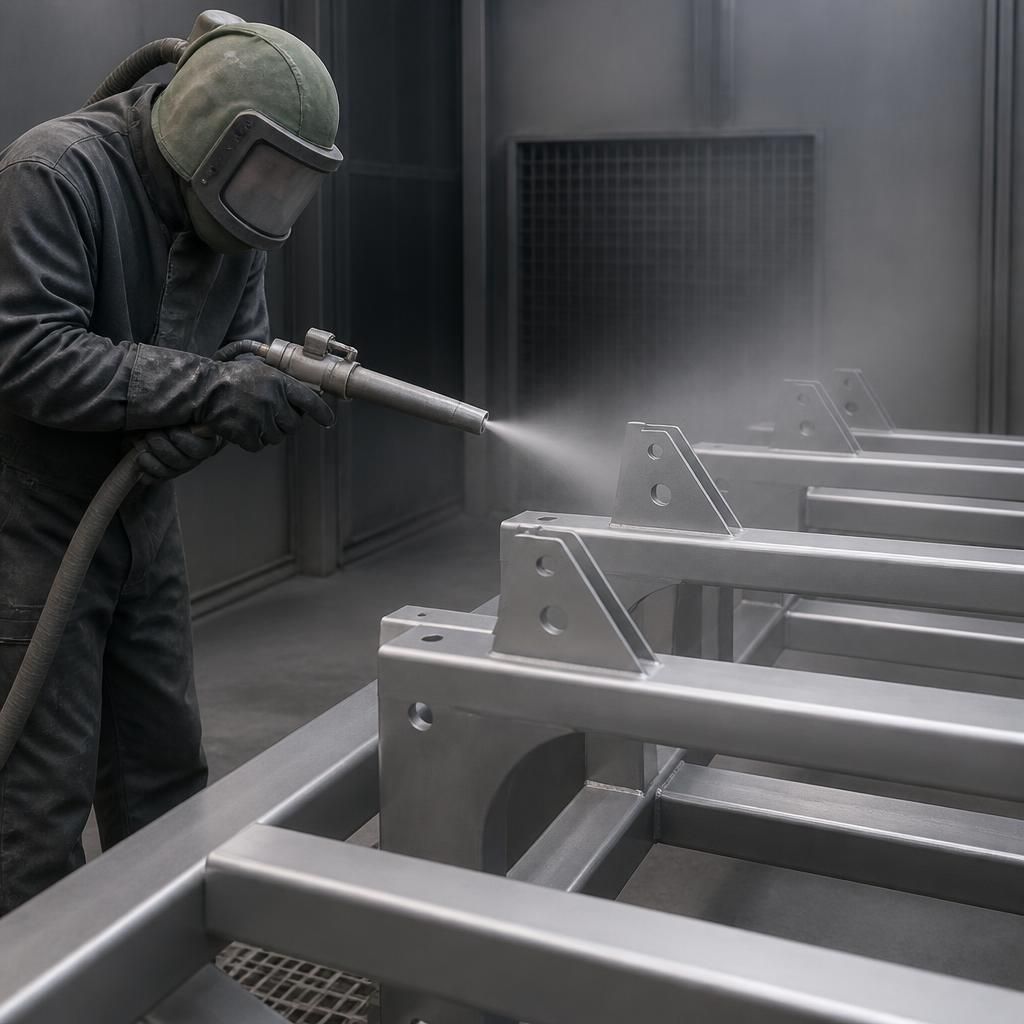
A further advantage of glass beads is that they are a non-ferrous blasting medium, so they do not introduce iron particles into aluminium, stainless steel or other non-ferrous surfaces. This reduces the risk of embedded ferrous contamination, which can later appear as staining or localised corrosion when the component is exposed to moisture.
This benefit depends on good process control. The beads, blast equipment and recovery system should be kept free from steel grit, iron dust, oils and previously removed coatings. Separate media and properly cleaned equipment are especially important where the treated surface must remain visually consistent or will receive a subsequent protective coating.