

Are there innovative technologies or methods that enhance the performance of anti-corrosion coatings for steel?
Yes. Performance can be improved through zinc-rich or duplex coating systems, advanced surface preparation, tightly controlled powder application and curing, and newer formulations incorporating hybrid or nano-scale additives; the appropriate method depends on the steel grade, exposure conditions and required service life.
Yes. In addition to coating chemistry, anti-corrosion performance can be improved through alternative deposition processes, intelligent quality monitoring, improved edge protection and coating systems designed to respond to local damage. These technologies do not suit every steel component; their value depends on the component’s geometry, operating environment, production volume and access to specialist equipment.
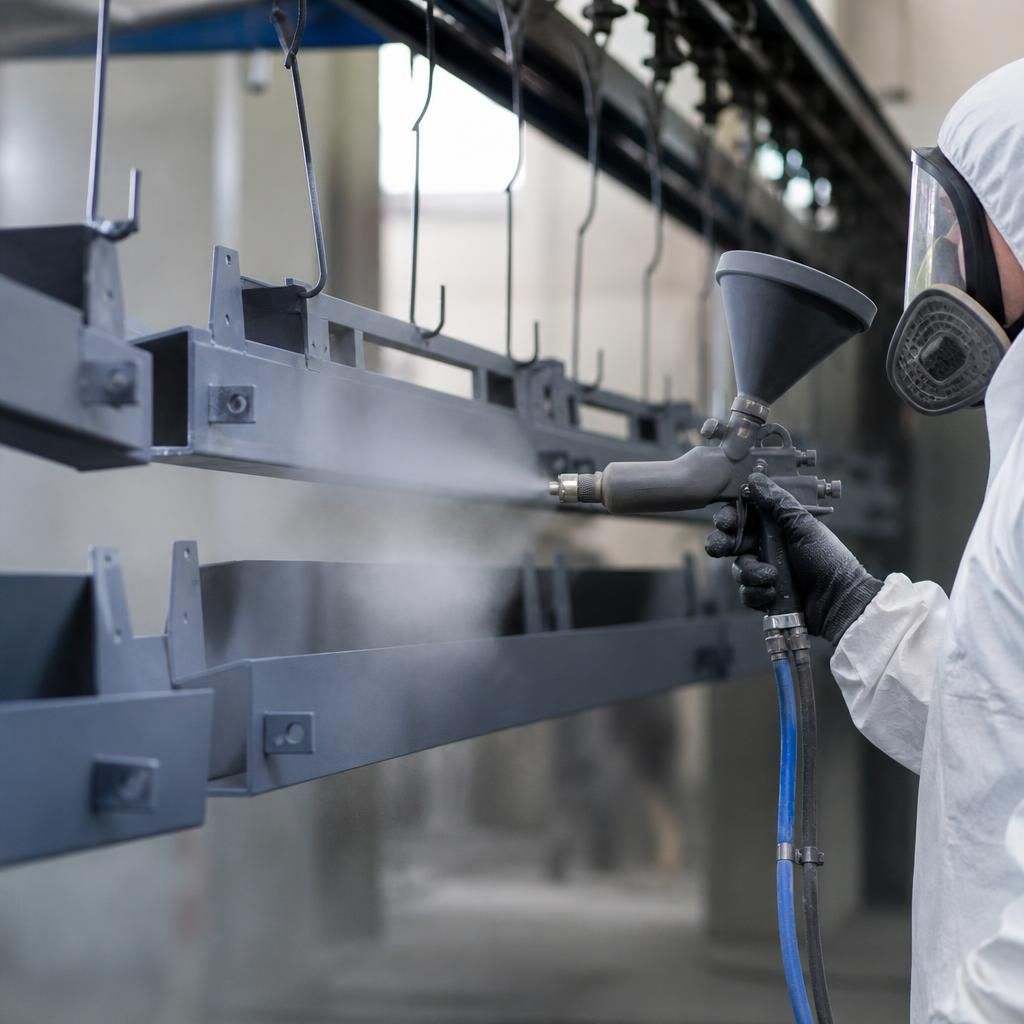
Thermal spray metallic coatings provide an alternative to conventional paint or powder systems for some steelwork. Wire, powder or metal rod is heated and propelled towards the prepared steel surface, forming a protective metallic layer. Processes such as arc spraying and flame spraying can deposit zinc, aluminium or alloy coatings on structural items and large components that may be difficult to process in an enclosed coating line.
Thermal spray coatings can be useful where the item is too large for an immersion tank or oven. Their performance depends heavily on surface profile, coating continuity, thickness control and sealing of pores in the sprayed layer. A compatible sealer or topcoat may be added where the steel will face persistent moisture, chemicals or contamination. Operators must also consider heat input, access to recessed areas and the risk of overspray.
Electrophoretic deposition, often called e-coating, uses an electrically charged bath to deposit a thin, even film over conductive metal. The process can reach complex shapes and internal sections more consistently than some spray applications, provided the component can be fully immersed and drained correctly. It is commonly used as a primer layer beneath a subsequent protective finish.
E-coating is particularly valuable where uniform coverage and repeatability are important across a high-volume production run. It is less practical for very large fabrications, sealed cavities or components that cannot be immersed. Drainage holes, electrical contact points and bath compatibility therefore need to be considered during design and process planning.
Self-healing and inhibitor-release coatings are an emerging area of development. Some systems contain microcapsules or embedded corrosion inhibitors that become active when the coating is damaged or when moisture reaches a vulnerable area. In principle, this can slow the spread of corrosion from a scratch before a full repair is made.
These coatings should not be treated as a substitute for adequate film thickness, sound steel preparation or inspection. Their performance can vary with temperature, damage size, exposure conditions and the number of times a particular area is affected. They are more appropriate for carefully specified applications than as a universal replacement for established industrial coating systems.
Water-repellent and low-surface-energy finishes can reduce the time that water remains on the steel surface. Superhydrophobic textures and related surface treatments encourage droplets to run off rather than spread across the coating. This may be useful in some atmospheric environments, but abrasion, dirt, ultraviolet exposure and handling can reduce the effect. A water-repellent surface is therefore best considered an additional function, not the sole corrosion barrier.
Improved edge and weld protection is another important method. Corrosion often begins at sharp edges, cut-outs, weld toes, fasteners and areas where coating film becomes thinner. Modern production specifications may use edge rounding, weld dressing, local stripe application or specially selected edge-tolerant materials to maintain a more consistent protective film. These measures can improve real-world durability even when the main coating formulation remains unchanged.
Component design also affects coating performance. Avoiding narrow crevices, providing drainage and ventilation, and allowing access for inspection can prevent water and contaminants from being trapped against the steel. This is not a coating technology in itself, but it can have as much practical influence as a change in coating material.
Digital process monitoring is increasingly used to verify that the coating has been applied correctly. Depending on the system, checks may include:
- dry-film thickness measurements at defined points;
- cure verification using the specified time and temperature profile;
- holiday or discontinuity testing to identify pinholes and breaks;
- adhesion testing where the specification requires it;
- surface profile, cleanliness and environmental condition records; and
- batch traceability for coating materials and processed components.
These checks do not make a coating more corrosion-resistant by themselves, but they reduce the risk of an undetected process defect. Data logging can also identify recurring issues such as thin areas around corners, incomplete curing or inconsistent coverage between production batches.
Low-temperature and fast-curing powder systems can improve process efficiency and allow coating of some heat-sensitive assemblies, although steel components generally tolerate conventional curing temperatures. The important technical point is that the complete cure cycle must be validated for the specific powder, component mass and oven conditions. A coating that appears dry may not have developed its intended chemical and mechanical properties if the steel has not reached the required metal temperature.
Selection should therefore begin with the exposure category and failure risks rather than with the newest available technology. For a large outdoor fabrication, thermal spray may be more practical than immersion-based deposition. For repeatable manufactured parts, e-coating and digitally monitored powder finishing may offer better consistency. For components exposed to severe chemicals, abrasion or immersion, laboratory testing and a defined multi-stage specification are more reliable than relying on a novel surface effect alone.
The most robust approach is usually a documented coating specification covering steel condition, coating process, target film thickness, curing or sealing requirements, inspection points, repair procedure and expected exposure. Specialist coating advice can help determine whether an innovative method offers a genuine performance advantage over a well-established system for the particular steel component.
Sol-gel and thin-film conversion pretreatments are emerging methods for improving the interface between steel and an anti-corrosion coating. These very thin layers can contain silane, zirconium or titanium-based chemistries that bond to the prepared steel surface and provide reactive sites for the subsequent powder or liquid coating. The result can be stronger intercoat adhesion and reduced corrosion spreading beneath a damaged area, provided the treatment is compatible with the steel, coating formulation and exposure environment.
Unlike a conventional thick primer, a conversion or sol-gel layer is designed to modify the steel–coating interface rather than act as the main barrier. Its performance depends on accurate cleaning, controlled application, adequate drying and consistent coverage. Before adoption, the complete system should be assessed for adhesion, humidity resistance, salt exposure and compatibility with the specified finish. This type of pretreatment can therefore enhance an established coating system without relying solely on changes to the topcoat chemistry.