

What factors should be considered when selecting the optimal curing temperature and time for black powder coated aluminium to ensure maximum durability and finish quality?
Select the curing temperature and time for black powder coated aluminium according to the powder manufacturer’s specified schedule, using the aluminium’s metal temperature rather than oven-air temperature as the key reference. Consider the coating chemistry, part thickness and geometry, load arrangement, oven calibration and heat-up rate, then verify that the coating has reached full cure without over-baking, which can affect finish quality and performance.
Optimal curing for black powder coated aluminium means achieving the coating manufacturer’s required degree of cross-linking while preserving the intended colour, gloss, texture and protective properties. The selected process should therefore be based on the coating’s cure window, the performance demanded by the finished component and evidence from inspection or testing, rather than on a single oven setting used for every job.
Start with the coating’s performance requirements
The required finish influences how closely the cure process must be controlled. Aluminium used outdoors, in industrial settings or in areas exposed to cleaning chemicals may require a coating with specific resistance characteristics. A finish selected for appearance alone may not be suitable where the component will experience abrasion, moisture, chemicals or repeated temperature changes.
Black finishes also make visual variation particularly noticeable. Differences in gloss, texture, shade and surface flow can be apparent when components are installed next to one another. For this reason, the approved powder specification, gloss level and appearance standard should be agreed before production. Parts intended to match existing coated items should be assessed against a retained reference sample where practical.
Understand the cure window
Powder coatings generally have a defined range within which they develop their designed properties. The lower part of that range may require a longer dwell, while a higher coating temperature may allow a shorter dwell. These alternatives are not automatically interchangeable because excessive heat can alter gloss, colour or texture, particularly on a visible black finish.
Under-cured powder may remain softer than intended and can show reduced resistance to chemicals, marking, impact or handling. It may also affect adhesion and long-term protection. Over-curing can lead to changes in appearance or brittleness, and repeated or excessive heating may be especially unsuitable for components containing heat-sensitive inserts, seals or assembled parts. The process should remain within the approved cure range rather than being adjusted simply to increase production temperature.
Account for the aluminium and the completed component
Aluminium conducts heat efficiently, but that does not mean every component reaches the required coating temperature in the same way. Extrusions, castings, machined sections and fabricated assemblies can respond differently because of their construction and surface area. Joints, recesses, enclosed sections and areas close to fixtures may require particular attention during process trials.
Parts should be positioned so that coated surfaces are exposed to the oven’s circulating heat and are not pressed together or shielded by adjacent work. Hanging points and contact areas should also be considered because they can affect both heat exposure and the continuity of the finished film. A trial load representative of normal production is more useful than judging the process from an empty oven or a lightly loaded run.
Control the surrounding process
Curing cannot correct contamination, unsuitable pre-treatment or an inconsistent powder film. Oils, moisture, residues and inadequate preparation can cause defects that may be mistaken for a curing problem. The aluminium should therefore enter the oven clean and correctly prepared, with the coating applied at a consistent and specified film thickness.
Oven cleanliness and airflow are also relevant. Residue from previous work can contaminate a light or dark finish, while poor circulation can contribute to uneven heating. Where a line handles different coating chemistries or colours, the cleaning and changeover procedure should prevent contamination and unwanted transfer between jobs.
Check the result rather than relying only on the oven display
A controller reading confirms the selected setting, but it does not by itself prove that the coating has achieved the required cure. Process verification can include independently monitored temperature profiles, checks at representative positions and records for each approved production arrangement. Measuring equipment should be maintained and checked so that decisions are based on reliable information.
Finished parts should be assessed for:
- uniform black colour, gloss and texture;
- orange peel, pinholes, craters, blistering or other surface defects;
- film continuity around edges, recesses and joints;
- adhesion using a suitable method for the coating system; and
- hardness, flexibility, impact or chemical resistance where those properties are important to the application.
Solvent-rub, adhesion and hardness checks can help identify incomplete cure, but the method and acceptance criteria should suit the powder system and the relevant specification. A visual inspection alone is not sufficient where the component has demanding protective or chemical-resistance requirements.
Use a controlled approval process
For a new black powder coated aluminium component, the preferred approach is to establish the process with representative samples before routine production. The sample should use the intended powder, pre-treatment, film build, hanging arrangement and loading conditions. Its appearance and test results can then be retained as a reference for later batches.
Any change to the powder system, component design, film thickness, oven loading, line speed or equipment settings should trigger a review of the curing process. Keeping a record of approved settings, inspection results and any corrective action helps distinguish a genuine cure issue from problems caused by preparation, application or handling.
In practice, the optimal curing process is the one that consistently produces the required protective and appearance properties without exposing the aluminium or powder film to unnecessary heat. Where the component is large, unusually shaped, supplied in batches or required to meet a specialist performance specification, a coating specialist can help interpret the powder data and confirm the process through representative trials.
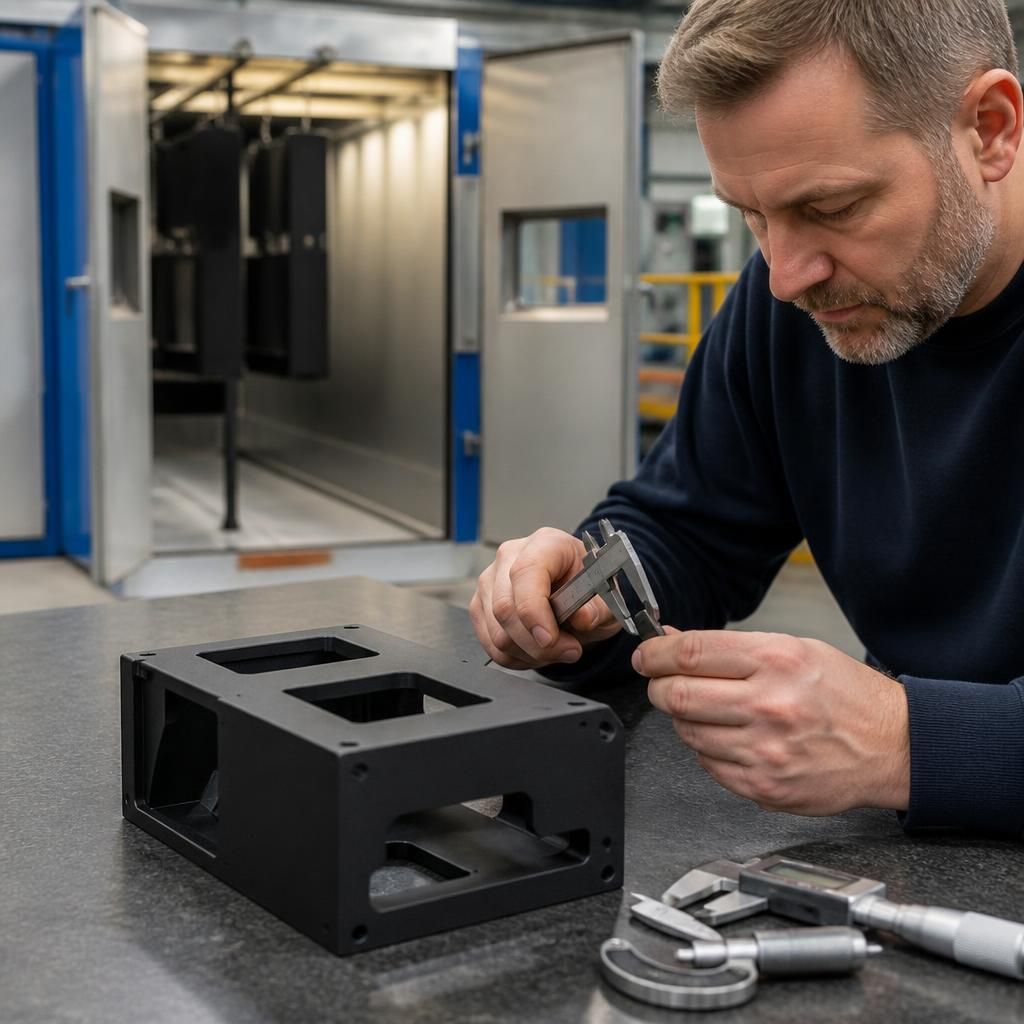
Curing conditions should also be assessed against the component’s functional tolerances. Powder build-up on threaded holes, mating faces, slots and locating surfaces can affect assembly even when the coating appears fully cured. Identify these areas before production, use suitable masking where required and confirm that the masking materials can withstand the selected cure schedule. A controlled check of critical dimensions after curing helps ensure that the temperature and time chosen deliver a durable finish without compromising how the aluminium component fits or operates.
Discuss Your Black Powder Coated Aluminium Curing Requirements
Discuss your black powder coated aluminium components with our specialists to review the powder specification, part design and curing requirements. We can help identify the information needed to develop a controlled process for your application.