

How can businesses ensure the consistent quality and appearance of UV resistant powder coatings over time?
Businesses can maintain consistent UV-resistant powder coatings by controlling the coating specification, surface preparation, application thickness and curing conditions for every batch. Documented quality checks, consistent colour assessment and periodic inspection help identify variation or early deterioration before it affects the finished metal components.
Businesses can preserve the consistent quality and appearance of UV-resistant powder coatings by managing the complete coating system throughout its service life, rather than assessing the finished surface only when it leaves production. The powder specification, component design, storage conditions, handling practices, exposure environment, cleaning regime and repair method all influence whether colour, gloss and protection remain uniform over time.
Define appearance requirements before production
Consistency is easier to maintain when the required finish is described in measurable terms. The specification should identify the colour reference, gloss level, texture, acceptable visual variation and any areas where appearance is less critical. It should also state whether components will be viewed together, fitted next to previously coated parts or exposed in different orientations. These details matter because adjacent parts can appear mismatched if they have different gloss, texture or weathering histories, even when they were originally selected as the same colour.
Where appearance is important, an approved reference panel or retained production sample provides a practical comparison standard. It should be labelled with the coating specification and production details, then stored so that it is not exposed to the same weathering as the installed components. Comparisons should be made under consistent lighting and with clean surfaces, as dirt, chalking and reflected light can make an otherwise acceptable finish appear different.
Control powder storage and material handling
Powder should be stored in the conditions recommended for the specified product and protected from moisture, contamination and excessive heat. Poor storage can affect flow, application behaviour and the final surface, while mixing materials from different batches without a defined control process can introduce variation in colour or texture. Stock rotation, clear batch identification and separation of different products reduce the risk of using the wrong material or combining incompatible powders.
Material traceability is particularly useful for repeat orders. Recording the powder identification, component reference and production details allows a business to investigate differences between batches and reproduce an established finish more reliably. It also supports controlled decisions if a component needs to be recoated or replaced several years later.
Consider component design and installation
Uniform appearance can be affected by the component itself. Sharp edges, recesses, welds, joints and areas that retain water may weather differently from broad, exposed faces. Designs should allow the coating to reach the required surfaces and should avoid features that encourage dirt or standing moisture to accumulate. Drainage, suitable contact between dissimilar materials and protection from unnecessary abrasion during transport and installation can all help the coating age more evenly.
Components installed in different orientations may also experience different levels of sunlight, heat, rain and deposited pollution. A façade panel, external framework and sheltered bracket may therefore develop slightly different appearances over time, even when coated during the same production run. Where several parts form one visible assembly, keeping them together within a controlled production plan can reduce avoidable variation.
Use exposure-based assessment
UV resistance does not mean that a coating will remain visually unchanged indefinitely. Outdoor finishes can gradually lose gloss, develop surface chalking or show colour change as a result of sunlight, heat, moisture, pollutants and cleaning. The relevant performance requirement should therefore reflect the actual environment, including coastal exposure, industrial atmosphere, heavy traffic pollution, sheltered locations and the amount of direct sunlight.
For demanding applications, businesses may use documented weathering or durability test data for the selected coating system and compare it with the conditions expected at the installation site. Testing does not exactly reproduce every outdoor environment, but it can help compare coating options and establish suitable inspection criteria. The same assessment method should be used for future checks so that changes are identified consistently rather than judged subjectively.
Maintain the surface correctly
Regular, appropriate cleaning helps preserve appearance by removing dust, salts, bird deposits, traffic film and other contaminants that can hold moisture against the coating. Cleaning methods should be compatible with the powder coating and should avoid unnecessarily abrasive tools, aggressive chemicals or excessive pressure. Any detergent should be thoroughly rinsed away, since residues can leave marks or attract further dirt.
Inspection should distinguish between removable contamination, mechanical damage and genuine weathering. Small scratches, impact marks and exposed edges should not be treated in the same way as general loss of gloss across an otherwise intact surface. Recording the location and type of change creates a useful maintenance history and helps identify whether a problem is isolated or associated with a particular exposure condition.
Use a controlled repair approach
Repairs can themselves create visible variation if the replacement coating has a different colour, gloss, texture or ageing history from the surrounding surface. The original specification and batch records should be consulted before selecting a repair material. The damaged area must be assessed for corrosion, adhesion loss and contamination, not simply covered cosmetically.
For components where a uniform appearance is essential, repairing a complete visible section may produce a more consistent result than treating a small isolated mark. Any touch-up or recoating should be evaluated against the surrounding finish after the repair has fully developed, because immediate visual similarity does not always indicate equivalent long-term appearance or protection.
By combining defined appearance criteria, controlled material handling, traceable production records, exposure-aware design, compatible cleaning and disciplined repair procedures, businesses can manage both the initial uniformity and the long-term appearance of UV-resistant powder-coated metal components.
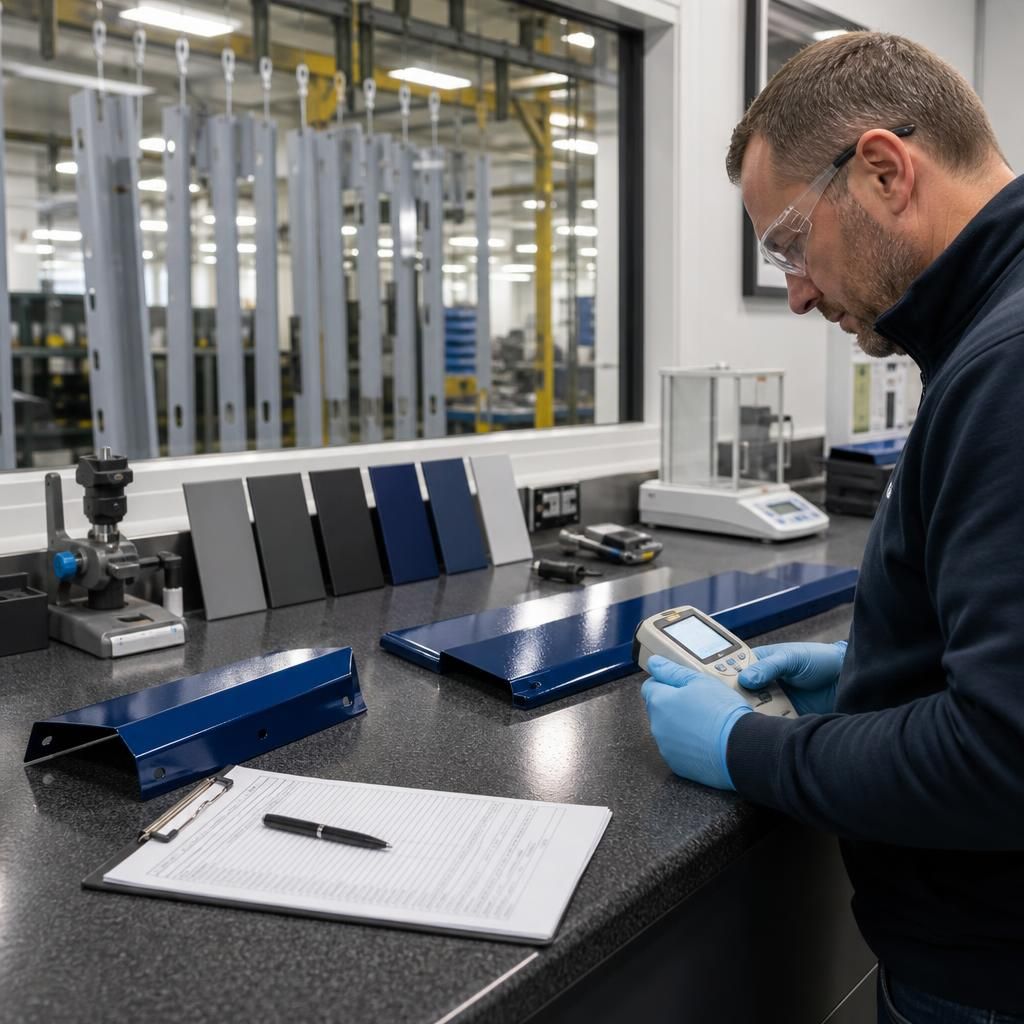
Consistent UV-resistant powder coating depends on verifying the finished film, not relying solely on visual inspection. A controlled release check can compare representative coated components with the approved specification before a batch is accepted for use or dispatch.
- Confirm the coating colour and gloss using the agreed assessment method.
- Check the film is continuous and free from visible defects such as pinholes, craters, runs or contamination.
- Verify coating thickness at defined points, particularly where component geometry could produce uneven coverage.
- Record the results against the component reference, powder identification and production batch.
Using the same inspection method for each production run makes gradual process variation easier to identify. If a result falls outside the agreed requirements, the cause can be investigated before further components are processed, helping prevent inconsistent appearance across an installation.
Discuss your UV-resistant powder coating requirements
Discuss your UV-resistant powder coating requirements with our team, providing details of the components, expected outdoor exposure and required finish. We can help identify the coating considerations and quality controls relevant to your application.