

What is the impact of different powder particle sizes on the finish quality and durability of powder-coated aluminium sections?
Powder particle size affects how evenly the coating flows, melts and builds on an aluminium section: finer particles can produce a smoother, more uniform finish, while coarser particles may create a more textured appearance and require careful application control. The correct particle-size distribution helps achieve consistent film thickness, minimise defects and support durability by ensuring reliable coverage and curing across the profile.
Powder particle size affects finish quality mainly by changing how the powder is transported, charged, deposited and fused on the aluminium section. It is not the sole indicator of coating performance: resin chemistry, pigment, pre-treatment, application settings, film thickness and cure are equally important. In practice, the particle-size distribution must suit the powder formulation, spray equipment and profile geometry.
Particle size is normally considered as a distribution rather than a single measurement. A batch contains particles across a range of sizes. If that range is well controlled, the powder can behave predictably during fluidisation and spraying. An excessively broad distribution may cause the smallest particles to behave differently from the larger particles, producing variation in transfer efficiency, deposition and surface appearance. Segregation during storage, handling or recovery can also alter the balance of particle sizes reaching the spray gun.
Finer particles have a relatively large surface area in relation to their mass. This affects how they fluidise and accept an electrostatic charge. If the powder is too fine for the equipment or application settings, it can be difficult to keep suspended consistently and may be more vulnerable to airborne loss. Excessive charge can also contribute to back ionisation, in which trapped air or charged powder disrupts the deposited layer. This can show as pinholing, cratering or an uneven surface after curing.
Coarser particles generally behave differently in the spray cloud and may have different transfer characteristics. If they are too large, they may not remain suspended or charged in the same way as the rest of the powder. They can produce uneven deposition, particularly on narrow sections, edges and recessed areas. The result may be local variation in coating thickness or visible differences in the cured appearance. These effects are more significant on long aluminium extrusions where a small process variation can be repeated over the full length of the section.
The particle-size distribution also affects the way powder reaches complex profile features. Aluminium sections may contain slots, channels, internal corners, ribs and enclosed or partly enclosed areas. Electrostatic fields can make it difficult for powder to enter recessed features, a behaviour commonly associated with the Faraday cage effect. Particle size, charge level, gun distance, spraying angle and air flow work together here. A powder that performs well on an open, flat section may require different application control on a detailed extrusion.
- Open faces: the priority is usually an even deposited layer with stable transfer and controlled build.
- Edges and corners: these can attract more powder and develop increased local thickness if the gun settings and movement are not controlled.
- Recesses: excessive charge or unsuitable particle behaviour can reduce penetration into the feature, leaving weaker coverage than on the exposed faces.
- Long profiles: consistent powder delivery, gun movement and booth conditions are needed to prevent variation from one end of the section to the other.
Particle size can influence the appearance produced during curing because the deposited particles must soften, flow together and form a continuous film. If the particle distribution or application conditions produce an unstable deposited layer, the cured coating may show visible texture, pinholes, craters, inclusions or areas of inconsistent appearance. These defects are not automatically caused by particle size; contamination, moisture, poor grounding, unsuitable compressed air, incorrect voltage and inadequate pre-treatment can create similar problems.
The relationship with durability is indirect but important. Particle size does not determine the coating’s resistance to weathering, chemicals, abrasion or impact; those properties depend primarily on the coating system and its correctly completed cure. However, unsuitable powder behaviour can create thin areas, voids, poor edge coverage or surface defects. Such discontinuities can expose the aluminium or provide routes for moisture and contaminants, reducing the practical protection of the finished section.
Particle size must therefore be assessed alongside the required film build. A coating that is too thin may provide incomplete coverage, while excessive build can affect appearance, dimensional fit and curing behaviour. On components that must assemble with seals, gaskets, sliding parts or other accurately fitted sections, the coating thickness on edges and contact surfaces is especially relevant. The target should be established from the powder manufacturer’s technical information and the section’s functional requirements rather than selected from particle size alone.
Application control is the most reliable way to turn a suitable powder into a consistent finish. Relevant checks include:
- confirming that the powder’s recommended particle-size range is compatible with the spray equipment and recovery system;
- maintaining stable fluidisation so that the powder feed does not fluctuate;
- setting voltage, current, air volume and gun distance to suit the profile rather than using one setting for every section;
- checking grounding and controlling the spray path around edges, corners and recesses;
- measuring coating thickness at representative locations across the aluminium section;
- examining the cured surface for pinholes, craters, inclusions, inconsistent texture and areas of incomplete coverage; and
- verifying that the coating has received the specified cure based on the powder system and the metal temperature, not simply the oven air temperature.
For critical applications, a trial section or sample batch can compare the selected powder with the actual aluminium profile, pre-treatment and curing conditions. This identifies whether the particle-size distribution gives acceptable deposition into detailed features, stable film build and the required appearance before full production. It also helps separate particle-size effects from problems caused by the substrate, handling or process settings.
The most suitable powder is therefore the one whose particle-size distribution works reliably with the complete coating process. A technically appropriate size range, controlled application, clean pre-treated aluminium and a verified cure provide a stronger basis for finish quality and long-term durability than choosing a fine or coarse powder in isolation.
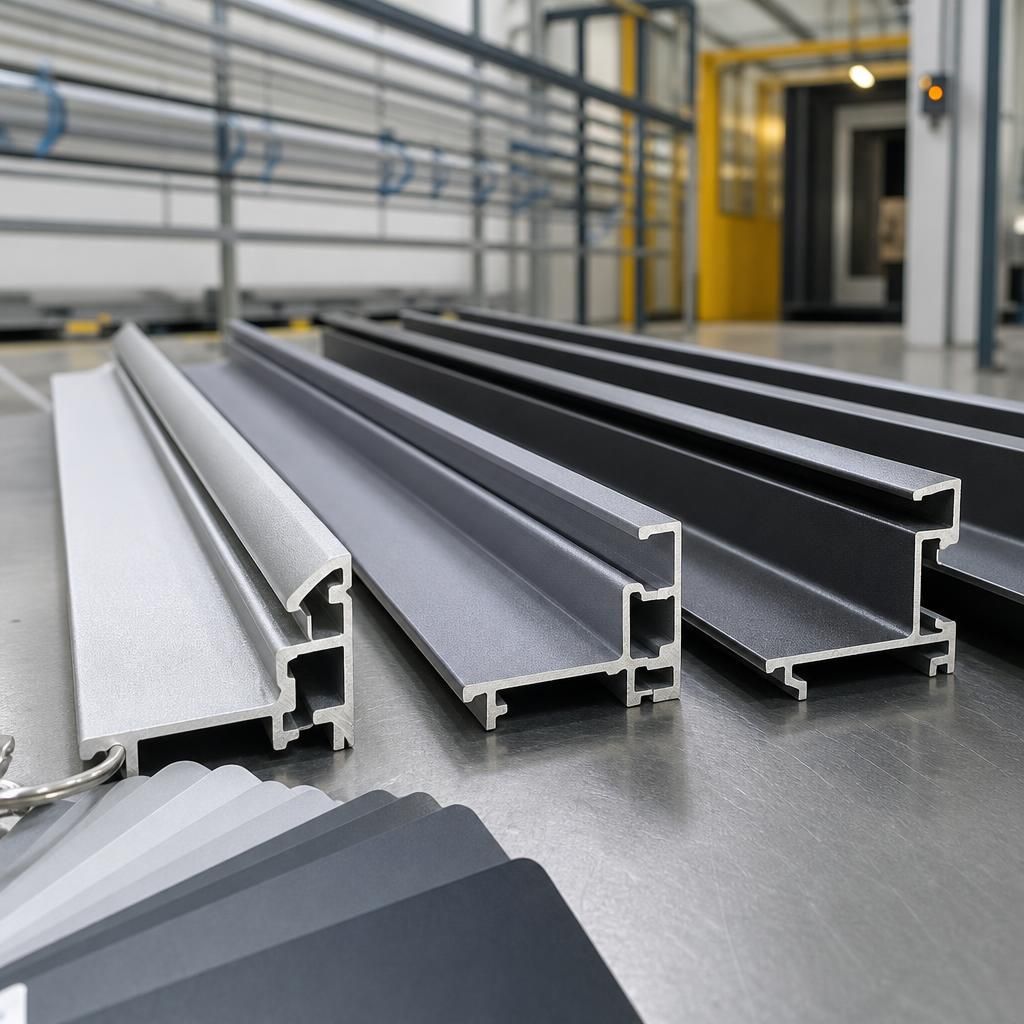
A change in particle-size distribution can affect colour and gloss consistency even when the powder formulation is otherwise unchanged. Differences in how the particles deposit and fuse may alter the cured surface’s reflectivity, making adjacent aluminium sections appear slightly different under directional or natural light.
For colour-critical work, compare a sample section using the intended powder, application settings and cure cycle before production. Assess the sample against the required reference finish and keep powder handling and recovery conditions consistent, so a shift in particle distribution does not introduce avoidable variation between batches.
Discuss powder particle size requirements for your aluminium sections
Discuss your aluminium section requirements with our powder-coating specialists, including the profile design, finish specification and intended application. We can help assess the powder and process conditions needed for consistent, durable results.