

What considerations should be taken into account when determining the durability and longevity of matte clear versus white powder coatings for aluminium in industrial environments?
The durability and longevity of matte clear versus white powder coatings on aluminium depend primarily on substrate preparation, powder chemistry, film coverage, curing accuracy and the severity of the industrial environment. Matte clear can preserve the aluminium’s visual character but may reveal surface defects or staining more readily, while white can make dirt and damage more visible, so exposure conditions, cleaning requirements and the required appearance should guide the specification.
For aluminium in an industrial environment, matte clear and white powder coatings can both provide long service, but their durability should be judged by the complete coating specification rather than colour alone. The resin type, coating formulation, aluminium alloy, component design, mechanical loading, chemical exposure and the required appearance after ageing all affect which finish is the more suitable choice.
Compare like with like. A meaningful comparison requires both finishes to use an equivalent exterior-grade resin system and a specification suited to the same exposure category. A high-performance coating in either colour will generally be a better choice than comparing a premium clear product with a lower-grade white product. Resin selection is particularly important outdoors: some systems are intended mainly for interior use, while others are formulated to resist ultraviolet exposure, humidity and atmospheric pollutants.
Consider the aluminium alloy and component construction. Different aluminium alloys and cast or extruded surfaces can respond differently during coating and service. The specification should account for alloy composition, surface condition, welds, machined areas and any previous treatment. Component geometry also matters. Sharp edges, recesses, joints and fixing points are more vulnerable to reduced protection, impact and moisture retention than broad, accessible faces. Radiused edges and drainage paths can therefore support longer-lasting performance for either finish.
Assess the actual industrial exposure. Relevant conditions include:
- ultraviolet radiation and weathering on external components;
- condensation, persistent humidity and water retention;
- salt-laden air or de-icing residues;
- contact with oils, solvents, detergents, acids or alkaline materials;
- abrasive dust, metal particles and process debris; and
- repeated contact with gloves, tools, packaging or adjacent components.
Matte clear and white coatings should be checked for resistance to the particular chemicals and contaminants present at the site. A coating that performs well in a dry factory may not be suitable for areas exposed to wash-down chemicals, airborne pollutants or continuous moisture. Where contact with a process substance is expected, compatibility data for the cured coating should take priority over assumptions based on colour.
Account for mechanical and thermal stress. Aluminium components may be subject to impact, rubbing, vibration, bolting, bending or repeated assembly. Damage at an edge or fixing point can expose the underlying metal and create a route for further deterioration. Thermal cycling can also place stress on the coating, particularly where large aluminium sections expand and contract or where dissimilar materials are joined. The design, handling method and installation sequence should minimise scratching and concentrated loads after coating.
The surface appearance selected can affect how ageing is assessed. Matte finishes are designed to reduce reflected glare, but rubbing, polishing or local abrasion can alter the texture and create visible patches. Matte clear can also develop an uneven visual character if sections weather differently or if repairs do not reproduce the original texture. White usually offers a more uniform colour reference, but any change in gloss, yellowing, chalking or local soiling may be apparent against the surrounding finish. These are appearance considerations rather than proof that one coating has failed structurally.
Specify performance separately from appearance. A project specification should state the intended environment, resin family, colour and texture, film requirements, permissible visual variation, chemical exposures and inspection criteria. It may also require testing for adhesion, impact, abrasion, gloss retention, colour change and resistance to relevant chemicals. Laboratory tests such as accelerated weathering or salt-spray testing are useful for comparing systems, but they do not predict an exact service life in every industrial location. Results should be interpreted alongside the component design and exposure conditions.
Maintenance planning should address both protection and finish retention. Regular removal of deposits using a suitable, non-abrasive cleaning method helps prevent contaminants from remaining on the coating, while harsh solvents, aggressive pads and unapproved cleaners may alter a matte texture or reduce gloss. Inspection should pay particular attention to edges, joints, fixings and areas exposed to repeated handling. Small defects are easier to control when identified before moisture, chemicals or abrasion extend the affected area.
In practical terms, the better choice is the finish whose formulation, texture and appearance requirements match the component’s environment and use. Matte clear is often selected where the natural aluminium appearance is part of the design intent, while white may be preferred where a consistent opaque colour is required. Neither choice should be treated as inherently more durable without comparing the proposed coating systems, exposure classification, component design and maintenance regime.
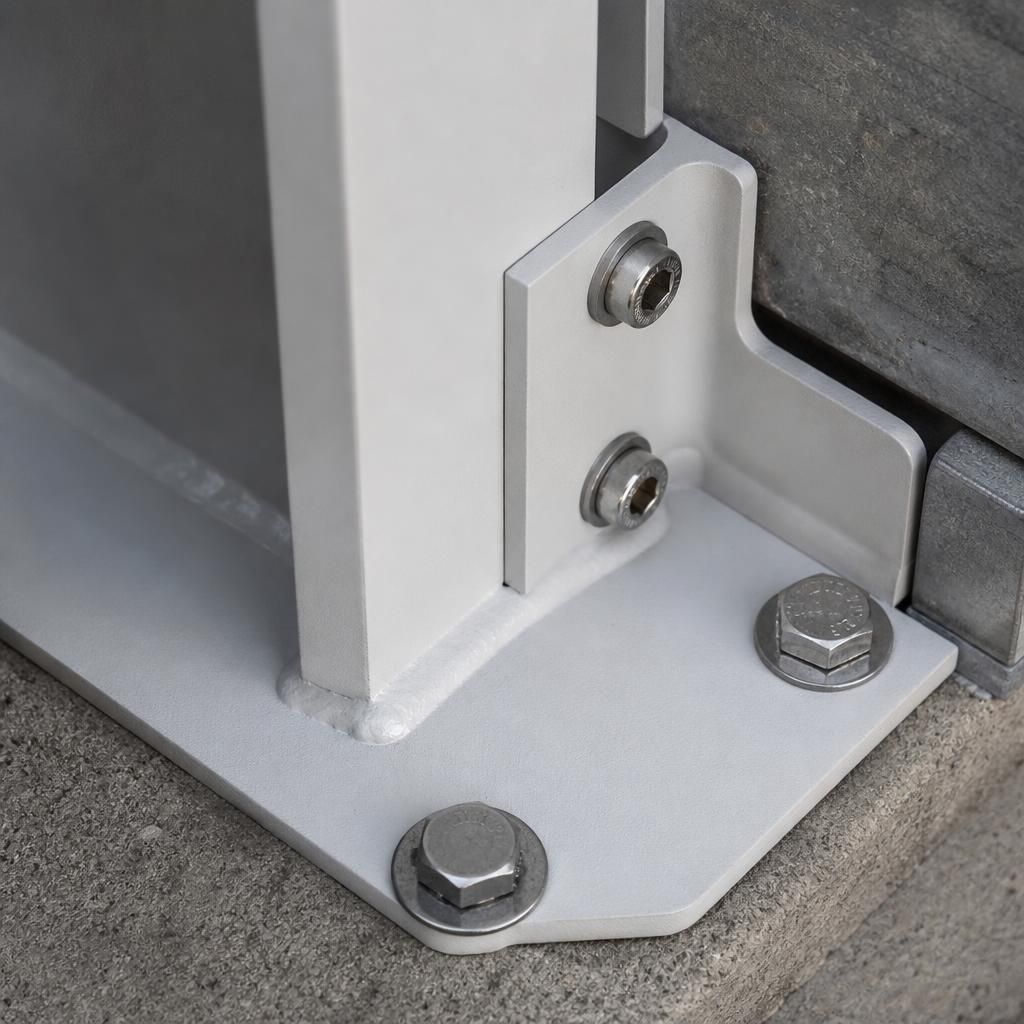
One often overlooked factor in the long-term performance of powder-coated aluminium is contact with dissimilar metals. Fasteners, brackets, inserts and adjacent steelwork can create localised corrosion risks where moisture or process residues become trapped, particularly if the coating has been drilled, cut or compressed during assembly. The coating specification should therefore be considered alongside the fixing and joint design, rather than treated as the only protective measure.
Durability can be improved by using compatible fixings, suitable separation between dissimilar metals and joint details that prevent water retention. Cut edges, drilled holes and concealed contact points should be checked after installation, because these areas may deteriorate without an obvious change to the main visible surface. This is relevant to both matte clear and white finishes: the difference in colour does not remove the need to control galvanic contact and moisture at the assembly stage.