

What unique advantages does polyester powder coating offer over traditional liquid painting for aluminium in industrial settings?
Polyester powder coating gives aluminium a tough, uniform finish with strong resistance to weathering, UV exposure, impact and corrosion, generally providing more durable protection than traditional liquid paint. It also avoids solvent-based application, can reduce material waste through efficient powder recovery, and produces a consistent decorative finish with relatively low ongoing maintenance.
Polyester powder coating offers aluminium a solvent-free, heat-cured finish that is particularly suited to repeatable industrial production. Compared with traditional liquid painting, its main advantages are more efficient film formation, reduced reliance on solvent handling, strong process control and a broad choice of functional and decorative finishes.
Controlled application and curing. Powder is applied as dry particles, commonly using electrostatic attraction to hold the coating on the prepared aluminium surface before curing in an oven. During curing, the particles melt and chemically cross-link to form a continuous coating film. Liquid paint, by contrast, depends on solvent evaporation as well as paint curing, so its final condition can be affected by solvent entrapment, drying conditions and the time allowed between coats.
This difference is useful in manufacturing environments because the powder process separates application from solvent flash-off. Once the coating has been correctly cured and cooled, the component can proceed to subsequent handling without the same concerns associated with wet paint remaining vulnerable during drying. The exact cure schedule must still be matched to the powder specification, aluminium alloy, component thickness and oven performance.
Lower solvent dependence. Polyester powder coating does not require the liquid solvents used in conventional solvent-borne paint systems. This can simplify material handling and reduce the need to manage solvent vapours during application. It also makes powder coating relevant to businesses reviewing workplace controls, extraction requirements and environmental procedures. Water-based liquid paints reduce solvent content compared with solvent-borne systems, but they still involve a wet application process and may require controlled drying conditions.
More options for specifying the finished component. Polyester powder is available in a wide range of colours, gloss levels, textures and surface effects. This allows an aluminium component to be specified for identification, visual integration with surrounding equipment or a particular design requirement without changing the underlying coating method. A project should define the required colour standard, gloss, texture and acceptable variation before production, especially where coated parts are manufactured in separate batches or need to match existing components.
Good suitability for aluminium fabrication. Aluminium is lightweight and commonly used for formed, machined and fabricated parts, but its surface must be prepared correctly before any coating is applied. Pretreatment removes contamination and helps establish a suitable surface for adhesion. This is essential because powder coating does not compensate for oil, oxide contamination, handling residue, poor weld cleaning or unsuitable surface preparation. Areas such as drilled holes, sharp edges, joints and recessed sections should be considered during design and specification so the coating process can reach the required surfaces without interfering with assembly.
Powder coating can also support a more defined production specification than an informal wet-paint approach. The coating system can be documented by its powder type, colour, gloss, pretreatment, application method and curing requirements. This gives manufacturers and fabricators clearer points to check when approving samples or investigating a difference between batches. It is important to distinguish a visual colour match from a complete technical match: two finishes may appear similar while differing in gloss, texture, coating chemistry or suitability for the intended environment.
Practical limitations should be assessed alongside the advantages. Aluminium components must be able to tolerate the specified curing temperature, and assembled parts may require masking where powder must not reach threads, bearing seats, electrical contact points or close-tolerance faces. Large parts also need to fit the available coating and curing equipment. Powder coating is therefore most effective when the component design, racking, masking and finishing requirements are reviewed before manufacture rather than treated as an afterthought.
For industrial aluminium, polyester powder coating is most appropriate when the project needs a repeatable dry-film process, a defined appearance and reduced dependence on wet-paint solvent handling. The final choice should be based on the service environment, aluminium preparation, curing requirements, dimensional tolerances, colour specification and the performance requirements of the finished component.
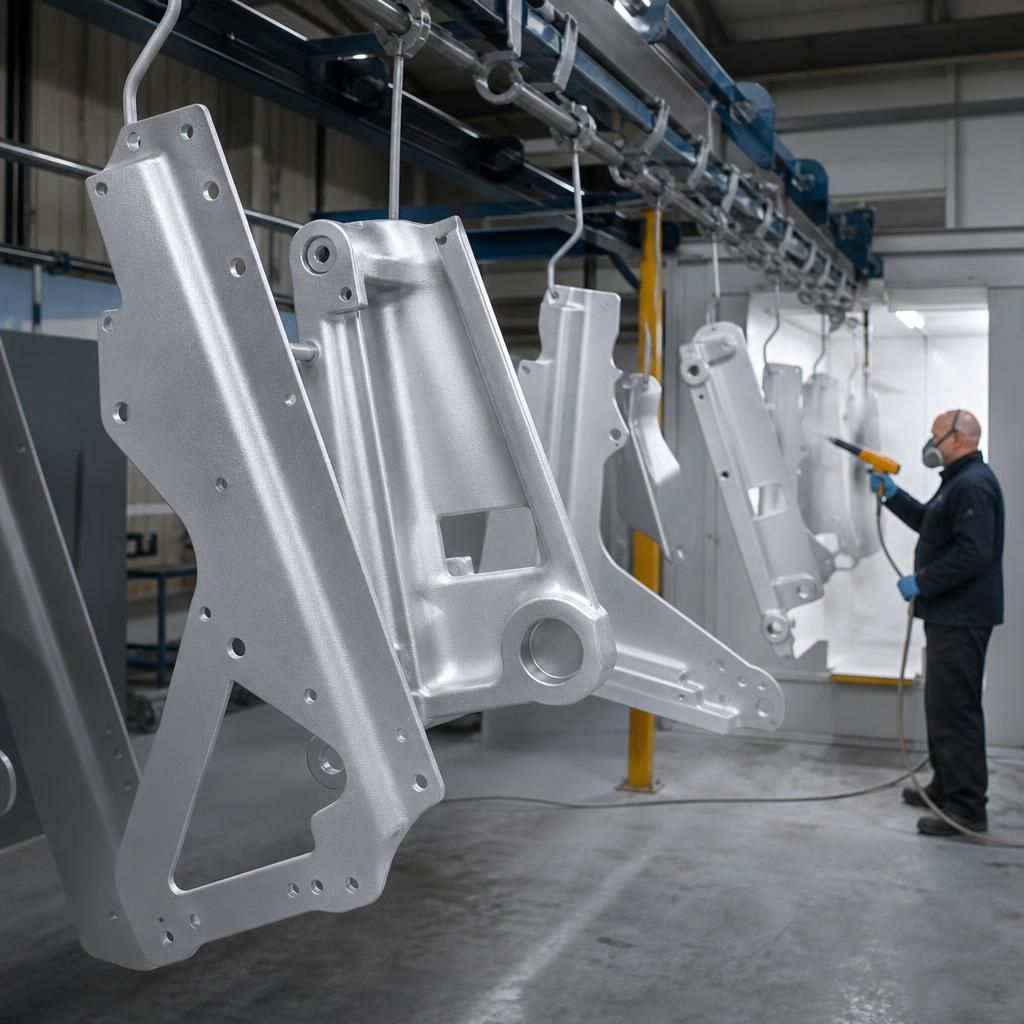
One practical advantage of polyester powder coating over traditional liquid painting is that the required finish can often be achieved in a single cured application rather than through several wet coats. This reduces the number of intercoat stages in which dust, handling marks or uneven drying could affect the aluminium surface.
For manufacturers, fewer application stages can also simplify inspection and process control. The required coating system still depends on the service environment, aluminium preparation and performance specification, but a suitably selected polyester powder can provide the specified decorative and protective finish without the additional wet-film management associated with multi-coat liquid painting.