

What are the cost implications and potential return on investment (ROI) of implementing automated powder coating lines in an industrial setting?
Automated powder coating lines require significant capital investment in equipment, installation, extraction, curing and integration, with ongoing costs for energy, maintenance, consumables and operator training. The potential ROI comes from higher throughput, reduced manual handling, more consistent finishes and improved powder utilisation, but payback depends on production volume, part mix, utilisation, labour costs and the level of automation selected.
The return on investment (ROI) of an automated powder coating line is the financial benefit generated by the line compared with the total cost of acquiring, integrating and operating it over an agreed assessment period. The investment is financially justified when the additional contribution from production, together with avoidable costs and capacity benefits, exceeds the line’s ownership and operating costs.
Separate the investment case into cash flows
A reliable assessment should distinguish between one-off expenditure, recurring expenditure and financial benefits. This prevents a business from comparing the purchase price alone with an assumed increase in output.
- Initial investment: include the complete installed project cost, site preparation, control-system integration, commissioning, validation and any production downtime required during implementation.
- Recurring ownership costs: allow for servicing, replacement components, calibration, software or control-system support and planned equipment inspections.
- Production-related costs: assess electricity, compressed air, powder, pretreatment materials, packaging and any additional handling required by the line.
- Financial benefits: include additional saleable output, reduced rework, lower scrap, avoided subcontracting, reduced overtime and the value of releasing existing equipment or staff for other work.
Only costs that will genuinely change as a result of automation should be treated as savings. For example, an operator’s full wage is not automatically an avoided cost if that person will be redeployed elsewhere. It may still create capacity value, but that value should be described separately from a direct cash saving.
Measure the effect on saleable capacity, not theoretical line speed
Automated equipment may have a substantial rated capacity, but the investment case should use the quantity of acceptable work that can realistically pass through the complete process. Constraints may arise from loading, masking, coating specification, curing requirements, unloading, inspection, packaging or downstream assembly.
Utilisation is particularly important. A line operating below its practical capacity still carries much of its ownership cost, so low or irregular demand can lengthen the payback period. The calculation should therefore use a realistic production pattern based on confirmed or well-supported demand rather than the maximum possible output.
For repair operations, the part mix may be less predictable than in a dedicated high-volume manufacturing process. Different dimensions, coating specifications, hanging arrangements and preparation requirements can create changeover time. A line that performs well with repeatable batches may deliver a weaker financial return when work consists mainly of short runs or highly varied components.
Account for quality-related financial effects
Consistent process control can affect ROI through the cost of non-conforming work. The assessment should record current levels of rework, rejected components, additional inspection, customer returns and delays caused by inconsistent application. It should then estimate which of these costs are genuinely avoidable through automation.
Quality benefits should not be converted into savings without evidence. A lower theoretical defect rate is not the same as a cash benefit unless it reduces material use, labour, transport, replacement components or lost production. It is also useful to distinguish between defects caused by coating application and those arising from substrate condition, masking, pretreatment or part design, since automation will not remove every source of failure.
Consider capacity value and opportunity cost
Automation can create value even when the business does not immediately sell more coated components. Additional dependable capacity may allow a manufacturer or fabricator to accept work that would otherwise be subcontracted, reduce delays between production stages or avoid investing in another bottleneck. These benefits should be included only where there is a credible operational plan to use the released capacity.
The comparison should include the alternatives. In some cases, the relevant choice is not simply whether to automate, but whether to continue using a manual process, add another manual shift, subcontract selected work, upgrade part of the process or invest in a complete line. Each option should be assessed using the same measures for quality, capacity, labour, lead time, risk and total cost of ownership.
Use payback and ROI together
Payback indicates how long it takes for accumulated net cash benefits to recover the initial investment. A simple calculation is:
Payback period = initial investment ÷ annual net cash benefit
ROI provides a broader view over a defined period:
ROI = (total benefit minus total cost) ÷ total investment
These measures answer different questions. Payback focuses on recovery of the initial outlay, while ROI shows the overall return across the selected assessment period. A project with a shorter payback is not necessarily the most profitable over its useful life, and a high projected ROI may still be unsuitable if the cash recovery period is too long for the business’s funding requirements.
A detailed appraisal should also consider depreciation, finance charges, tax treatment, inflation, residual value and the cost of capital. These items may not change the operational performance of the line, but they can materially affect the investment decision and should be reviewed with the finance team.
Test the assumptions before approving the project
ROI forecasts are sensitive to assumptions about demand, utilisation, product mix, labour allocation, powder consumption, energy use, maintenance and quality performance. A sensitivity analysis should model at least a cautious case, an expected case and a strong-demand case. It should show how payback changes if output is lower than planned, the mix becomes more complex, commissioning takes longer or operating costs rise.
The break-even utilisation level is especially useful. This identifies the amount of saleable work required for the line to cover its incremental costs. If expected demand remains below that level, automation may need to be justified by a separate strategic benefit, such as protecting capacity, meeting a customer requirement or reducing dependence on external processing.
Review the non-financial return
Some benefits are difficult to express accurately in pounds but can still influence the decision. These include improved production planning, more traceable process records, reduced dependence on individual operator technique, better use of floor space and a more predictable route between coating and subsequent manufacturing stages. They should be listed as operational benefits rather than presented as guaranteed financial savings.
In practice, the strongest business case combines verified production data with a complete lifecycle cost model. Before committing to an automated powder coating line, compare actual batch volumes, part variation, changeover requirements, current defect costs and available capacity with the proposed line’s practical operating profile. This produces a more defensible ROI estimate than relying on equipment capacity or headline purchase price alone.
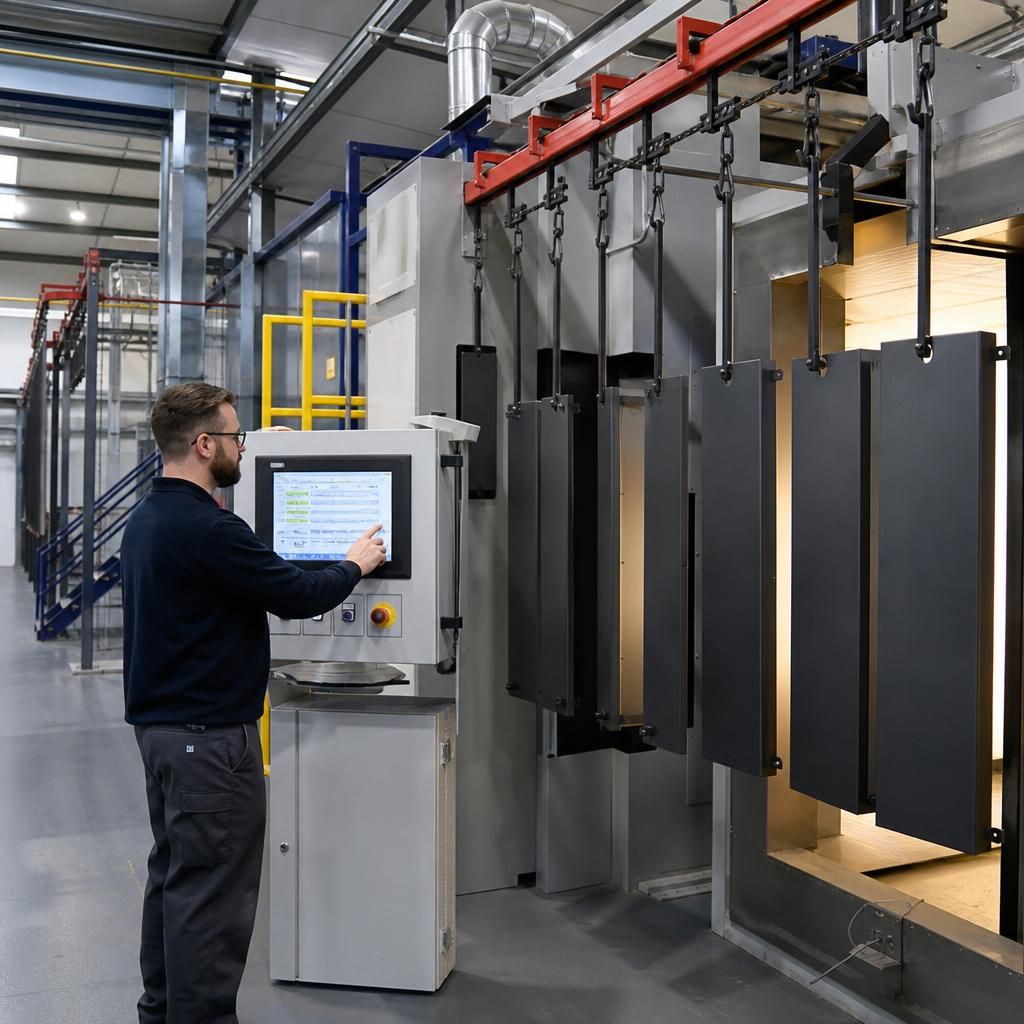
Flexibility can materially affect the long-term ROI of an automated powder coating line. When comparing options, assess the cost of adapting the equipment if component dimensions, coating specifications or production requirements change. A line that cannot accommodate future work may require additional equipment or costly modification, reducing its useful value. Conversely, flexibility should not be treated as a financial benefit unless there is a credible operational need for it. Include likely upgrade, replacement and integration costs in the lifecycle appraisal, while valuing only the capacity that the business can reasonably expect to use.
Discuss the costs and ROI of an automated powder coating line
Discuss your production volumes, part mix and existing process with Powder-coatings.co.uk to establish whether an automated powder coating line is financially suitable for your operation. A structured review can help identify the information needed for a realistic lifecycle cost and ROI assessment.