

What criteria determine the effectiveness of abrasives used in the shot blasting process for preparing large industrial metal components?
The effectiveness of shot blasting abrasives for large industrial metal components depends on their material, size, shape, hardness, cleanliness and compatibility with both the substrate and defective coating. The abrasive must remove the coating consistently without distorting or excessively roughening the metal, while working efficiently with the blasting equipment and required surface profile.
The effectiveness of an abrasive for preparing large industrial metal components is determined by how reliably it converts blasting energy into controlled coating removal, produces the required surface condition and avoids unnecessary damage to the underlying metal. The correct choice must therefore be assessed against the coating system, component geometry, blasting equipment, production requirements and the surface standard specified for the subsequent finish.
Removal performance is the first practical criterion. An abrasive should break down or detach the defective coating at a workable rate rather than merely polish it, embed itself in the surface or leave isolated patches. Thick, layered or strongly bonded coatings may require a more aggressive abrasive or a staged process, whereas a thin or friable coating may be removed effectively with a less severe impact. Trial blasting on a representative area helps establish whether the selected abrasive removes the coating cleanly without excessive passes.
Impact energy and particle behaviour must suit the equipment and the component. The abrasive should transfer enough energy at the operating pressure or wheel speed to reach recessed areas and deal with firmly attached coating. If the particles fracture too readily, performance can become inconsistent and dust generation may increase. If they are excessively aggressive for the application, they can create sharp peaks, peen thin sections or make later finishing more difficult. The best result is controlled impact rather than maximum impact.
The resulting surface profile is important because it affects how a new coating keys to the metal. A profile that is too shallow may leave insufficient mechanical anchoring, while an unnecessarily deep or irregular profile can increase coating consumption and may remain visible through a thinner finish. Profile should be checked using an appropriate inspection method after blasting, alongside visual assessment for remaining rust, scale, coating edges and embedded debris.
Consistency across a large component is more difficult to achieve than an acceptable result on a small test panel. Abrasive performance should remain predictable as the blast stream travels across broad faces, welds, corners, holes and partially enclosed sections. Particle flow, nozzle distance, angle, traverse speed and overlap all influence the result. Large components may need a defined blasting sequence so that accessible areas are not overworked while difficult areas remain insufficiently prepared.
Substrate protection is especially important where components contain thin sections, machined faces, sharp edges, weld details or close-tolerance interfaces. Abrasive selection should be judged by the condition of these features after processing, not just by the speed of coating removal. Any distortion, rounding of edges, peening, surface contamination or change to critical dimensions can affect assembly and the performance of the final coating.
Cleanliness during use also affects the result. Abrasive containing oil, moisture, previous coating residues or excessive fines can transfer contamination to the component or interfere with the blasting process. Storage and handling should keep the abrasive dry and protected. The blast stream and extraction system should be monitored for signs of contamination, while spent abrasive and detached coating should be managed so that debris does not settle back onto prepared metal.
Reusability and breakdown rate influence both process stability and practical operating cost. A reusable abrasive can maintain more consistent working characteristics when it is correctly separated and replenished. An abrasive that breaks down rapidly may alter the particle distribution during a job, requiring closer control of recovery, screening and replacement. This is particularly relevant when preparing numerous large components, where changing abrasive characteristics can produce variation between batches.
Equipment compatibility should be confirmed before work begins. The abrasive must pass through the selected nozzle, wheel or recovery system without causing blockages or abnormal wear, and its operating range must match the available pressure, air volume or wheel speed. Extraction and filtration capacity are also relevant because fines and removed coating affect visibility, housekeeping and the ability to maintain a controlled blast stream.
A practical selection process normally includes:
- identifying the coating layers and the condition of the exposed metal;
- checking the required cleanliness and surface-profile specification;
- reviewing the component’s thickness, geometry, welds, edges and tolerance-sensitive areas;
- matching abrasive behaviour to the blasting method and recovery equipment;
- conducting a controlled trial on representative areas; and
- recording the operating settings and inspection findings before full-scale preparation.
The abrasive should be accepted only when the trial demonstrates uniform coating removal, an appropriate profile, no unacceptable substrate damage and a clean surface ready for the next treatment. For large industrial components, effectiveness is therefore a balance between removal capability, process control, surface preparation quality, equipment performance and repeatability—not simply the abrasive that appears most aggressive.
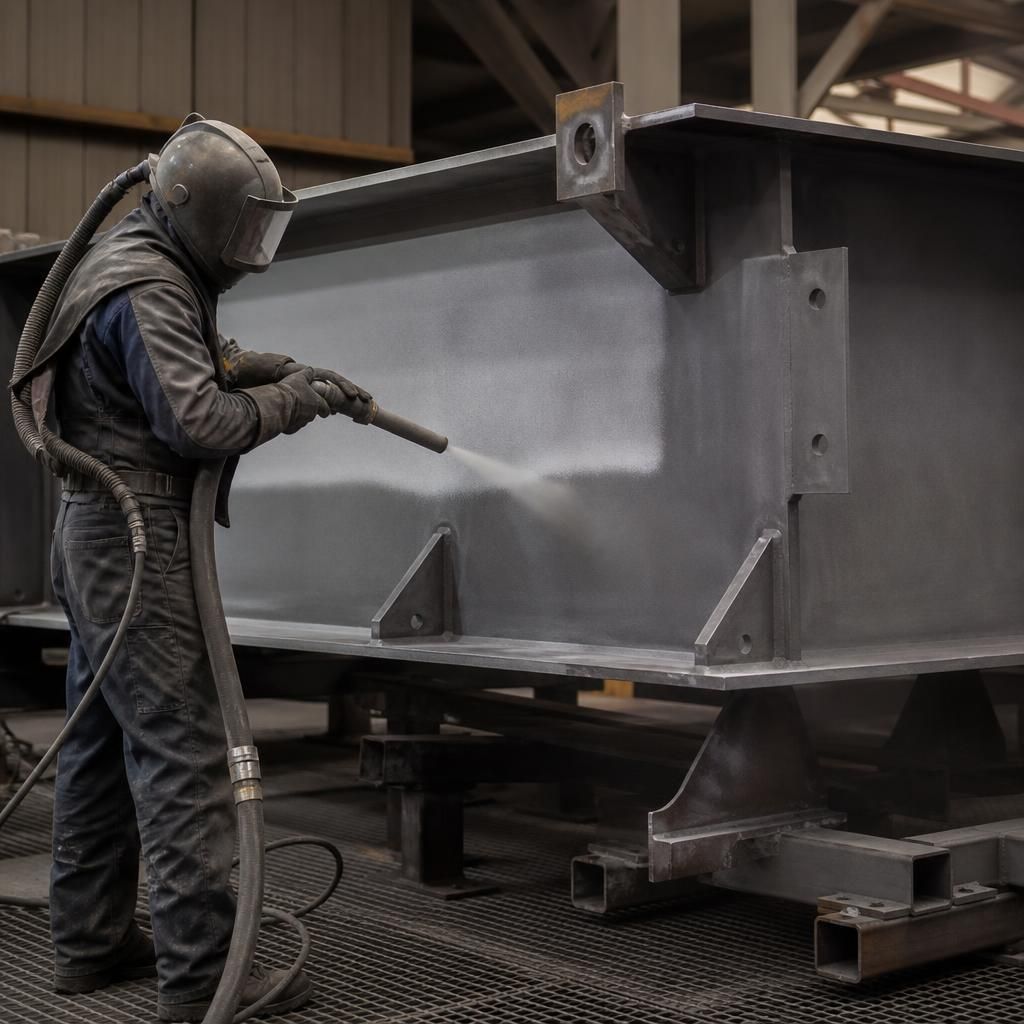
Particle shape determines how abrasive energy is applied to the coating. Rounded shot delivers a more concentrated impact and is suited to controlled cleaning where preserving the underlying profile matters. Angular grit presents cutting edges that can penetrate brittle, layered or strongly bonded coating, but may create a more pronounced profile if the operating conditions are too severe.
Neither form is universally more effective. The correct choice depends on whether the priority is lifting the defective coating, cutting through contamination or producing a defined key for the replacement finish. Comparing the blasted surface with the specified cleanliness and profile requirements is more reliable than judging abrasive performance by removal speed alone.
Discuss shot blasting abrasives for your large industrial components
Share your component drawings, coating details and any dimensional or surface requirements with our team to discuss a suitable shot blasting approach. We can then advise on preparation requirements before the metal components proceed to their next treatment.