

What is the role of surface texture created by sandblasting in enhancing powder coating repairs?
Sandblasting creates a controlled profile of fine peaks and valleys on the metal, giving powder coating a larger, more receptive surface to grip. During a repair, this texture helps the new coating key into the prepared area, supporting consistent adhesion and reducing the risk of lifting or premature failure.
Surface texture created by sandblasting provides a mechanical key for the replacement powder coating and helps establish a consistent transition between the repaired area and the surrounding finish. Its role is not simply to make the metal look rough; it creates a controlled surface condition that supports coating coverage, edge blending and long-term repair integrity.
Mechanical anchoring
On a smooth or previously damaged surface, a new powder coating has fewer physical features with which to engage. Sandblasting changes the surface topography by forming a fine, even profile. During application, the powder settles over and around this profile. Once cured, the coating is physically anchored to the prepared metal rather than relying solely on surface contact.
This is particularly relevant at a repair boundary. If the surrounding coating has been removed or feathered back, the textured section gives the replacement material a more gradual and stable foundation. A well-prepared transition is less likely to create a sharp weak line where the old and new finishes meet.
Influence on coating coverage
The texture must be controlled. A suitable profile gives the powder enough surface detail to follow without creating deep recesses or pronounced peaks. If the surface is excessively rough, the coating may cover the high points less effectively while collecting more heavily in the low points. That can produce variations in film build, texture and gloss.
For this reason, sandblasting for a repair should be matched to the metal, the condition of the existing finish and the powder coating system being applied. The objective is an even, usable profile rather than the roughest possible surface. Flat components, folded sections, edges and weld areas may each respond differently to the same blasting treatment.
Improving the repair boundary
Surface texture also helps the repair area merge physically with the retained coating. Where damaged coating has been removed, the surrounding edge may need to be softened rather than left as a distinct step. Blasting can help prepare this boundary, but it cannot compensate for loose coating, deep corrosion, pitting or damage that remains underneath. Those defects need to be removed or addressed before the new powder is applied.
A properly prepared boundary supports a more consistent visual result because the replacement coating is not being applied over abrupt changes in level or contamination. However, texture alone does not make a repair invisible. Colour, gloss, powder formulation, curing conditions and the extent of the damaged area also affect how closely the repaired section matches the original finish.
Controlling the texture during blasting
The resulting profile depends on several process variables, including:
- the blasting medium and its particle characteristics;
- air pressure, nozzle distance and blasting angle;
- the hardness and thickness of the substrate;
- the time spent on each area; and
- the condition and thickness of any coating being removed.
These variables need to be managed to avoid warping thin metal, rounding critical edges or producing an uneven pattern. Excessive treatment in one location can create a different surface profile from the rest of the repair, which may then affect appearance and coating build.
After blasting, the surface must be free from spent abrasive, dust, oil, moisture and other residues. A textured surface can retain contamination more readily than a smooth one, particularly in recesses and around welds. If residue remains, it can interfere with the powder coating process and undermine the benefit of the prepared profile.
Texture and durability
The value of the profile is greatest when it is uniform, clean and appropriate for the repair specification. It gives the cured coating a stable physical foundation and reduces the risk that the repaired area will behave differently from the properly prepared surrounding metal. It does not replace correct powder selection, application or curing, but it is an important part of the surface-preparation stage.
In practice, the appropriate texture is determined by inspection rather than by appearance alone. The operator considers whether all failed coating and corrosion have been removed, whether the repair edge has been suitably blended, and whether the surface is consistent enough for the intended finish. This assessment is especially important for manufactured components where dimensional tolerances, edge definition and visual uniformity matter.
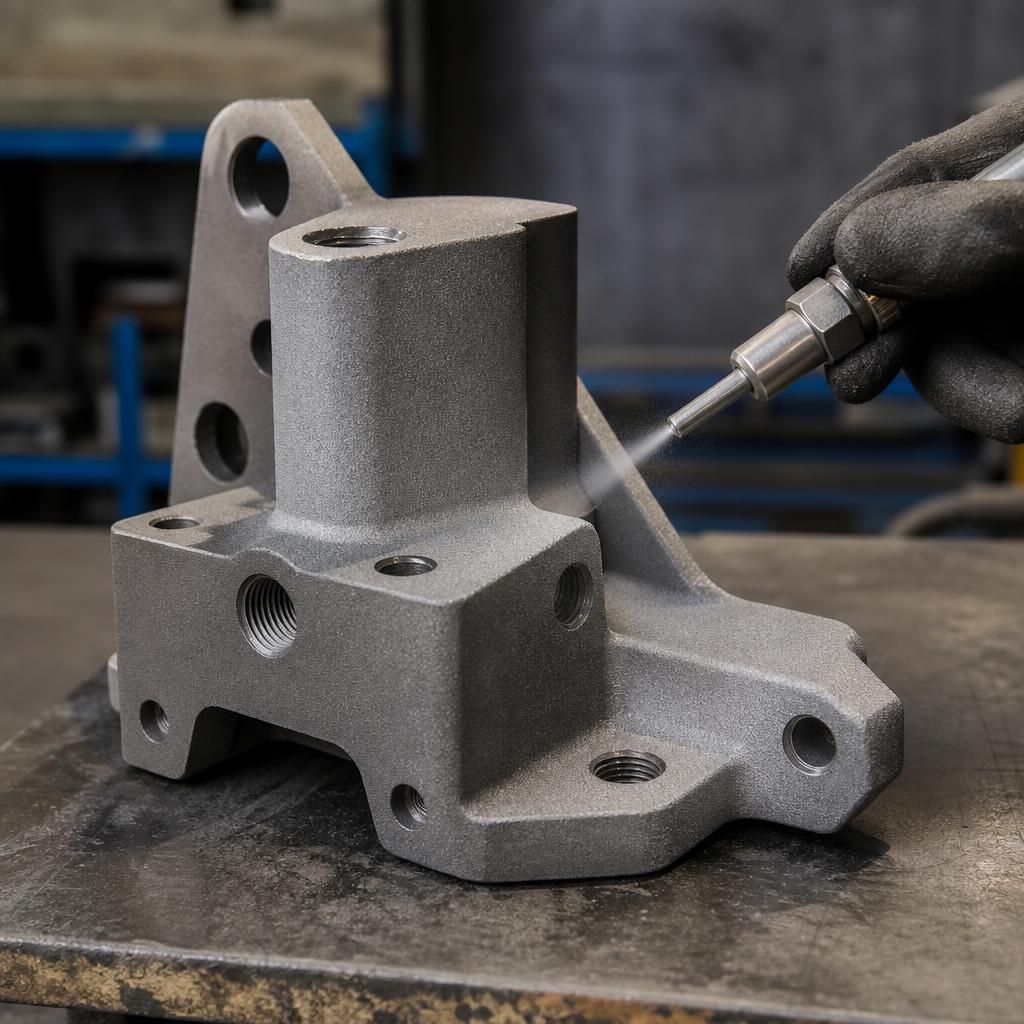
Surface texture also affects dimensional accuracy. On components with threaded holes, mating faces, slots or close-fitting edges, the blasted profile and the replacement powder coating both add to the finished surface condition. Excessive roughness or uneven coating build can interfere with fit, clearance or sealing performance even when adhesion is satisfactory.
For this reason, repair preparation should distinguish between areas that require a coating finish and surfaces that must remain within a defined tolerance. Masking, controlled blasting and careful powder application help preserve functional features while providing an effective key for the repair. The correct texture is therefore determined not only by adhesion requirements, but also by how the component is assembled or used.