

What are the advantages of choosing a two-coat and thermoset system over a single-layer coating for industrial applications?
A two-coat and thermoset system combines a protective basecoat with a durable thermoset topcoat, providing greater corrosion protection and resistance to abrasion and chemicals than a single-layer coating. It also allows the coating specification to address both substrate protection and the required surface finish, making it more suitable for demanding industrial applications.
A two-coat and thermoset system is generally preferable to a single-layer coating when the component must withstand demanding service conditions, because each coat can be selected for a different function. The first coat supports protection and adhesion to the prepared metal, while the thermoset topcoat provides the specified surface characteristics. This division allows the coating specification to be matched more closely to the component’s environment, geometry and appearance requirements.
More controlled performance
A single-layer system has to provide adhesion, coverage, protection and appearance in one film. That can restrict the choice of coating or require compromises between competing properties. With two coats, the basecoat and topcoat can be formulated and applied to perform separate roles. This is useful where the component needs a robust foundation as well as a particular colour, gloss level, texture or final surface finish.
The thermoset topcoat forms a cross-linked film during curing. Once properly cured, this structure does not soften and flow again when reheated in the way a thermoplastic material can. It provides a stable, hard-wearing surface that is suitable for many industrial components subject to handling, contact and regular use. The result is a more technically specified finish than a single film chosen to cover every requirement.
Improved coverage of complex components
Metalwork may include corners, recesses, edges, welds, apertures and areas that are more difficult to coat evenly. A two-coat process gives the applicator an additional opportunity to establish consistent coverage before the final finish is applied. It does not replace proper cleaning, blasting or other preparation, and it cannot correct contamination or unsuitable metalwork, but it can provide greater control over the finished coating build when the process is correctly specified.
This is particularly relevant to fabricated parts and batch-produced components, where different shapes may need to meet the same specification. The coating system can be assessed according to the part’s design and service conditions rather than treating every surface as if it presents the same application challenge.
Greater flexibility in specification
Two-coat systems allow the basecoat and topcoat to be selected as a compatible system rather than relying on one product to meet all performance objectives. Factors that may influence the specification include:
- the type and condition of the metal substrate;
- the component’s exposure to moisture, pollutants, chemicals or repeated handling;
- the required colour, gloss, texture and visual uniformity;
- the geometry of the part, including edges, joints and recessed areas; and
- the intended service environment and cleaning regime.
This flexibility can be valuable when the visible finish must meet a design or identification requirement without reducing the protective function of the underlying coating. It also helps the applicator define suitable inspection criteria for each stage, including surface preparation, intercoat compatibility, film coverage and final cure.
More reliable finish consistency
Applying the final appearance coat over a prepared and suitably cured basecoat can make the visual result easier to control across a production batch. The topcoat establishes the visible surface, while the underlying coat helps provide a consistent foundation. Correct curing remains essential: insufficient curing, excessive curing or poor compatibility between layers can affect adhesion and the final appearance.
For this reason, a two-coat system should be treated as a complete process rather than two unrelated applications. The materials, preparation method, application conditions, curing schedule and handling procedure all need to be compatible. A single-layer coating may involve fewer process stages, but the apparent simplicity does not remove the need for accurate preparation and curing control.
When the additional process is justified
A two-coat thermoset system is most justified where the consequences of coating failure, inconsistent appearance or premature rework are significant. It may be appropriate for industrial parts that face demanding handling, complex fabrication, challenging exposure conditions or a strict appearance specification. For lightly used components in a controlled environment, a correctly selected single-layer coating may be adequate and may involve a simpler process.
The correct choice therefore depends on the substrate, service environment, required finish and performance specification. A coating specialist can assess these factors before recommending whether the additional layer provides a worthwhile technical advantage. Whichever system is selected, the expected result depends on suitable preparation, compatible materials, controlled application and complete curing.
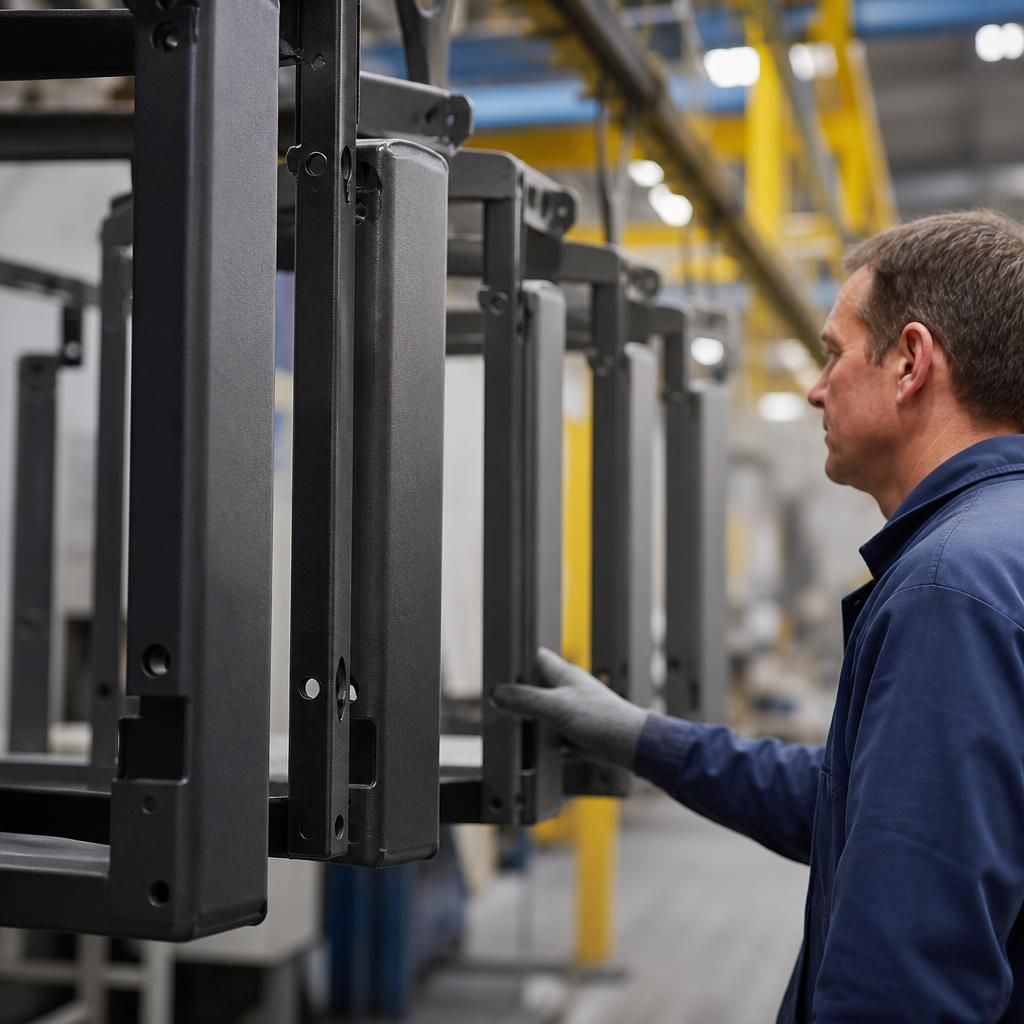
The main advantage of a two-coat system over a single-layer coating is that it can provide a degree of barrier redundancy. If the thermoset topcoat suffers minor scuffing or local wear, the underlying coat can continue to separate the exposed area from the metal substrate, provided both layers remain properly bonded and the damage has not penetrated the full coating build.
This can reduce the immediate consequences of superficial handling damage on components that are moved, assembled or exposed to routine contact. It does not make the coating immune to impact or remove the need to inspect damaged areas, but it gives the specification an additional protective layer to consider when assessing risks during installation and service.
Discuss your two-coat and thermoset coating requirements
Discuss your component’s substrate, service environment and finish requirements with a powder-coating specialist to determine whether a two-coat and thermoset system is appropriate. You can also review the preparation, application and curing requirements before specifying the coating for production.