

What potential challenges can arise during the repair of specialty coatings such as nylon, and how are they effectively managed?
Repairing nylon and other specialty coatings can be difficult because adhesion, surface contamination, colour or texture matching, and heat sensitivity may affect the result. These challenges are managed by assessing the existing coating, selecting a compatible repair material, preparing the damaged area carefully, and controlling application and curing conditions.
Repairing nylon and other specialty coatings is challenging because the coating often behaves differently from conventional thermoset powder, both during application and in service. Effective management depends on identifying the type and condition of the existing finish, determining whether a local repair is technically suitable, and controlling the repaired area so that it meets functional, dimensional and visual requirements.
Deciding whether a local repair is appropriate
A small mark, chipped edge or isolated area of wear may be suitable for a local repair. However, widespread flaking, extensive abrasion, corrosion beneath the coating or damage around welds can indicate that the component needs more extensive treatment. Attempting to patch a coating that is failing beyond the visible defect can leave weak material around the repair and cause the problem to reappear.
The decision also depends on the purpose of the component. A minor visual mismatch may be acceptable on an internal bracket but not on an exposed architectural part. Similarly, a repair on a sliding, impact-prone or chemically exposed surface requires closer consideration than one on a lightly handled item. The required performance should be agreed before work begins, including appearance, wear resistance, dimensional tolerance and the areas that must remain free from coating.
Managing the different behaviour of nylon coatings
Nylon is a thermoplastic material, so it does not respond in exactly the same way as a conventional thermoset powder coating. Heating can soften or disturb the existing finish, while excessive heat may affect the coating’s surface appearance or the metal beneath it. A repair method that is suitable for one coating system may therefore be unsuitable for another.
Where the existing coating can be identified, its technical characteristics should guide the repair method. If its composition or previous treatment is unknown, a cautious approach is needed. A small test area can help establish whether the proposed repair material forms an acceptable bond, develops the required surface texture and remains stable under the planned process conditions. This reduces the risk of applying a full repair before an incompatibility becomes apparent.
Dealing with difficult component geometry
Edges, corners, recesses, holes, welds and internal faces are particularly difficult to repair consistently. Coating can build up at sharp edges or collect in recesses, while damaged corners may have less material than flat sections. On parts with close-fitting interfaces, even a small increase in coating thickness can affect assembly, movement or clearance.
These risks are managed by defining the repair boundary carefully and protecting areas that must not receive coating. The operator may also need to account for the component’s orientation during application, the accessibility of the damaged region and the way the coating will behave around edges. Threads, bearing seats, electrical contact points and machined faces should be checked before and after repair rather than assumed to be unaffected.
Controlling appearance without creating a visible patch
A local repair may remain visible even when the replacement material is technically suitable. Differences in gloss, surface profile, colour depth or edge transition can make the repaired section stand out. Nylon finishes can also have a distinctive texture, and reproducing that texture requires more than matching the colour alone.
Where appearance is important, the repair area should be defined with a practical boundary rather than simply coating the smallest possible spot. The finish is then assessed under consistent lighting and from normal viewing distances. If an invisible local blend cannot reasonably be achieved, a larger controlled recoat or complete refurbishment may provide a more uniform result.
Managing moisture and handling risks
Nylon can be affected by moisture, and stored or recently processed components may require careful handling before the coating is applied or exposed to service conditions. Water, cleaning residues and handling marks can interfere with the repair or alter the final surface. Components should therefore be kept in suitable conditions, allowed to reach a stable state where necessary, and protected from recontamination between preparation and coating.
Handling damage is another practical issue. Repaired areas can be marked by unsuitable supports, lifting equipment or contact with other parts before the finish has reached the required condition. Appropriate supports and separation methods help prevent fresh damage, particularly on edges and contact surfaces.
Allowing for substrate and hidden damage
A coating defect can conceal damage to the metal itself. Dents, distortion, sharp burrs, corrosion or cracked weld areas may need attention before a replacement finish is applied. Coating over such defects may improve the appearance temporarily without resolving the underlying cause.
The surrounding metal should be examined as part of the repair assessment. Where necessary, the repair scope should include correction of the substrate, removal of unsound material and confirmation that the component remains dimensionally suitable. This is especially important for fabricated parts that have been exposed to impact, outdoor conditions or repeated mechanical loading.
Verifying the completed repair
Inspection should cover more than whether the repaired area looks complete. A suitable check may consider:
- continuity of the repaired coating and the absence of exposed substrate;
- the transition between the existing and replacement finish;
- coating build-up around edges, holes and mating faces;
- surface texture, gloss and colour in relation to the surrounding coating;
- signs of blistering, pinholes, cracking or incomplete coverage; and
- whether the component still fits, moves or assembles as intended.
For critical components, the inspection method should be agreed in advance and recorded with the repair specification. Reference samples, photographs or retained coating information can help compare the repaired finish with the original. Where the component will face demanding wear, impact or chemical exposure, any additional testing should reflect its actual service conditions rather than relying solely on visual inspection.
In practice, the most reliable approach is to treat nylon coating repair as a materials and process-control problem, not simply as touch-up work. Clear acceptance criteria, suitable handling, controlled boundaries and checks of both the finish and the component’s function allow the repair method to be selected on evidence. When the damage, coating type or required performance makes a local repair unsuitable, replacing the coating over a wider area is often the more technically sound option.
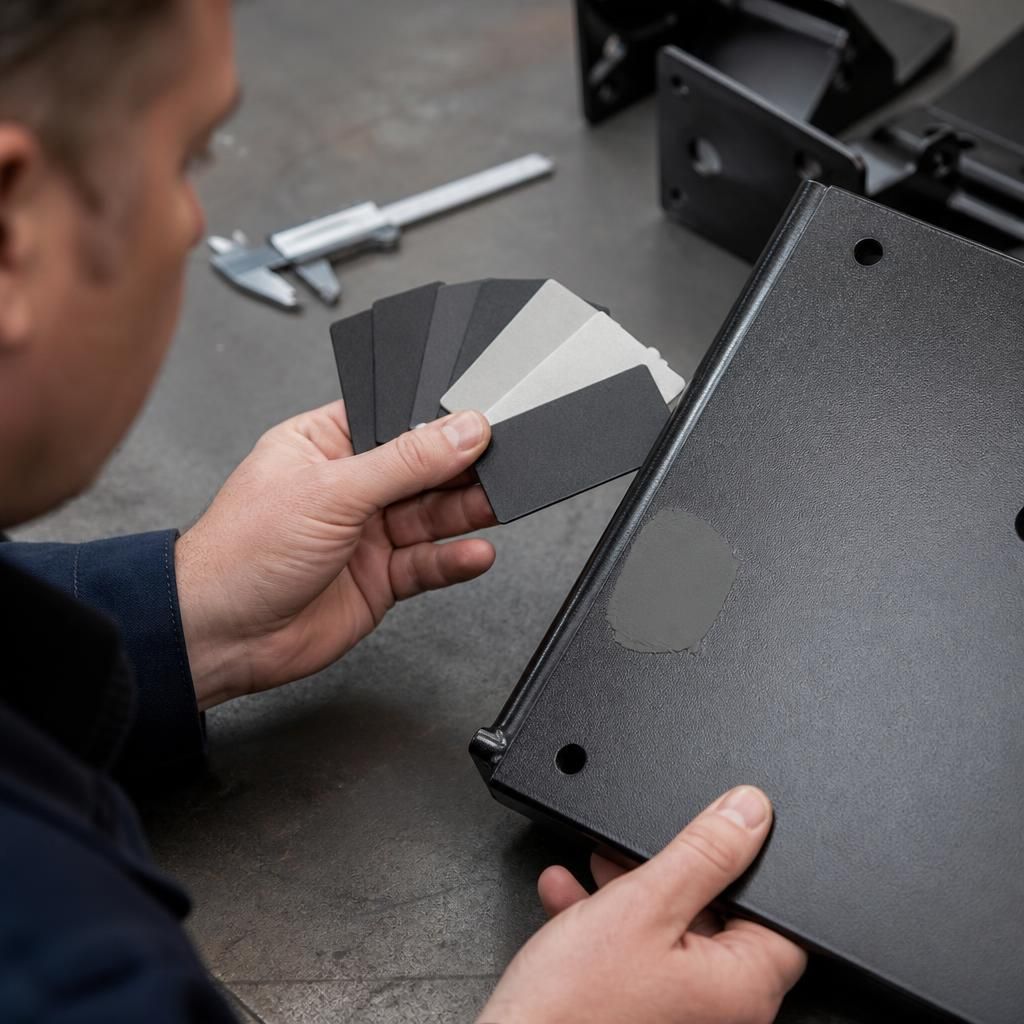
The repair material for a nylon coating should be selected for the component’s service conditions, not solely for a close colour match. A finish exposed to sliding contact, repeated impact, cleaning chemicals or outdoor weathering may need different performance characteristics from one used on a protected internal component.
Before repair, the required properties should be identified and compared with the proposed material, including flexibility, abrasion resistance, chemical resistance, surface friction and operating temperature. This prevents a visually acceptable patch from failing because it cannot withstand the conditions affecting the original coating.
Discuss Your Nylon Coating Repair Requirements
Discuss your nylon coating repair requirements with the Midlands powder-coating specialists, providing details of the component, existing finish, damage and service conditions. This information helps determine whether a local repair or wider recoating assessment is appropriate.