

What measures do nylon coating suppliers in the Midlands take to ensure their coatings provide optimal performance under diverse environmental conditions?
Nylon coating suppliers in the Midlands optimise performance by matching the nylon formulation, coating thickness and application method to the component’s environment and intended use. They control surface preparation and curing, then assess the finish against relevant stresses such as moisture, UV exposure, chemicals, abrasion and temperature changes before approving it for production.
Nylon coating suppliers support reliable performance in varied environments by treating the coating as part of a specified protection system rather than as a standard finish applied in the same way to every component. They establish the service conditions, review the component’s design and material, define acceptance requirements, and retain production records so that the finished coating remains suitable for its intended use.
The first measure is to obtain a clear operating brief. Relevant information includes whether the part will be used indoors or outdoors, exposed to standing water or condensation, cleaned with chemicals, handled frequently, or placed near contaminants such as road salt, oils or industrial residues. Suppliers also need to understand whether the component will experience intermittent exposure or continuous immersion, and whether appearance, electrical insulation, low friction or impact resistance is the main priority. These details help prevent a coating being selected solely on colour or initial appearance.
Component design is reviewed because geometry can affect environmental protection. Sharp edges, recesses, overlapping sections, threaded areas and drainage points can create weak areas or make it difficult to achieve consistent coverage. A supplier may identify these risks before processing and advise on suitable masking, racking or design adjustments. Drainage is particularly important for outdoor or wash-down applications: water trapped in a hollow section or joint can undermine protection even when the accessible surfaces are correctly coated.
Suppliers also separate the performance of the nylon layer from the condition of the underlying metal. Corrosion resistance depends on the complete system, including the substrate, preparation, any pre-treatment and the coating itself. The condition of incoming parts is therefore checked for rust, mill scale, oil, weld residue, previous finishes and other contamination. Where a component has been repaired, welded or previously coated, those areas may require particular attention because differences in surface condition can affect adhesion and long-term protection.
Control of the production environment is another important safeguard. Temperature, humidity, contamination and handling practices can influence the result before and after coating. Parts should be stored and moved in a way that avoids renewed contamination or mechanical damage, while masking materials must remain secure where bores, threads, contact points or identification surfaces must be kept clear. Correct racking also helps limit contact marks and allows the coating system to reach the required areas without creating avoidable defects.
For demanding applications, suppliers can use representative samples or trial components to confirm that the proposed system is compatible with the part and its use. This is useful where the design is complex, the substrate is unusual, the finish will be exposed to a particular cleaning agent, or the component will combine several environmental stresses. A trial can reveal issues such as unwanted build-up in recesses, interference with assembly, changes in surface texture or inadequate access to protected areas before full production begins.
Performance requirements should be agreed in measurable terms rather than described only as “durable”. Depending on the application, the specification may address:
- adhesion after the coating has been applied and exposed to the intended conditions;
- resistance to impact, flexing, scratching or repeated contact;
- protection of edges, seams, welds and recessed features;
- colour and gloss retention where appearance is functionally important;
- compatibility with lubricants, detergents, fuels or other process chemicals; and
- limits on coating build in areas that must be assembled or electrically connected.
Inspection is normally carried out at several stages rather than only at final dispatch. Visual checks can identify runs, pinholes, inclusions, bare areas, blistering or damage from handling. Instrument checks may be used where appropriate to verify coating build and surface uniformity, while adhesion or other performance checks can be arranged against the agreed specification. The method selected should reflect the component’s real duty; a test that is relevant to a dry indoor part may not provide enough information for a part exposed to moisture, chemicals or repeated abrasion.
Traceability provides further protection against inconsistent results. Recording the incoming condition of the parts, preparation route, coating material, processing parameters, inspection findings and any corrective action allows unusual results to be investigated. It also helps identify whether a problem originates in the substrate, the coating process, assembly or the operating environment, rather than assuming that every failure is caused by the nylon finish.
Finally, suppliers should provide practical guidance on installation, storage and maintenance. Coated parts can be damaged by unsuitable lifting equipment, aggressive cleaning methods, incompatible sealants or cutting and drilling after coating. Protecting the finish during transport, using appropriate cleaning products and repairing local damage according to the agreed method all help preserve the protection delivered by the coating system. Collection and delivery arrangements can also be planned around suitable packaging and handling, reducing the risk that a correctly processed component is compromised before it reaches the customer.
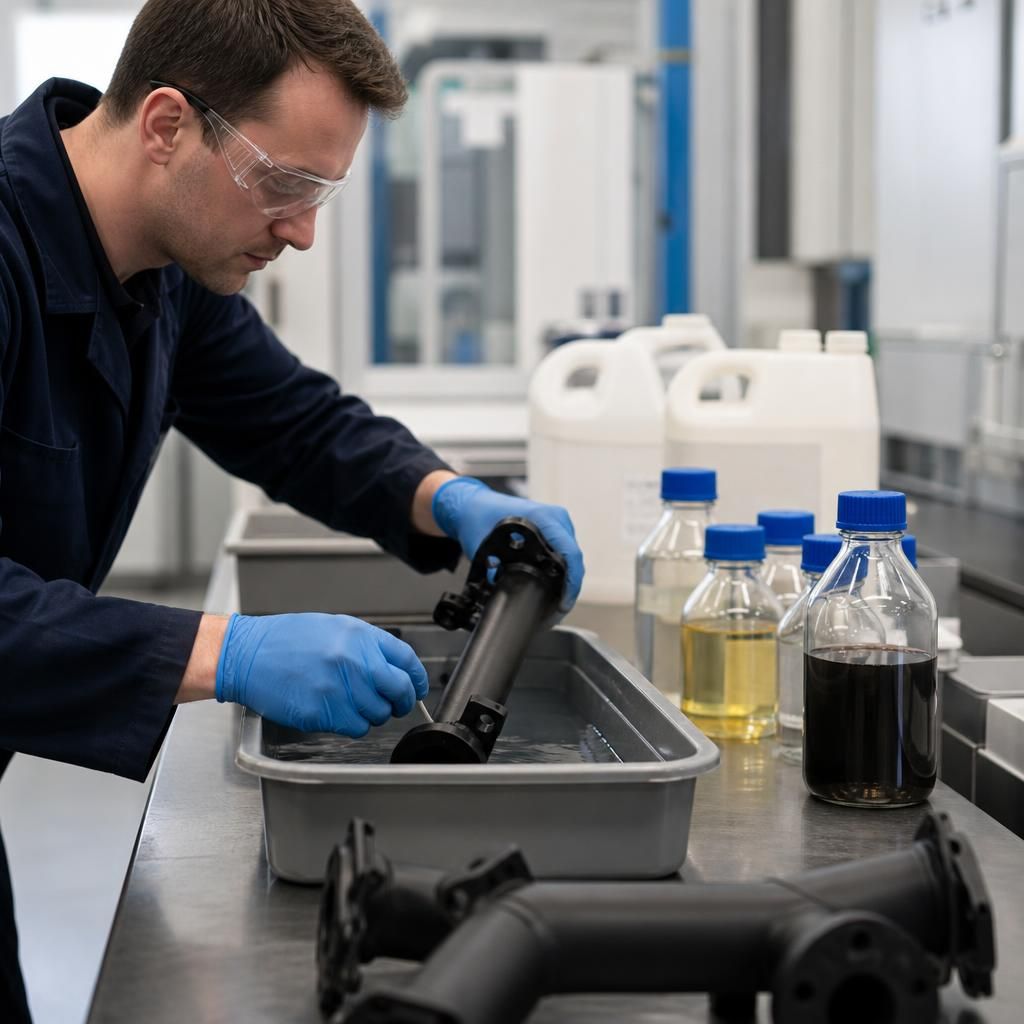
Chemical exposure is assessed against the conditions the coated component will actually encounter, rather than through a general claim of chemical resistance. A nylon coating supplier may review the substance involved, its concentration, contact time, temperature and whether exposure is occasional splashing, repeated cleaning or prolonged immersion. These factors can produce different results, even when the same chemical is involved.
Representative coated samples can then be exposed to the relevant cleaning agents, oils, fuels or process fluids and examined for softening, swelling, staining, loss of adhesion or changes in surface condition. This evidence helps determine whether the selected nylon formulation and coating build are suitable, or whether the application requires a different specification and additional protection.