

How do stainless steel high temp powder coatings enhance resistance to thermal cycling in industrial components?
Stainless steel high temp powder coatings enhance resistance to thermal cycling by forming a durable protective layer that accommodates repeated expansion and contraction as component temperatures change. When the coating is correctly formulated, applied and cured, it helps reduce cracking, flaking and loss of adhesion, preserving protection and finish integrity through repeated heating and cooling.
Stainless steel high temperature powder coatings improve thermal-cycling resistance by maintaining a stable bond and protective barrier as a component passes repeatedly between lower and higher operating temperatures. Their performance depends on more than the powder itself: the formulation, stainless steel preparation, coating thickness, curing conditions, component design and temperature profile must all be suited to the application.
Thermal cycling creates mechanical stress because the steel substrate and coating expand and contract as temperatures change. If the coating cannot accommodate this movement, stress can accumulate at the interface or within the film. Repeated cycles may then produce hairline cracking, edge lifting, blistering or delamination. A coating selected for high-temperature service is formulated to retain its cohesion and adhesion over the intended temperature range, reducing the likelihood that these defects will develop prematurely.
Several features influence how well the coating tolerates this movement:
- Binder and resin chemistry: The resin system determines how the film responds to heat, cooling and repeated exposure. A suitable high-temperature formulation should resist softening, embrittlement and degradation at the component’s actual operating temperature.
- Film flexibility: Some ability to accommodate dimensional movement is important, particularly where the component experiences frequent changes rather than one stable elevated temperature. Excessive hardness without sufficient tolerance for movement can make a film more vulnerable to cracking.
- Adhesion to stainless steel: A sound bond distributes thermal stress across the interface. Contamination, inadequate keying or unsuitable pretreatment can create weak areas that become starting points for lifting during cycling.
- Coating thickness: An excessively heavy or uneven film can retain greater internal stress and may cure inconsistently. Controlled application helps produce a more uniform layer, including around edges, corners and transitions.
Stainless steel requires particular attention during preparation because its smooth, corrosion-resistant surface does not automatically provide an ideal key for powder coating. Cleaning must remove oil, grease, salts and other residues, while an appropriate mechanical or chemical pretreatment can improve surface compatibility. The preparation method must be selected for the grade and condition of the stainless steel; aggressive treatment that damages the substrate or leaves residues may create later problems rather than improve adhesion.
Curing is equally important. The coating needs to reach the specified metal temperature for the required period so that the resin develops its intended properties throughout the film. Under-curing can leave a coating with inadequate cohesion or adhesion, while excessive heat can alter the finish or damage the substrate, seals or adjacent materials. For components with substantial variation in section thickness, the curing process should account for how quickly different areas reach temperature.
Component geometry also affects thermal-cycle performance. Sharp corners, holes, welds, folded sections and abrupt changes in thickness can concentrate stress or receive less consistent coverage. Weld-cleaning and removal of surface contaminants are therefore important before coating. Where practical, edges should be prepared to support an even film, and masking should protect mating surfaces or areas that must remain free of coating.
The thermal profile in service matters as much as the peak temperature. Rapid heating can create temperature differences between the outer surface and the cooler interior, while rapid cooling can impose the reverse gradient. Large or thick parts may therefore experience more severe local stress than smaller components exposed to the same air temperature. Repeated exposure to moisture, chemicals or corrosive deposits can compound the effect if a thermal movement creates a pathway through the film.
Assessment should reflect the intended duty rather than relying only on a general high-temperature description. Consider the normal and maximum metal temperatures, cycle frequency, heating and cooling rates, dwell periods, atmosphere, cleaning chemicals and any mechanical vibration. The selected coating should then be validated on representative stainless steel, with attention to adhesion, visible cracking, blistering, colour or gloss change and corrosion at any damaged areas after cycling.
In practice, a durable result comes from matching the complete coating system to the service conditions. Powder coating can provide a robust protective finish for stainless steel components exposed to repeated heat changes, but thermal-cycle resistance is not an unlimited property: it is governed by the specified formulation, application quality and the stresses imposed by the finished component’s design and operating environment.
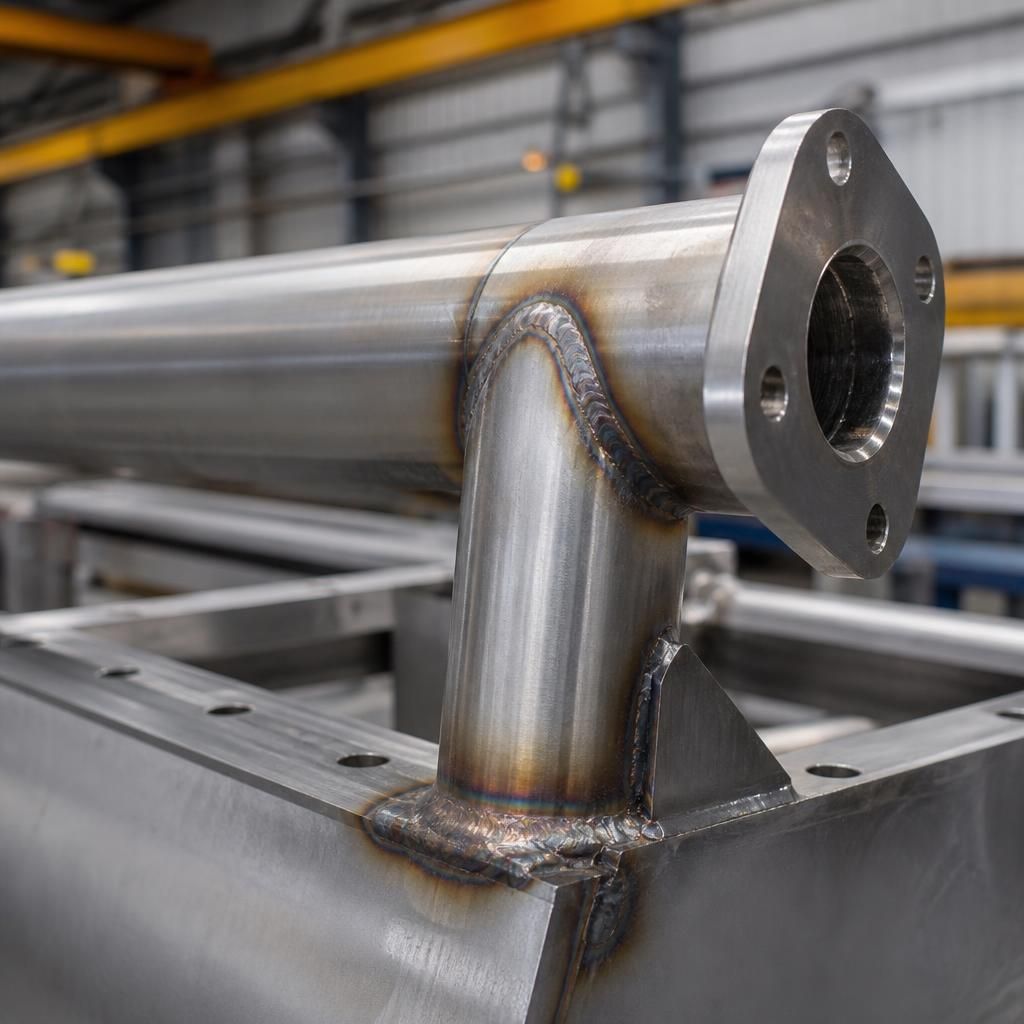
Thermal-cycle resistance cannot compensate for movement or distortion in the stainless steel component itself. Welds, restrained joints and thin sections may change shape as temperature varies, imposing additional strain on the coating. If that movement exceeds the film’s flexibility, the coating may lose continuity even when the operating temperature remains within its stated range.
For this reason, the coating assessment should consider the component’s mechanical behaviour as well as its heat exposure. Parts with significant welded areas, fixed mounting points or mixed section thicknesses benefit from a review of how they move during heating and cooling. This helps determine whether the coating specification is suitable for the complete component rather than the stainless steel surface alone.
Discuss Your Thermal Cycling Requirements
Discuss your component’s thermal cycling requirements with the Powder-coatings.co.uk team to assess the most suitable stainless steel high-temperature coating specification. Share details of the operating temperatures, cycle conditions and component design for an informed coating recommendation.