

What are the environmental considerations and safety regulations associated with the application of high temp powder coatings in industrial settings?
High temperature powder coating can reduce solvent-related emissions, but industrial application still requires control of airborne powder, overspray, curing emissions, energy use and coating waste through suitable extraction, recovery and disposal procedures. In the UK, operators should assess risks under COSHH and, where relevant, DSEAR and workplace equipment requirements, supported by adequate ventilation, dust-explosion controls, safe curing-oven operation, training and appropriate personal protective equipment.
Environmental and safety compliance for high temperature powder coating depends on controlling the complete process, from powder selection and substrate preparation to curing, storage, maintenance and waste disposal. The coating must be assessed not only for its performance at the component’s service temperature, but also for the substances it contains, the products it may release when overheated and the risks created by the equipment used to apply and cure it.
Assess the coating before it enters production
The technical data sheet and safety data sheet should be reviewed before a high temperature powder is approved. Important information includes the recommended application conditions, curing profile, storage requirements, classification, ingredients of concern and any decomposition products identified by the manufacturer. A coating that is stable at its specified operating temperature may behave differently if a component is exposed to a higher temperature, prolonged overheating or repeated thermal cycling.
UK chemical controls are relevant to the powder, primers, pre-treatment products, cleaning agents and any other substances used alongside it. Products supplied in Great Britain must be managed in line with the applicable UK REACH and GB CLP requirements; supply chains involving Northern Ireland may involve different arrangements. The classification on the current safety data sheet should guide the risk assessment, storage arrangements, labelling and emergency instructions.
Consider the whole environmental footprint
Powder coating is often selected because it can avoid much of the solvent content associated with conventional liquid coatings, but that does not make the process environmentally neutral. A meaningful assessment should consider:
- the composition and classification of the powder and pre-treatment chemicals;
- the electricity or other energy required for curing and associated plant;
- the quantity of unused, contaminated or off-specification powder generated;
- waste from filters, booth cleaning, masking materials, abrasive preparation and chemical treatment;
- the risk of contamination entering drains, soil or surface water; and
- the expected service life of the finished component and the need for future stripping or recoating.
Product selection should therefore balance high-temperature performance with durability, repairability and end-of-life requirements. A coating that remains intact for the intended service conditions may reduce the need for replacement or repeated refinishing, but this should be established from the component’s actual operating environment rather than assumed from the coating description alone.
Meet environmental permitting and waste obligations
The scale and nature of a coating operation can determine whether environmental permitting or local authority controls apply. Businesses should establish whether their particular installation falls within a regulated coating activity and whether conditions apply to emissions, plant operation, monitoring or record keeping. Requirements can vary according to the process, materials and throughput, so the relevant regulator or competent environmental adviser should be consulted rather than relying on a generic classification.
Waste must be identified and handled under the waste hierarchy. Powder residues, contaminated filters, cleaning materials, chemical-treatment residues and rejected coated parts should not be sent for disposal until their classification has been confirmed. Some wastes may be hazardous, while others may not be; the decision depends on the material and contamination involved. Appropriate containers, storage controls, transfer documentation and authorised waste contractors are required where applicable. Waste transfer and consignment records should be retained in accordance with the relevant UK requirements.
Wash water, pre-treatment solutions and cleaning residues require particular care. They should not be discharged to a foul or surface-water drain unless the discharge is expressly permitted. Bunding, sealed working areas, spill kits and a documented spill response procedure help protect drainage systems and nearby land. Staff should know how to isolate a spill, prevent it spreading and report it internally.
Apply machinery and workplace safety controls
The oven, conveyor, spray equipment, recovery equipment and associated handling systems should be assessed as work equipment. Under the Provision and Use of Work Equipment Regulations, equipment should be suitable, maintained, inspected where necessary and operated by people with appropriate information and instruction. Guards, interlocks, emergency stops and access arrangements should be tested rather than treated as permanent safeguards.
High temperature applications create hazards beyond the powder itself. Components, racks, oven surfaces and nearby fixtures can remain hot after the process has stopped. Controls should address burns, heat exposure, handling of heavy or awkward parts, unexpected movement of conveyors and access during maintenance. Isolation procedures should cover electrical, mechanical, thermal and stored energy before cleaning, adjustment or repair. Electrical installations and equipment must also be maintained in accordance with the Electricity at Work Regulations where those requirements apply.
Storage areas should keep powder and associated chemicals in their original, clearly identified containers and protect them from conditions that could damage packaging or alter product quality. Stock rotation, segregation of incompatible materials and control of ignition sources are sensible safeguards. Damaged containers, spills and unidentified powders should be quarantined until their contents and disposal route are established.
Control changes, overheating and abnormal conditions
High temperature coating lines should have defined operating limits for powder application, curing temperature, dwell time and component loading. A change of powder, substrate, pre-treatment, oven setting or recovery arrangement can alter both coating performance and risk. Changes should be reviewed before production, with updated instructions and safety information where necessary.
Overheating, smoke, unusual odour, discolouration or a failed temperature control should be treated as an abnormal event, not simply a quality defect. Operators need clear instructions for stopping the process, isolating equipment, restricting access and escalating the incident. The response should reflect the decomposition information in the safety data sheet and the site’s fire and emergency procedures. Fire detection, extinguishing arrangements and emergency access should be suitable for the equipment and materials present.
Keep evidence that controls are working
Good compliance is supported by documented assessments, equipment inspections, maintenance records, training records, waste documentation, incident reports and reviews of safety data sheets. Environmental checks should be proportionate to the permitted process and site risks, while workplace inspections can identify damaged containers, defective guards, poor housekeeping or incorrect waste segregation before they cause harm.
For a manufacturer, fabricator or other industrial user commissioning high temperature powder coating, useful questions include whether the coater can identify the selected powder and its safety information, explain the treatment and waste route, demonstrate control of the curing equipment and provide evidence that the finished coating is suitable for the specified thermal conditions. Those checks help distinguish a coating that merely tolerates high temperature in theory from a process that is properly controlled in industrial use.
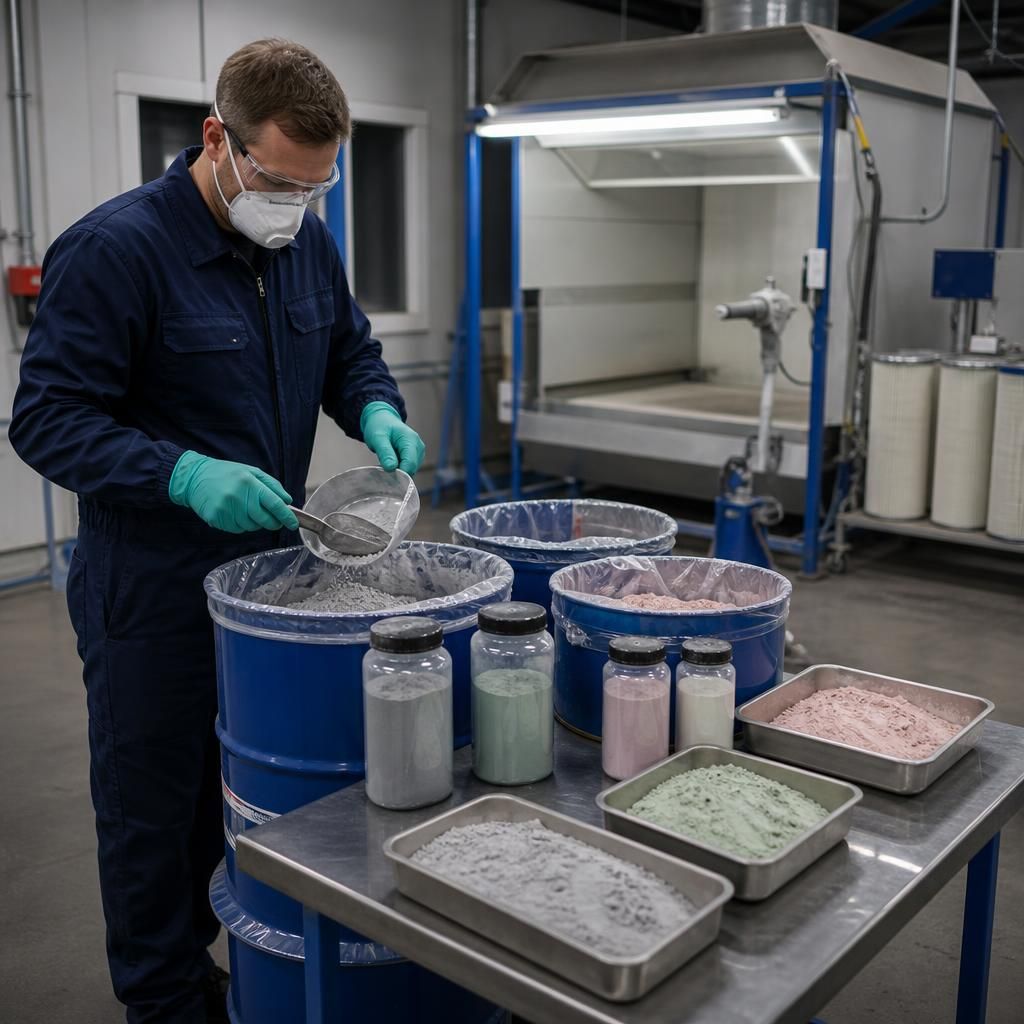
Powder recovery can reduce material waste, but recovered material should only be reused where the coating supplier’s process guidance and the site’s quality controls allow it. Powder collected from extraction or booth systems may contain mixed colours, overspray, pre-treatment residues or other contaminants. Reusing unsuitable material can affect coating performance and create an uncontrolled waste stream.
Recovered and unused powders should therefore be clearly identified and kept in closed, suitable containers. Separate collection routes for different powders, routine inspection of recovery equipment and documented decisions on reuse or disposal help prevent cross-contamination. Powder that cannot be reliably identified or is contaminated should be treated according to its confirmed waste classification rather than returned to production.
Discuss Your High Temp Powder Coating Requirements
Discuss your high temp powder coating requirements with our team, including the metal substrate, operating temperatures and component specifications. We can help you identify the information needed to assess a suitable coating process for your industrial application.