

What are the key environmental and cost benefits of using polyester powder coating in large-scale industrial projects?
Polyester powder coating can reduce environmental impact by avoiding solvent-based application and limiting volatile organic compound emissions, while excess powder may be reclaimable in a controlled production system. For large-scale projects, its durable finish can lower whole-life costs by reducing recoating, maintenance and replacement requirements, with efficient batch processing also helping to control application costs.
For large-scale industrial projects, polyester powder coating can provide environmental and cost benefits through efficient dry application, controlled material use, consistent production quality and a serviceable finish suited to many external metal applications. The overall benefit depends on the coating specification, pretreatment, curing process and quality controls used for the particular component.
Lower material and handling requirements
Polyester powder is supplied as a dry coating material rather than a liquid system containing a carrier. This can simplify storage and handling within a production environment, as there is less need to manage liquid coating containers, solvent residues or associated cleaning materials. In a high-volume operation, these practical differences can reduce the resources needed to move, store and manage coating materials.
The dry application process also allows coating thickness to be managed more precisely when the equipment and settings are correctly controlled. Avoiding excessive film build reduces unnecessary material consumption and helps the finished components meet the required specification without adding coating that provides no useful performance benefit.
Reduced production waste
Large projects often involve repeated runs of similar components. Standardising the polyester powder, colour, film build and curing parameters can make production more consistent and reduce the likelihood of parts being rejected because of avoidable coating defects. Fewer rejected components means less wasted metal, pretreatment chemicals, packaging and production time, as well as less need to repeat the coating process.
Waste reduction should not be assumed simply because powder coating is being used. Overspray controls, booth maintenance, correct gun settings and suitable housekeeping remain important. Where a production line has appropriate recovery equipment, collected powder may be managed within a controlled system, subject to the coating material and process requirements.
Energy use requires a balanced assessment
Powder coating requires a heated curing stage, so the environmental assessment should include the energy used by ovens, extraction systems and associated plant. Efficient loading, suitable oven maintenance and accurate cure schedules can help prevent energy being used to heat empty space or process parts for longer than necessary. Applying the correct cure schedule is also important because under-curing can lead to defective components, while unnecessary over-curing consumes additional energy and may affect the finish.
For a large-scale project, energy performance is therefore a process-management issue as well as a coating choice. The relevant assessment may consider the size and loading of the oven, the shape and mass of the components, the number of production stages and the source of the electricity or fuel used by the facility.
Whole-project cost control
The cost of a coated component is not limited to the powder or the application charge. It can also include preparation, masking, transport, inspection, handling, rectification and the consequences of late or rejected parts. A repeatable polyester powder coating process can help control these indirect costs by making the finish easier to specify, inspect and reproduce across a large batch.
Clear technical requirements are particularly important. The project specification should define the substrate, pretreatment, colour, gloss level, expected exposure, coating thickness, curing requirements and inspection criteria. Resolving these points before production reduces the risk of applying a finish that is unsuitable for the intended environment and then having to strip, rework or replace components.
Protection of the underlying metal
When correctly selected and applied, polyester powder coating forms a continuous protective layer over suitable metal surfaces. This can help limit the effects of moisture, weathering and general handling on the substrate. The resulting benefit is not simply an attractive appearance: maintaining the condition and usability of the component can support longer service planning and reduce disruption associated with premature remedial work.
However, polyester powder coating is not a substitute for correct design or preparation. Sharp edges, inaccessible joints, trapped moisture, contamination and inadequate pretreatment can create weak points regardless of the coating material. Addressing these issues at the design and preparation stages is essential if the anticipated environmental and financial benefits are to be achieved.
How to assess the benefit for a specific project
- Compare the required service environment with the performance of the selected polyester powder system.
- Assess material use, curing energy, recovery arrangements and waste handling across the complete production process.
- Include preparation, masking, inspection, transport, rework and installation when comparing project costs.
- Use representative sample parts or process trials where geometry, mass or substrate condition could affect curing and finish quality.
- Record the agreed specification so that repeat batches can be produced and inspected against the same requirements.
In practice, the strongest environmental and cost case comes from combining an appropriate polyester powder specification with disciplined preparation, controlled application and properly managed curing. The coating material contributes to the result, but process control determines how much of its potential benefit is realised on a large industrial project.
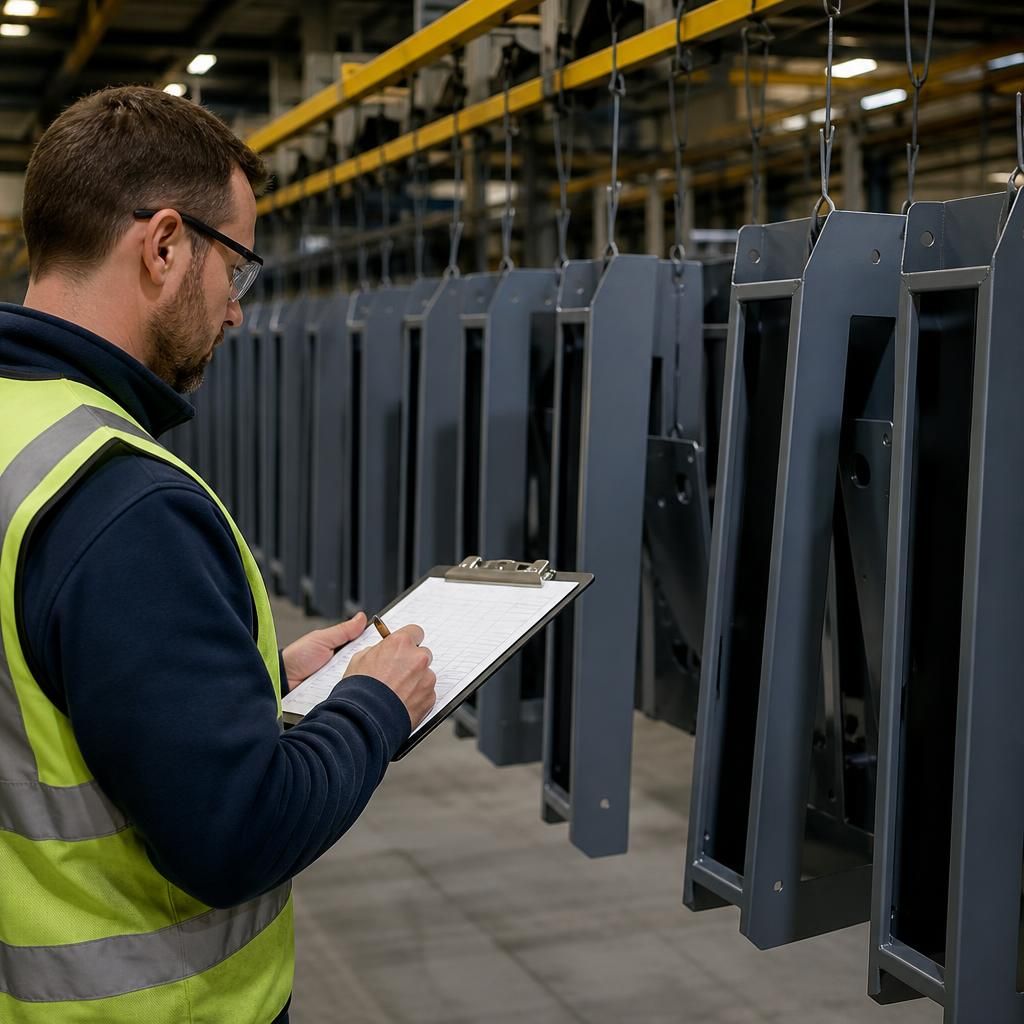
Production planning can add a further environmental and cost benefit by grouping components with compatible colours and finish requirements into organised runs. Fewer colour changes can reduce cleaning materials, contaminated powder and time spent preparing the equipment between batches. It can also make material usage easier to monitor, particularly where several component sizes are being processed for the same project.
This approach requires practical coordination between the project schedule and the coating specification. Components should be grouped only where their substrate, pretreatment and curing requirements are compatible; combining unsuitable parts could compromise quality. When planned correctly, run sequencing reduces avoidable process waste without changing the performance requirements of the polyester powder coating.