

How does the selection of matt or gloss black powder finishes impact the thermal performance of metal components in industrial environments?
Matt and gloss black powder finishes can influence a metal component’s radiant heat absorption and heat dissipation: matt black typically absorbs and emits more radiation, while gloss black reflects more incoming radiation and may reduce solar heat gain. The actual operating temperature is also strongly affected by the metal substrate, component geometry, airflow, insulation and surrounding heat sources, so finish selection should be assessed alongside the complete thermal design.
The thermal effect of a matt or gloss black powder finish is mainly a surface-level consideration: it changes how the component exchanges radiant heat with its surroundings, while the coating itself has limited influence on heat conduction through the metal. Consequently, the finish can affect surface temperature and cooling behaviour, but it should not be treated as a substitute for proper thermal design.
Radiation is only one part of the heat balance. A metal component may gain or lose heat through conduction into connected parts, convection to surrounding air, and radiation to nearby surfaces. Changing from matt to gloss therefore has the greatest practical significance where radiant heating or cooling is important. Examples include outdoor equipment exposed to sunlight, components positioned near furnaces or heated machinery, and enclosures that must release heat into a cooler environment.
In an enclosed assembly, the surrounding surfaces can be as important as the coating. A black-finished component facing a hot wall, roof or process vessel may receive substantial radiant heat even when the surrounding air temperature is relatively moderate. Conversely, a component with a clear view of cooler surroundings may lose heat by radiation more readily. The finish should therefore be assessed in relation to the component’s orientation, surroundings and operating cycle rather than by colour and sheen alone.
Surface temperature and internal temperature are not always the same. A thin bracket, panel or guard may respond quickly to changes in radiant exposure, whereas a substantial fabricated part may retain heat because of its mass. The temperature at the coating surface can also differ from the temperature at a bearing seat, threaded section, weld or internal interface. Where thermal limits apply to a fitted component, the design assessment should identify the critical location instead of relying solely on the apparent temperature of the coated exterior.
The coating’s thickness and the metal beneath it can influence how quickly heat moves from the surface into the component. In most powder-coated metalwork, the substrate remains the dominant thermal conductor, but the coating introduces an additional surface layer. This may be relevant for small parts, thin sheet, precision assemblies or components where a small temperature difference affects clearances, seals or electrical performance. The coating specification should be considered alongside the substrate material, thickness and any insulation or air gaps.
Gloss level is not a complete description of thermal behaviour. Two finishes that are both described as matt or gloss may use different powder formulations, pigments, textures and film characteristics. Their radiative properties may therefore differ. A textured matt surface can also have a different effective surface structure from a smooth matt surface, although visual appearance alone cannot reliably quantify its thermal performance. If the operating temperature is critical, obtain relevant technical data for the proposed coating system or validate the finished part under representative conditions.
Thermal expansion should also be considered when coated components are joined to other materials. Metal expands and contracts as its temperature changes, and repeated cycling can place stress on fasteners, inserts, seals, bonded interfaces and dissimilar-metal joints. The matt or gloss choice does not remove these effects. It may, however, contribute to a different surface temperature under the same radiant exposure, so the expected temperature range should be checked wherever dimensional stability or joint integrity matters.
For electrical enclosures and equipment housings, the finish should be evaluated as part of the complete heat-management arrangement. Ventilation, fin design, fans, mounting clearances and internal heat sources generally have a greater effect on the removal of conducted and convected heat than the visible sheen of the coating. A darker finish may be selected for appearance or corrosion protection, but the enclosure still requires adequate thermal capacity and airflow for its equipment load.
A practical selection process includes:
- Identifying whether the principal heat source is sunlight, nearby hot equipment, internal electrical components, friction or conduction from another assembly.
- Determining the temperatures permitted at the coating surface, substrate, fixings and any temperature-sensitive adjacent parts.
- Reviewing the component’s mass, geometry, orientation, ventilation and contact with other materials.
- Comparing the proposed coating’s technical information rather than assuming that every matt or gloss black product behaves identically.
- Considering thermal cycling, expansion and contraction where the component is part of a precision, sealed or mechanically loaded assembly.
- Using a prototype or representative sample for measurement when the thermal margin is small or the component operates near a specified limit.
For routine metalwork with no narrow thermal operating range, the choice between matt and gloss black is often governed primarily by appearance, cleaning requirements, surface texture and the intended environment. Where heat absorption, heat rejection or dimensional stability is important, the finish should be specified with the metal grade, coating system and wider thermal design. A powder-coating specialist can use the component drawings, material details and operating conditions to identify whether a standard matt or gloss finish is suitable or whether further technical evaluation is needed.
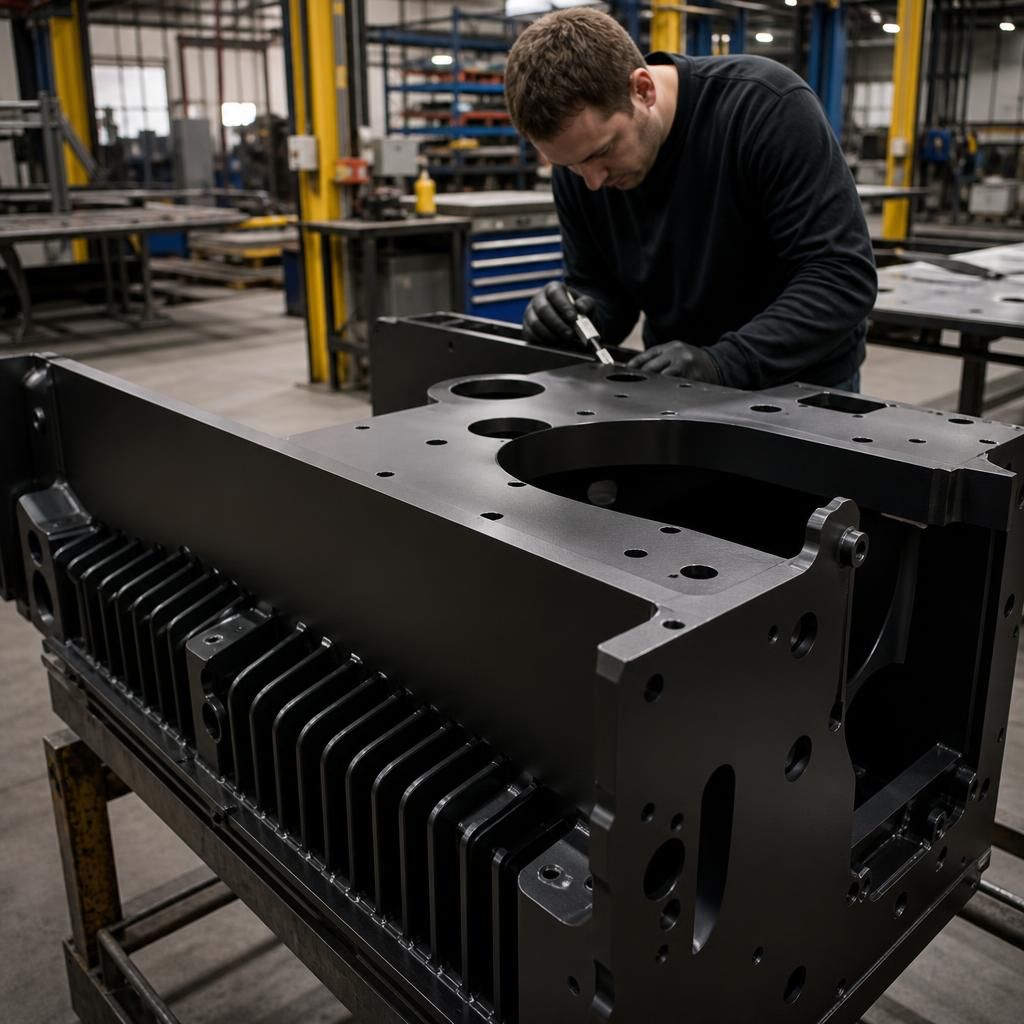
Thermal behaviour is better assessed using radiative properties than visual gloss level alone. Solar absorptance indicates how much short-wave radiation a finish takes in, while thermal emittance indicates how effectively a warm surface releases long-wave radiation. These properties can differ between coating formulations that appear similarly matt or gloss, so a visual sample is not a reliable thermal specification.
For components exposed to sunlight or radiant process heat, request the coating system’s relevant absorptance and emittance data, including the proposed colour, texture and film specification. Where the thermal margin is limited, compare those values with the component’s orientation, surrounding surfaces and expected operating temperatures before approving the finish.