

What advanced technologies or innovations are integrated into modern UV and high-performance powder coatings to enhance their protective capabilities?
Modern UV and high-performance powder coatings combine weather-resistant resin chemistry with UV stabilisers, durable pigments and specialist additives that help limit colour fading, chalking, moisture ingress and surface degradation. Some formulations also use enhanced cross-linking and barrier technologies to improve adhesion, chemical resistance and long-term protection of coated metal in demanding outdoor or industrial environments.
Modern UV and high-performance powder coatings enhance protection through more than one formulation change: they combine engineered particles, functional layers, specialised curing systems and improved application controls. These technologies are designed to reduce pathways for water, salts, chemicals and abrasion while helping the coating retain its mechanical integrity in demanding service conditions.
Nanocomposite technology. Some advanced powders incorporate very fine inorganic particles into the coating matrix. When properly dispersed, these particles can increase hardness, wear resistance and barrier performance without creating obvious surface defects. They may also reduce the movement of moisture and corrosive substances through the cured film. The benefit depends heavily on particle compatibility, dispersion and film thickness; simply adding a nano-material does not automatically produce a better coating.
Functional primers and multi-layer systems. High-performance protection is increasingly specified as a coating system rather than a single decorative layer. A compatible primer can improve adhesion to prepared steel, aluminium or galvanised substrates and provide an additional barrier against corrosion. The topcoat then contributes weathering, colour retention, chemical resistance and cleanability. In particularly demanding applications, powder primer and powder topcoat systems can be selected to work together, provided the substrate preparation, curing schedule and intercoat compatibility have been verified.
Some systems use corrosion-inhibiting pigments or active particles in the primer. These can help limit corrosion at small defects or exposed edges, although they do not remove the need to prepare the metal correctly or repair substantial damage. The appropriate system depends on the substrate, expected exposure and whether the component will be exposed to salts, industrial chemicals, condensation or repeated wetting and drying.
Improved edge and recess protection. Innovations in powder formulation and application are also aimed at difficult geometries. Controlled particle size, better melt flow and improved transfer efficiency can help produce more consistent coverage around corners, folded sections and fabricated joints. Special attention is still needed around sharp edges, welds, drainage holes and crevices, because these areas are more vulnerable to thin films, trapped contaminants and early coating failure.
Low-temperature and rapid-curing chemistries. Newer curing systems can be engineered to form a strong film at lower metal temperatures or within a shorter controlled cure window than traditional formulations. This can reduce the thermal load on heat-sensitive components and help limit distortion. It also makes process control more important: the coating must receive sufficient heat throughout the part, not merely reach the correct temperature at the oven air sensor. Under-curing can leave reduced chemical and mechanical resistance, while excessive curing may affect appearance or long-term performance.
Thermoplastic and flexible powder technologies. Thermoplastic powders, including specialist nylon-based systems, form a continuous protective layer without the same cross-linking mechanism used by thermoset powders. They can be selected where impact resistance, flexibility, abrasion resistance, electrical insulation or resistance to particular chemicals is important. Their suitability must be assessed against ultraviolet exposure, operating temperature, dimensional tolerances and the required finish, as no single powder type performs equally well in every environment.
Specialist surface functions. Some high-performance coatings are developed with a specific secondary function, such as:
- enhanced resistance to abrasion from handling, friction or particulate contact;
- improved resistance to oils, fuels, cleaning agents or industrial chemicals;
- low-friction surfaces to reduce material build-up or ease cleaning;
- anti-static or electrically dissipative properties for selected industrial equipment; and
- flexible films that tolerate limited movement or impact better than a rigid decorative finish.
These features are application-specific. A coating described as chemical-resistant, for example, should be assessed against the actual chemical, concentration, temperature and duration of contact rather than treated as universally resistant.
Emerging self-repair approaches. Research and specialist development include coatings containing microcapsules or reversible polymer structures intended to respond to minor scratches or localised damage. Such technologies may help close very small defects or slow the spread of deterioration, but they should not be confused with a coating that can repair deep impact damage, exposed metal or poor preparation. They remain a specialist consideration rather than a universal feature of high-performance powder coating.
More precise application and verification. Protective capability depends on how a powder is applied as well as on its chemistry. Modern systems may use improved electrostatic control, automatic gun management and more consistent powder recovery to reduce variation across batches. Operators can verify film thickness, cure development, adhesion and surface condition using appropriate inspection methods. For outdoor or corrosive service, performance testing may include accelerated weathering, adhesion assessment, impact or abrasion testing, and corrosion testing selected to reflect the intended environment.
For a manufacturer, fabricator or construction business, the most useful specification is therefore based on service conditions rather than the phrase “high performance” alone. Identify the substrate, geometry, exposure, operating temperature, chemicals, cleaning regime, expected mechanical loading and required appearance. The coating supplier can then match the formulation, primer or topcoat arrangement, preparation method and curing process to the risk. Advanced technology improves the available protection, but correct system selection and controlled application remain essential to achieving it.
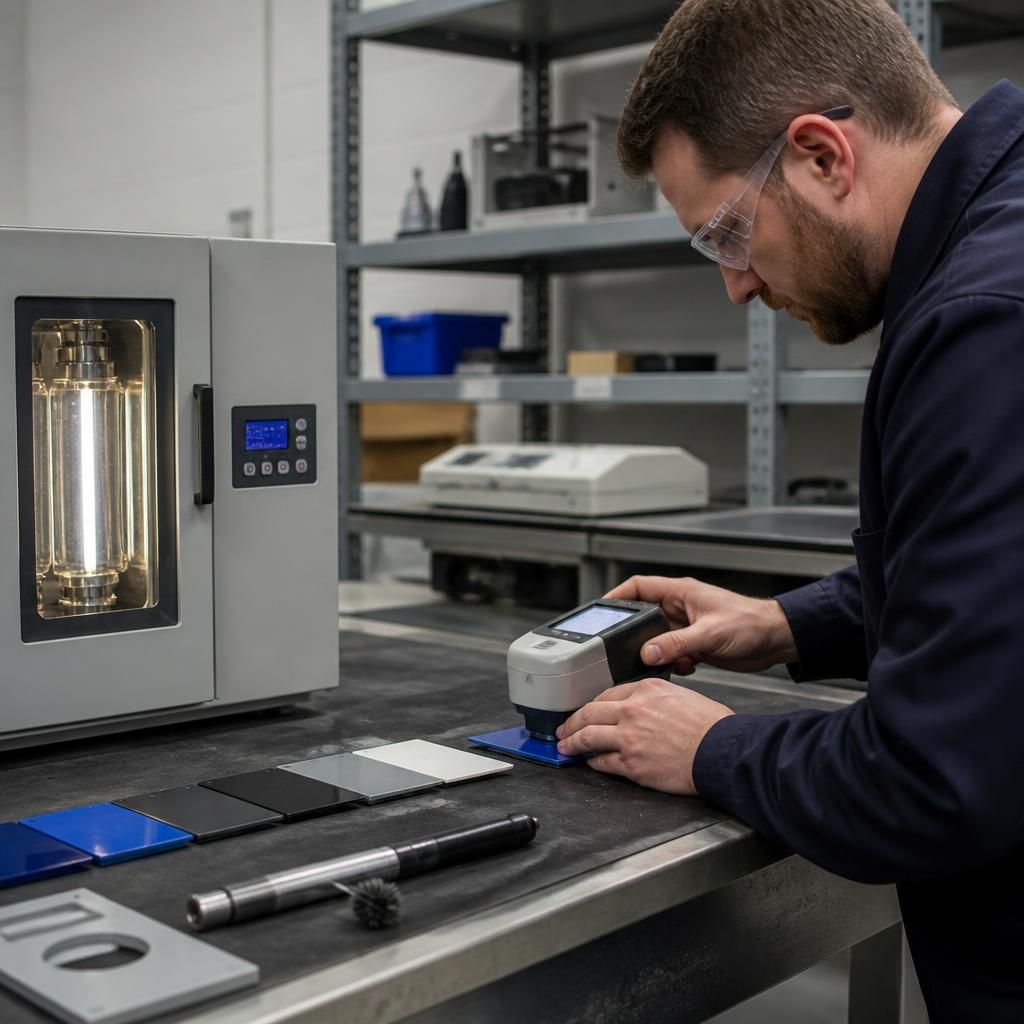
Performance testing is an important part of modern high-performance powder coating development. Controlled exposure tests can compare how formulations respond to ultraviolet radiation, moisture, temperature changes and corrosive conditions before a system is specified for a component.
Useful assessment goes beyond visual inspection. Colour and gloss measurements can identify early weathering, while adhesion, flexibility and impact checks show whether the film is likely to remain intact during handling and service. Test results should always be interpreted against the component’s actual exposure, because accelerated laboratory conditions provide comparative evidence rather than a guarantee of identical outdoor performance.
Discuss the Right UV and High-Performance Coating Technology
Discuss your component’s substrate, exposure conditions and performance requirements with the powder-coating.co.uk team to identify a suitable UV or high-performance coating system. Ask for guidance on the appropriate preparation, finish and specification before commissioning a production batch.