

What are the specific curing temperature and time requirements for the different thermoset powder coating types?
Thermoset powder coatings cure at temperatures and times set by their resin chemistry, with epoxy, polyester and hybrid powders each requiring the manufacturer’s specified metal temperature and dwell time. The correct cycle is measured at the component—not simply the oven display—and should be confirmed from the product technical data sheet and validated for the part’s size, thickness and loading.
The curing requirements for thermoset powder coatings are determined by the resin system and are normally specified as a combination of metal temperature and dwell time. As a general guide, many epoxy, polyester and epoxy-polyester hybrid powders cure at a component temperature of approximately 160–200°C for around 8–20 minutes. Polyurethane and acrylic systems commonly fall within a similar range, while fusion bonded epoxy may require a higher component temperature or a shorter, more tightly controlled cycle. The product technical data sheet remains the controlling specification for any production coating.
Typical requirements for the principal thermoset powder coating types are as follows:
- Epoxy powder coatings: commonly cure at approximately 180°C for 10 minutes, although some grades use lower-temperature cycles or alternative schedules such as a higher temperature for a shorter dwell. Epoxy is selected where corrosion resistance, chemical resistance and strong adhesion are important, but prolonged exposure to ultraviolet light can cause chalking or loss of appearance.
- Polyester powder coatings: often cure at approximately 180°C for 10 minutes, with some exterior-grade formulations specified for 160–200°C metal temperature and a corresponding change in dwell time. The correct polyester formulation and cure cycle are particularly important where colour retention, gloss and weathering performance are required.
- Epoxy-polyester hybrid powders: commonly use a cycle close to 180°C for 10 minutes. Their precise requirements vary according to the balance of epoxy and polyester resins, pigment package and intended application. Hybrids are generally used for interior components or applications where a combination of appearance and general protection is required.
- Polyurethane powders: typically cure within the broad 160–200°C range. The specified dwell time must be followed carefully because insufficient cure can affect hardness, adhesion and chemical resistance, while excessive heat can damage the finish or alter its appearance.
- Acrylic powder coatings: may use curing conditions around 180–200°C, often with a dwell period of approximately 10–20 minutes at the metal temperature. Acrylic systems can be more sensitive to contamination, surface preparation and overbaking, so the coating supplier’s process limits should be followed closely.
- Fusion bonded epoxy: generally uses a higher-temperature process than many general-purpose decorative powders, commonly involving a preheated component or controlled induction of heat followed by a relatively short period at the specified metal temperature. The required range can vary substantially between products and applications, particularly for thick steel sections, pipes and buried or immersed components.
These figures are indicative rather than universal recipes. A technical data sheet may provide several approved schedules, for example a lower temperature with a longer dwell or a higher temperature with a shorter dwell. Those alternatives are not interchangeable unless they are specifically stated by the powder manufacturer. The formulation, film thickness, substrate, part geometry and required performance all affect the valid curing window.
The most important measurement is the temperature of the metal surface, not the temperature shown on the oven controller. Dwell time normally begins when the coated component has reached the specified metal temperature. A large, heavy or densely loaded component can take considerably longer to heat through than a small bracket, even when both are placed in the same oven. Oven air temperature and conveyor speed therefore need to be set with the component’s heating curve in mind.
Parts with different wall thicknesses may need particular attention. Thin sections can reach curing temperature quickly and risk being overbaked while heavier sections are still heating. Complex fabrications can also have shaded areas, enclosed sections or joints that receive less effective heat transfer. Thermocouples or other temperature-recording equipment attached to representative locations can be used to establish the actual heat-up and dwell profile.
Under-curing leaves the resin system insufficiently cross-linked. Possible results include poor adhesion, reduced hardness, lower chemical resistance, weaker corrosion protection and a finish that remains softer than expected. Over-curing can cause yellowing, gloss variation, brittleness or other changes in appearance and performance. Excessive heat can also affect the substrate, seals, masking materials or previously applied coatings.
For a new component or coating specification, the appropriate process is to:
- Identify the exact powder formulation and obtain its technical data sheet.
- Confirm whether the stated schedule refers to metal temperature, oven air temperature or another test condition.
- Measure the heating rate and peak temperature at representative points on the actual component.
- Check that the complete surface receives the required dwell time at temperature.
- Verify the cured coating using suitable checks for the specification, such as appearance, film thickness, adhesion, hardness and resistance to the chemicals or environment expected in service.
Low-cure thermoset powders should not simply be substituted into a conventional cycle without recalculating the process. They are formulated to cross-link at a lower temperature or within a shorter cycle, but their permissible range is still product-specific. Similarly, increasing the oven temperature to compensate for slow heating may over-cure thin areas while failing to resolve an uneven heat profile.
For industrial batch work, the reliable curing schedule is therefore the one demonstrated on the actual part, load arrangement and coating system. The powder type provides the starting point, but the final process should be based on the supplier’s stated cure curve and verified metal-temperature measurements rather than on a nominal oven setting alone.
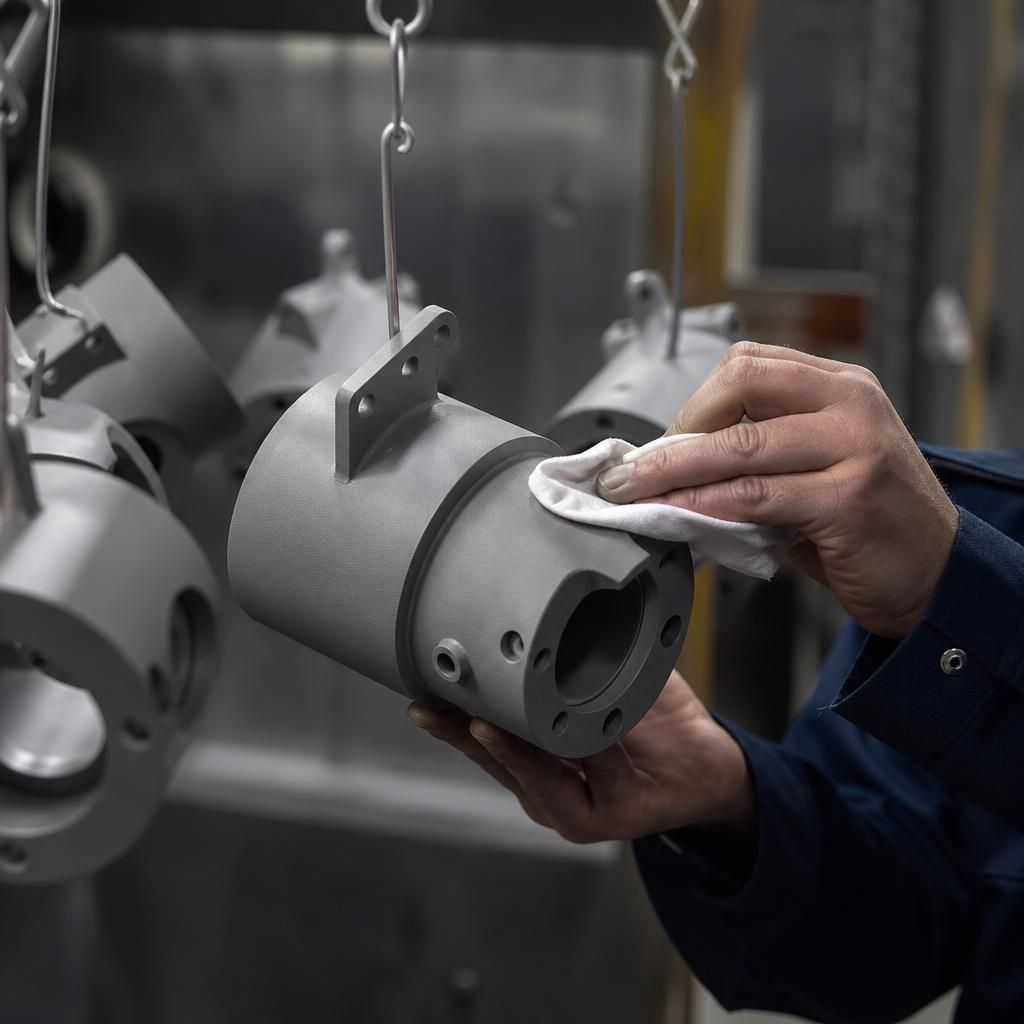
A cure check should assess cross-linking rather than relying on appearance alone. Where specified by the powder supplier or quality system, a solvent-rub test can provide a practical indication of whether the coating has cured sufficiently. The test method, solvent, rubbing action and acceptance criteria must be defined for the particular coating system; results from one powder should not be applied to another.
Use a representative coated sample or an accessible area of the production component, and record the result alongside the coating batch and process conditions. Gloss, colour and surface hardness can appear acceptable even when the resin has not reached its required cure, so they should support—not replace—the specified cure verification method.