

How does powder coating contribute to the resale value and longevity of automotive vehicles?
Powder coating helps protect automotive metal components from corrosion, abrasion and everyday wear, supporting longer service life and a well-maintained appearance. By preserving both the condition and presentation of parts such as wheels, brackets and chassis components, it can contribute to stronger resale value, although the vehicle’s overall condition and maintenance history remain important.
Powder coating can support a vehicle’s resale value and service life by maintaining the condition, function and consistency of its metal components. Its financial effect is indirect rather than guaranteed: a buyer is more likely to value a vehicle whose refurbished parts are sound, correctly finished and supported by clear maintenance records, but the coating cannot compensate for mechanical faults, accident damage or neglected servicing.
Longevity depends on more than the powder itself. A properly prepared component is cleaned and treated to remove contaminants, loose material and surface defects before the coating is applied and cured. This creates a bonded finish that is less likely to detach during normal use. If preparation is rushed, contamination remains or curing is incorrect, the coating may fail prematurely regardless of the powder specification.
The process can be particularly useful when restoring removable metal components rather than replacing them. Underbody hardware, brackets, guards, wheels and other ancillary parts may remain serviceable even when their original finish is damaged. Recoating these items can preserve the usable substrate and return a consistent finish without altering the underlying design. However, powder coating is not a structural repair: cracked, distorted, excessively thin or badly damaged parts should be assessed and repaired or replaced before coating.
For resale, consistency matters because mismatched or visibly deteriorated components can suggest uneven maintenance. A uniform finish across suitable parts may make the vehicle appear better cared for and can help prospective buyers assess its condition more easily. The coating should still be selected for the component’s location and duty. A finish suitable for an exposed wheel may not be appropriate for a part exposed to high temperatures, frequent impact, aggressive chemicals or continual movement.
Application details also affect whether the coating protects value over the longer term:
- Masking: Threads, bearing seats, electrical contact areas, machined faces and other critical interfaces must remain within their required dimensions.
- Coverage: The coating should reach the relevant faces and edges without creating heavy build-up where parts are assembled.
- Curing: The coating must reach the specified cure for the powder and the component, rather than being judged only by surface appearance.
- Part suitability: Heat-sensitive assemblies, rubber, plastics and components containing seals or electronics may need removal, alternative treatment or exclusion from the process.
- Inspection: Finished parts should be checked for missed areas, inclusions, poor adhesion, excessive film build and damage caused during handling.
These controls are important because a visually attractive finish can still cause problems if it interferes with assembly or conceals a defect. On parts with close tolerances, even a small increase in surface build can affect fit. A coating provider should therefore understand the part’s function, masking requirements, operating environment and any areas that must remain uncoated.
Ongoing care also influences service life. Powder-coated automotive parts should be cleaned with suitable products and inspected for chips, impact damage and signs of lifting, particularly where stones, road contamination or repeated contact are likely. Damage should be dealt with before it spreads into surrounding areas. Abrasive cleaning methods and unsuitable solvents can reduce the finish’s performance and appearance.
When a coated vehicle is sold, useful supporting information includes the parts treated, the preparation and coating specification where available, photographs taken before and after refurbishment, and records of any repairs carried out beforehand. This does not establish a higher value by itself, but it gives a buyer a clearer basis for judging the work and distinguishing cosmetic refinishing from a properly controlled component refurbishment.
In practice, the strongest contribution to resale value comes when powder coating forms part of a wider maintenance programme. Correctly selected and applied coatings can help retain usable metal parts, preserve a consistent standard of presentation and reduce the likelihood that finish-related deterioration will undermine the vehicle’s condition. The overall result still depends on the vehicle’s age, mileage, mechanical state, service history, accident history and the quality of the coating work.
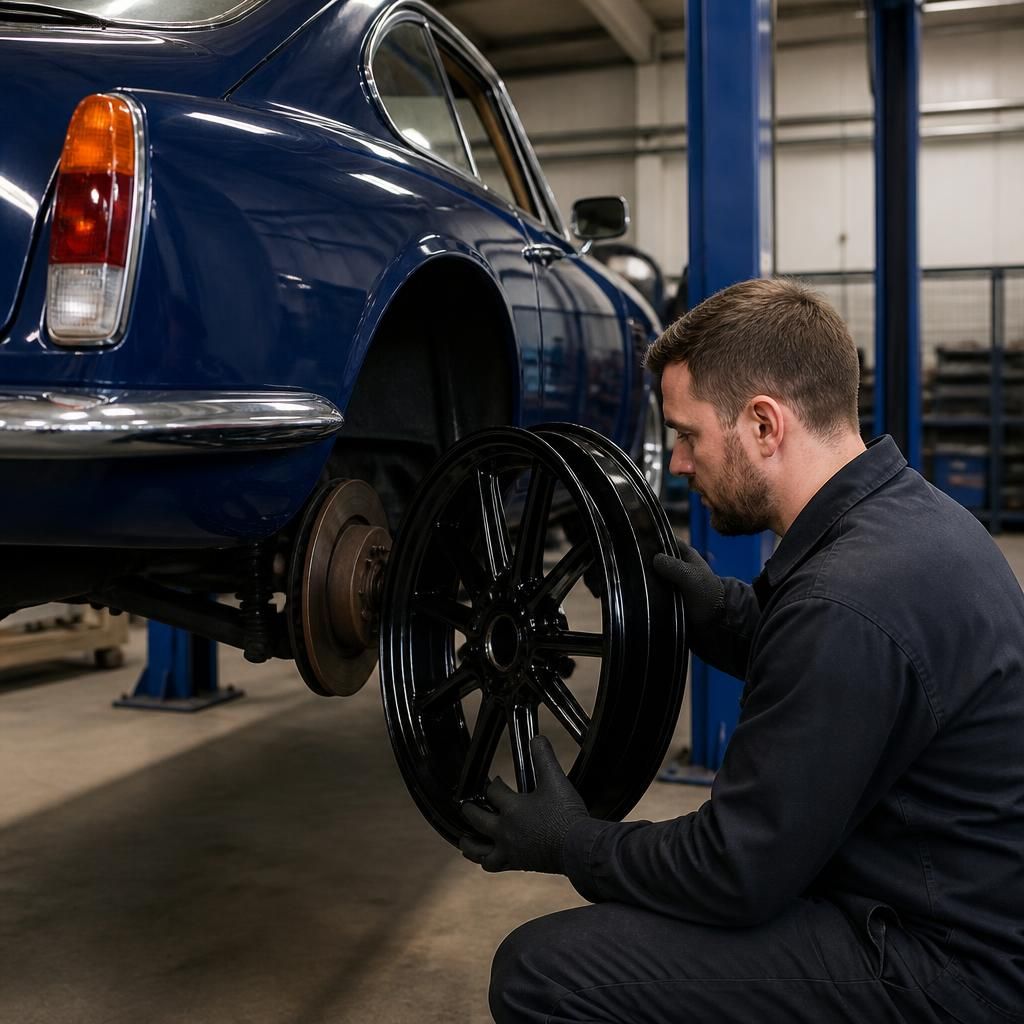
Powder coating contributes most to resale value when it preserves the vehicle’s intended specification rather than simply making individual parts look newer. Colour, gloss level and texture should be appropriate to the vehicle and the component, particularly on visible wheels, trim supports and restoration parts. An unsuitable finish may draw attention to refurbishment or make otherwise sound components appear inconsistent.
The coating should also remain compatible with future servicing. Parts that can be removed, inspected and refitted without damaging their interfaces are easier for a subsequent owner or technician to assess. This supports long-term usability and gives the finish practical value beyond appearance. In this sense, powder coating is best viewed as part of responsible vehicle preservation: it helps retain the condition and serviceability of suitable components while leaving the vehicle’s wider mechanical and historical condition to be judged separately.
Discuss Your Automotive Powder Coating Requirements
Discuss your automotive powder coating requirements with Powder-coatings.co.uk, including the component type, operating environment and any areas that must remain uncoated. This will help establish whether powder coating is suitable for the parts being considered.