

What are the benefits of using powder coating on steel versus traditional liquid paint methods?
Powder coating generally provides steel with a tougher, more uniform and longer-lasting finish than traditional liquid paint, offering improved resistance to chipping, scratching, corrosion and weathering. The dry application process also produces less overspray waste and avoids the solvent emissions associated with many liquid coatings, which can support more efficient and environmentally responsible production.
Powder coating is a dry finishing process in which electrically charged powder is applied to prepared steel and then heated until it melts and cures into a continuous film. Compared with traditional liquid paint, it can offer more consistent process control, quicker handling after curing, and a finish that is well suited to repeat production of steel components.
Key benefits of powder coating steel include:
- Consistent film formation: Powder is applied as a measured dry coating and fused during curing, which can produce an even appearance across a batch when the preparation, application and oven conditions are properly controlled. This is particularly useful where components must match one another in colour, gloss and texture.
- Efficient production handling: Once the powder has been correctly cured, the component does not need the same extended drying period associated with many liquid systems. This can simplify movement, packing and assembly within a manufacturing process, although the required cure schedule depends on the powder specification, steel thickness and component design.
- Good control of coating build: The application process allows the coater to manage the deposited film with the equipment settings, powder type and curing conditions. This helps when a project calls for a defined finish thickness, provided the specification is agreed before production and checked during quality control.
- Wide finish selection: Powder systems are available in different colours, gloss levels and surface effects, including smooth, textured and fine-textured finishes. This gives designers and manufacturers more choice than a basic painted finish while allowing components in the same project to be visually coordinated.
- Reduced use of liquid carriers: Powder is applied without the liquid carrier used in conventional wet paint. That changes the ventilation, storage and application requirements of the finishing operation and avoids waiting for a liquid film to evaporate before the part can proceed to the next stage.
- Suitable for repeatable batch work: Steel brackets, frames, panels, enclosures, fabricated parts and other components can be processed to an agreed specification across multiple production runs. Repeatability depends on consistent steel preparation, racking, powder application, oven temperature and part loading.
Powder coating is not automatically the best choice for every steel application. The component must normally tolerate the heat required for curing, and its size, mass and geometry affect how evenly it reaches the required temperature. Assemblies containing heat-sensitive materials, seals, adhesives or electronics may require masking, partial treatment or a different coating system.
Component design also matters. Recesses, narrow corners and enclosed areas can be harder to coat evenly because of electrostatic effects, while sharp edges, weld spatter, burrs and contamination can affect the final result. Appropriate cleaning and pre-treatment are therefore essential rather than optional. Liquid paint may be more practical for very large fixed structures, on-site work, heat-sensitive parts or situations requiring extensive colour changes and local touch-up.
Cost should be assessed across the whole process rather than by comparing the price of a tin of paint with a quantity of powder. Relevant factors include steel preparation, masking, racking, batch size, curing requirements, colour changes, inspection, rework and the expected maintenance cycle. Powder coating can be especially practical where components are produced in repeatable batches and can be transported to a suitable coating line.
For a fair comparison, the coating specification should define the steel grade or component type, preparation standard, required thickness, colour reference, gloss or texture, areas to remain uncoated and any performance requirements. It should also state how the finished work will be inspected. A specialist powder coater can then advise whether powder or liquid paint is more suitable for the component’s dimensions, operating environment and production method, rather than treating the two systems as interchangeable.
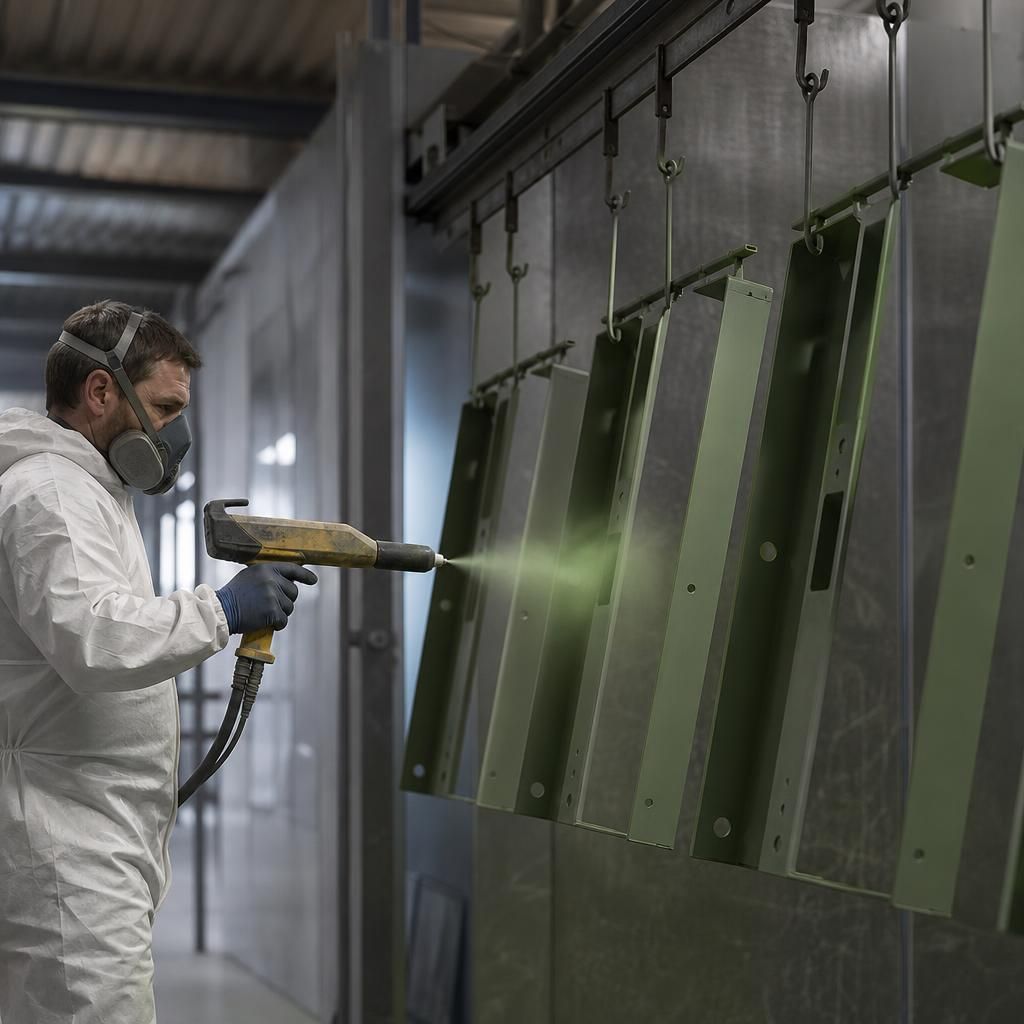
One important advantage of powder coating on steel is that the finish can be selected for the component’s operating environment rather than purely for appearance. Different powder formulations are available for applications exposed to outdoor weather, handling, abrasion or particular industrial conditions. The correct choice depends on the steel component, expected exposure and required performance, so a general-purpose decorative powder should not be treated as equivalent to a specialist protective system.
This makes the coating specification important when comparing powder with traditional liquid paint. The required finish should identify the environment, surface preparation, coating build and any resistance requirements before production begins. Matching the powder system to those conditions helps avoid choosing a finish that looks suitable but is not appropriate for the component’s service conditions.