

What innovations in powder coating technology can provide the most significant advantages for industries requiring high-speed, large-scale production?
The most significant innovations for high-speed, large-scale powder coating are automated conveyorised handling, advanced electrostatic application, efficient curing controls, powder recovery and digital process monitoring. Together, these technologies can improve throughput, transfer efficiency, finish consistency and material control while supporting repeatable production of large batches.
The powder coating innovations with the greatest potential for high-speed, large-scale production are faster-curing powder formulations, lower-temperature systems, UV-curable powders, improved film-formulation chemistry and more efficient colour-change arrangements. These developments can reduce cure time, broaden the range of suitable components, improve coating performance and limit disruption when production involves large volumes or several finish specifications.
Faster-curing and low-temperature powders are among the most practical developments for production lines. Conventional powders require a defined combination of metal temperature and time to achieve complete cure. Newer formulations are designed to reach their required chemical and mechanical properties more quickly, or at a lower substrate temperature. This can be particularly valuable where components have a high thermal mass, where heat-sensitive inserts are present, or where reducing the thermal load on the production process is important.
Low-temperature products should not be selected solely because their stated cure schedule appears shorter. The actual result depends on the part’s thickness, shape, loading pattern and the way heat reaches the metal. The specification should therefore be checked against the coldest area of the component, rather than the air temperature in the curing zone. Test panels and representative production parts can confirm adhesion, hardness, impact resistance and chemical resistance before a new powder is introduced at scale.
UV-curable powder coating is another specialised innovation. The powder is first melted to form a continuous film and is then cured using ultraviolet energy. Because the chemical curing stage can be rapid, this approach may suit high-throughput work involving relatively thin, accessible components. It can also reduce the time that some parts need to remain at elevated temperature.
UV systems have important limitations. The coating must receive sufficient UV exposure, so recessed areas, enclosed sections, deep profiles and shaded surfaces require careful assessment. The powder chemistry, lamp arrangement, line speed and component geometry all affect the result. For this reason, UV-curable powder is most useful where the product design and production route are compatible with the technology, rather than as a universal replacement for thermally cured powder.
Powder chemistry has also advanced in ways that improve performance at scale. Formulations can now be specified for particular requirements, including exterior durability, corrosion resistance, chemical exposure, edge coverage, flexibility or a defined appearance. A production engineer may therefore select a powder not only by colour and gloss, but also by the service environment and the forming, assembly or handling operations that follow coating.
For example, a component that will be bent after coating needs a finish with suitable flexibility and adhesion. A part used outdoors requires resistance to weathering and ultraviolet exposure. Components exposed to oils, cleaning agents or industrial chemicals need a compatible formulation. Matching the powder to the service conditions helps avoid rework and prevents a high-volume line from producing a large batch with an unsuitable finish.
Thin-film and high-build formulations can also provide production advantages when used for the right application. A thin-film powder may reduce material use and help preserve detail on accurately formed components, while a high-build or textured system may provide the coverage and appearance required on larger fabricated parts. These options must be applied within the manufacturer’s specified film range. Excessive thickness can affect appearance, curing and dimensional fit; insufficient thickness can reduce protection and coverage.
Specialist formulations can address difficult geometries and demanding environments, but they do not remove the need for sound preparation. Oils, oxides, mill scale and fabrication residues can interfere with adhesion regardless of how advanced the powder is. Effective pretreatment, appropriate rinsing and correct drying remain essential parts of a reliable high-volume process. The most advanced powder cannot compensate for contamination or poor surface condition.
Faster colour and product changeovers are another area of innovation for large production schedules. Modern booth layouts, powder feed arrangements and cleaning methods can be designed to minimise contamination when changing between colours or specifications. This is especially relevant where a manufacturer runs multiple batches rather than one continuous product. The benefit is not simply a shorter cleaning operation: a controlled changeover also reduces the risk of particles from a previous colour affecting the next finish.
Changeover design should be assessed alongside the production mix. A line producing a small number of high-volume finishes may favour a dedicated arrangement, whereas a jobbing operation may require greater flexibility. Components with different dimensions, hanging requirements or coating specifications may also need separate process settings. The most suitable arrangement is the one that balances throughput with the number of finish changes, cleaning requirements and acceptable levels of production interruption.
Improved application materials and coating specifications can support consistency across large batches. Powders are available in smooth, textured, matt, satin and gloss finishes, as well as specialist protective grades. Colour matching should be controlled using an agreed standard and checked under consistent viewing conditions. Where parts are manufactured in separate batches or at different times, the same product specification, substrate preparation and curing method should be retained to reduce visible variation.
Before adopting an innovation, businesses should compare the complete process rather than one isolated feature. Useful questions include:
- Can the powder achieve full cure at the required production rate and on the heaviest component?
- Will the formulation withstand the component’s service environment and any later forming or assembly?
- Are recessed areas, edges and internal surfaces adequately covered?
- Will a new finish create additional cleaning, storage or quality-control requirements?
- Can the coating specification be repeated across different batches and component sizes?
- Has the process been validated using representative parts rather than test panels alone?
For high-speed, large-scale production, the most effective innovation is usually the one that removes a specific constraint. A rapid-cure powder may address excessive dwell time; a low-temperature formulation may protect heat-sensitive components; a UV-curable system may suit accessible parts requiring a short curing stage; and a specialised formulation may improve durability or reduce defects in a demanding environment. Selection should be based on the part, substrate, finish specification and production sequence together.
Industrial coating specialists can help assess whether a newer powder technology is suitable for a particular batch process, especially where manufacturers or fabricators need to balance finish quality with repeatability. Trials, documented specifications and checks on complete cure provide a more reliable basis for investment than choosing a product solely because it is described as faster or more advanced.
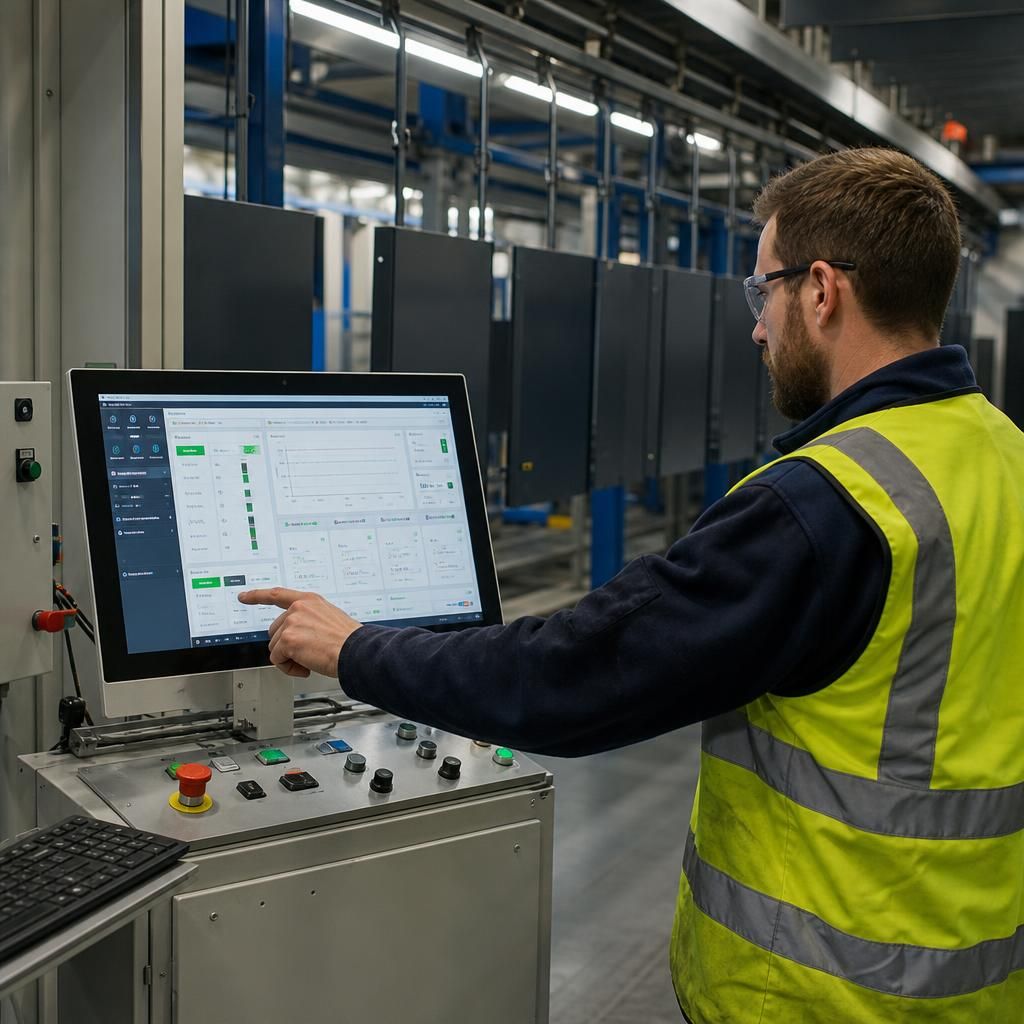
Digital process monitoring and recipe-based control are important innovations for high-speed powder coating because they help maintain the same application conditions throughout a large batch. Instead of relying solely on manual checks, sensors and control software can record process variables such as powder delivery, electrostatic settings, line speed and component temperature. A saved process recipe can then provide a consistent starting point when the same component or finish is produced again.
Inline inspection can identify process drift before it affects an entire production run. Coating thickness checks, visual inspection systems and recorded batch data can help trace variation to a particular stage of application. This supports faster investigation of defects, more controlled adjustments and clearer records for manufacturers supplying components into demanding industrial applications.
These systems are most effective when the monitored limits are based on trials using representative parts. Digital records should support, rather than replace, physical checks of appearance, adhesion, film thickness and cure. Used in this way, connected monitoring improves production control without treating automation as a substitute for sound coating specifications and operator judgement.
Discuss Powder Coating Innovations for Your Production Line
Discuss your production requirements with a powder coating specialist to assess which technology is appropriate for your components, finish specification and planned output. A review of representative parts and the existing process can help identify suitable options before investment or large-scale trials.