

How can industrial powder coating services be customised to meet specific aesthetic and functional requirements of metal components?
Industrial powder coating can be customised by selecting the required colour, gloss level, texture and coating formulation, then matching these choices to the component’s substrate, geometry and service environment. This allows metal parts to achieve a consistent appearance while receiving functional properties such as wear, corrosion, chemical or impact resistance where required.
Industrial powder coating is customised by translating the component’s design, operating conditions and presentation requirements into a controlled coating specification. The specification can define the visual finish, areas to be coated or left bare, film build, edge coverage, masking requirements, acceptance criteria and the checks needed to keep production batches consistent.
Aesthetic requirements are normally set out in more detail than simply choosing a colour. A project specification may identify:
- the colour reference or approved colour sample;
- the required gloss appearance, from a low-sheen finish to a higher-gloss surface;
- the desired texture, such as a fine, coarse or lightly structured effect;
- whether the finish must be uniform across separate components or matched to an existing assembly;
- which faces, edges, recesses and visible features are critical to appearance; and
- acceptable limits for minor visual variation, depending on the component’s position and purpose.
These details are important because the same nominal colour can appear different when applied with another gloss level or texture. Viewing conditions, part orientation and the visual effect of adjacent coated components can also affect how a finish is perceived. For assemblies, specifying one consistent system and defining which surfaces are visually critical helps avoid mismatched appearance between separate production runs.
Functional customisation concerns how the coating needs to perform in service. The brief should describe the exposure the component will face, including handling, abrasion, moisture, cleaning agents, industrial chemicals, outdoor conditions or repeated contact with other parts. This information helps determine the appropriate coating system and the areas that require particular attention. A component used indoors with limited handling may need a different performance specification from one exposed to continual weathering or mechanical wear.
Part geometry also affects the specification. Deep recesses, narrow channels, sharp transitions, threaded holes and closely spaced features can influence powder access, coverage and curing. The design may therefore require agreed masking points, plugged holes, protected mating faces or defined uncoated areas. These decisions preserve dimensional accuracy where components must fit together and prevent coating from interfering with electrical contact, earthing points, bearings, threads or other interfaces.
Film thickness and dimensional control are further customisation options. A coating needs sufficient build to provide the required surface protection, but excessive build can affect fit, edge definition and the operation of moving or assembled parts. Critical dimensions should be identified before production, particularly on components that slide, bolt, hinge or locate against another surface. Masking and racking arrangements can then be planned around those tolerances rather than treated as an afterthought.
The component’s material and condition must also be included in the coating plan. Different metals, castings, fabricated parts and previously treated surfaces can require different preparation and handling decisions. Welds, sharp edges, pores, casting marks and fabrication residue may influence the final appearance or create areas where coating performance is reduced. For this reason, the specification should distinguish between defects that must be corrected before coating and surface characteristics that are acceptable in the finished part.
Production consistency is especially important for batches containing parts of different sizes or shapes. A repeatable specification can record the approved finish, preparation requirements, masking layout, racking position and inspection points. Retaining an approved reference sample or agreed visual standard gives future batches a practical comparison point. It is also useful to identify whether colour consistency across one batch is more important than matching an older component coated under different conditions.
Customisation should include the way the finished parts will be inspected. A purchase specification may define the viewing distance, lighting conditions, acceptable areas for inspection and the checks required for coverage, adhesion, film build or visible defects. The appropriate checks depend on the component’s intended use and the level of risk associated with coating failure. Clear criteria reduce disputes caused by subjective judgements about colour, texture or minor surface marks.
A practical coating brief should therefore provide:
- component drawings or clear dimensional information;
- the substrate and any existing surface treatment;
- the required colour, gloss and texture;
- service conditions and likely sources of wear or chemical exposure;
- critical dimensions, mating faces and areas to remain uncoated;
- masking, racking and handling requirements;
- the required appearance and performance checks; and
- the approved reference for evaluating repeat batches.
Providing this information early allows the coating process to be tailored to the part rather than selecting a finish on appearance alone. For manufacturers, fabricators, construction suppliers and automotive businesses, that approach links the visible result with the component’s fit, use and expected service conditions while supporting repeatable production across larger orders.
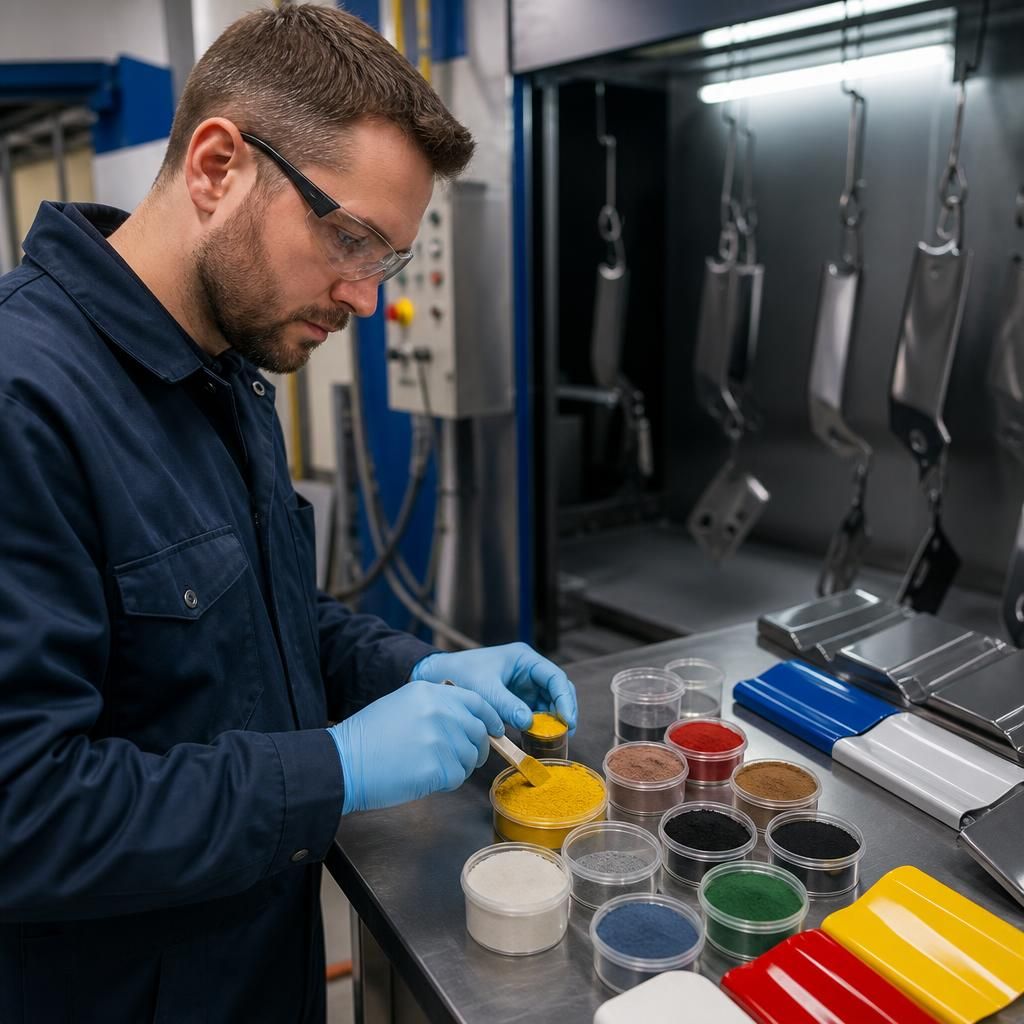
Coating formulation is a key way to customise industrial powder coating beyond the visible finish. The resin, curing system and additives can be selected according to the metal component’s service environment, so the coating’s functional properties support its intended use as well as its appearance.
For example, an epoxy-based system may be considered where chemical resistance and strong adhesion are important, while polyester formulations are commonly selected for components exposed to outdoor conditions because they can provide improved resistance to weathering. Hybrid systems can offer a balance of properties for particular indoor applications. The correct choice depends on the substrate, exposure, handling demands and required service life rather than on colour alone.
Some components may also benefit from a multi-layer approach, such as a primer and compatible topcoat. This can be used where additional corrosion protection is required, provided the complete system is suitable for the component and its operating conditions. Discussing the exposure in detail allows the coating specification to address likely failure mechanisms, including underfilm corrosion, chemical attack, loss of adhesion or surface wear, without selecting unnecessary performance characteristics that could affect cost or processing.