

What role does environmental control, such as temperature and humidity, play during the powder coating process for scaffold tubes?
Environmental control helps keep powder coating consistent by reducing the risk that temperature or humidity will affect powder application, curing and adhesion on scaffold tubes. Controlling these conditions supports an even finish and helps prevent defects such as poor flow, uneven curing or moisture-related coating problems.
Environmental control is essential because powder coating scaffold tubes depends on stable conditions from preparation through to curing. Temperature, relative humidity, surface temperature, air movement and cleanliness should be checked at each stage so that the coating system operates within the limits specified for the powder and the metal substrate.
Temperature control covers more than the oven setting. The temperature of the scaffold tube before spraying affects how the powder behaves when it reaches the surface. Tubes that are unusually cold or warm can alter the way powder deposits and melts. This is particularly relevant where tubes have been stored in a different environment from the coating area, as the metal may lag behind the surrounding air temperature. Allowing the steel to reach a stable, suitable condition before coating helps make the process more predictable.
Oven control also involves checking the temperature reached by the metal, rather than relying solely on the displayed air temperature. Scaffold tubes can vary in wall thickness, length, mass and loading arrangement. These differences influence how quickly each part heats through. A curing assessment or temperature profile can identify whether the tube itself has reached the powder manufacturer’s specified metal temperature for the required dwell time. This is more informative than assuming that an oven set point represents the condition of every component.
Humidity is especially important before and during preparation. If the steel is cooler than the surrounding air, moisture may condense on its surface even when the room does not appear wet. This can occur after washing, during storage or when tubes are moved between areas with different temperatures. Coating should not proceed until the substrate is visibly dry and environmental checks confirm that condensation is not likely. Particular attention is needed around tube ends, joints, recesses and other areas where water can remain hidden.
Relative humidity should be considered alongside the temperature of the steel. A dew-point assessment provides a more useful indication of condensation risk than relative humidity alone because it compares the surface temperature with the moisture content of the air. If the tube temperature is too close to the dew point, the work should be paused or the conditions corrected in line with the coating procedure. This prevents moisture becoming trapped beneath the applied film or interfering with the prepared surface.
Environmental conditions also affect the powder before it is applied. Powder should be stored and handled in the conditions stated on its technical documentation, with containers kept sealed and protected from moisture, heat and contamination. Powder that has absorbed moisture may flow differently, form agglomerates or create inconsistent delivery through the spray equipment. Stock rotation, clean handling and separating opened material from unused material help reduce these risks.
Within the spray area, stable airflow and controlled cleanliness are important. Excessive or poorly directed air movement can disturb the powder cloud and increase overspray, while airborne dust, fibres, oil vapour and water from compressed air can contaminate the coating. Booth ventilation should therefore support safe powder capture without creating turbulence around the scaffold tubes. Compressed-air supplies should be suitably clean and dry, and the booth, hooks and surrounding equipment should be maintained to prevent deposits transferring to the work.
Scaffold tubes present practical environmental-control challenges because they are long, cylindrical and often processed in batches. Their spacing on the line should allow air to circulate and provide the spray equipment with consistent access. Overcrowded loading can create sheltered areas, restrict drying and make heat distribution less uniform. Hanging points should also be considered, since contact areas may affect electrical continuity and leave small regions that require careful inspection or touch-up in accordance with the coating system.
A useful control routine includes:
- checking the ambient temperature and relative humidity in the preparation, spraying and curing areas;
- checking the temperature of the scaffold tubes where condensation or storage conditions create a risk;
- comparing surface temperature with dew point before coating;
- confirming that cleaned tubes are dry, including internal edges and difficult-to-see areas;
- storing powder and keeping it sealed according to the product instructions;
- checking booth ventilation and compressed-air cleanliness;
- using temperature profiling where the load, tube dimensions or oven conditions make heat penetration uncertain; and
- recording environmental readings and any corrective action as part of batch documentation.
When conditions fall outside the coating system’s recommended range, the appropriate response may be to move the work to a controlled area, allow the components to acclimatise, improve drying, adjust the process or obtain technical guidance from the powder supplier. Applying powder in unsuitable conditions and relying on visual inspection alone can leave problems that only become apparent after handling, installation or service exposure.
For businesses preparing scaffold tubes in batches, environmental records provide useful evidence that each stage was carried out under controlled conditions. They also help link any later coating irregularity to a particular load, shift, storage period or process change. Environmental control is therefore both a quality measure and a practical part of repeatable batch production.
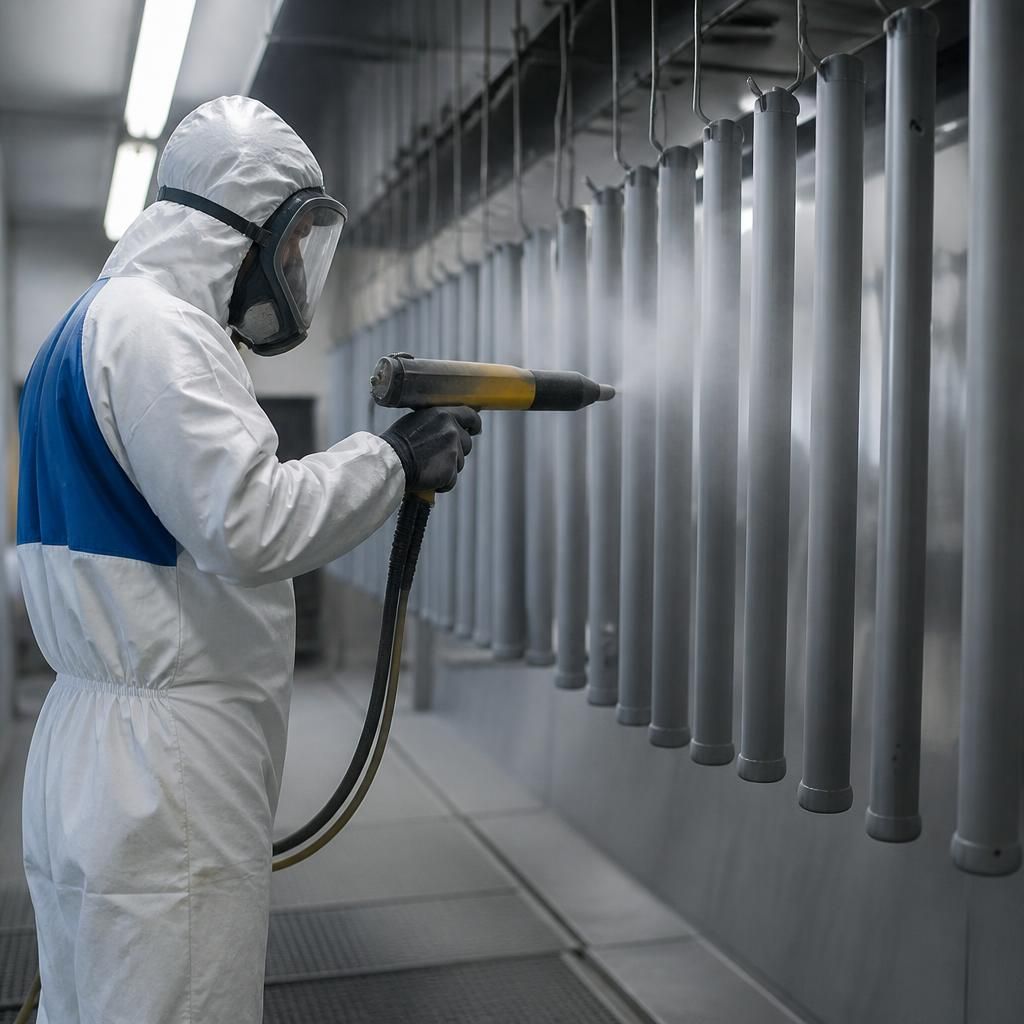
Environmental control affects the electrostatic application of powder as well as the condition of the scaffold tube. During spraying, the powder particles must accept and retain an electrical charge so they are attracted to the earthed steel. Changes in humidity, airborne contamination or electrical continuity can alter transfer behaviour, making deposition less consistent around the tube and at edges, ends or recessed areas.
This is why environmental checks should be considered alongside equipment and workpiece preparation. If powder transfer changes during a batch, the cause may not be an adjustment to the spray gun alone; the surrounding conditions, earthing points and cleanliness of the booth may also need investigation. Keeping these variables stable helps produce a more uniform deposited film before the coating enters the curing stage.