

What safety features should be considered when purchasing a mini powder coating machine to ensure secure and efficient operation?
When purchasing a mini powder coating machine, prioritise guarded moving and heated parts, emergency-stop controls, electrical protection, reliable earthing, temperature safeguards and effective powder ventilation or extraction. Clear operating controls, fault indicators and accessible isolation points also help operators use the equipment safely while maintaining consistent, efficient coating performance.
A safe mini powder coating machine should combine controlled powder handling, dependable access protection, documented compliance and practical safeguards for cleaning, servicing and operator use. The machine must be suitable for the powder, component size and intended production environment; a small footprint does not remove the risks associated with combustible dust, moving equipment, heat or industrial electricity.
Consider the following features and evidence before purchasing:
- Access protection and interlocks: Doors, covers and removable panels should prevent access to hazardous areas during operation. Where an access point is opened, the machine should prevent the relevant process from starting or bring it to a safe state. Interlocks should be robust, clearly identified and difficult to bypass without authorised maintenance procedures.
- Safe powder containment: The powder path, hopper and application area should minimise unintended release of coating material. Look for sealed connections, secure lids and collection arrangements that limit deposits on surrounding surfaces. Containment makes housekeeping more manageable and reduces the amount of airborne powder available for inhalation or ignition.
- Static-dissipation arrangements: Powder movement and spraying can generate static charges. In addition to the machine’s main electrical design, check that guns, hoses, hoppers, recovery components and removable parts have a defined method of dissipating charge. The supplier should explain how continuity is maintained after cleaning or reassembly.
- Combustible-dust suitability: Ask whether the machine and its powder-handling components are suitable for the coatings being used. Some powders can form an ignitable dust cloud, so the assessment should cover the spray area, collection system, filters, motors and any electrical equipment in the relevant zone. Where applicable, request information supporting compliance with the site’s dangerous-substances and explosive-atmosphere risk assessment rather than assuming that a compact machine is automatically suitable.
- Fire prevention and detection: Check for measures that reduce the chance of ignition and limit the spread of a fire, such as suitable materials, protected electrical components and arrangements for dealing with a blocked or overloaded filter. Depending on the design and risk assessment, additional detection or suppression may be required. These provisions should be specified by the supplier and integrated into the site’s fire procedures.
- Clearly separated operating and service functions: Operators should not need to expose themselves to hazardous parts to change powder, clear a blockage or remove a component. A machine with defined operating, cleaning and maintenance modes can reduce unsafe improvisation. Service access should be practical, with instructions explaining how stored energy is released before work begins.
- Safe cleaning and colour-change design: Powder residue can become a respiratory, contamination and combustible-dust hazard. Prefer equipment designed for controlled vacuum cleaning or other approved methods, with smooth internal surfaces and minimal inaccessible recesses. The supplier should state which cleaning tools and methods are permitted; compressed air may disperse dust and should not be used where it creates an unsafe cloud.
- Operator information and training support: A purchase should include a comprehensive manual covering installation, commissioning, normal operation, cleaning, fault response and servicing. It should identify residual risks, required personal protective equipment and restrictions on use. Diagrams, labels and straightforward instructions are particularly important when several operators will use the same equipment.
- Compliance documentation: Request the declaration of conformity or other relevant supplier documentation, technical safety information and instructions for the specific configuration being purchased. Check that the documentation covers accessories such as spray guns, powder recovery units and control equipment, not only the main cabinet. The buyer should also confirm that the completed installation can be incorporated into the employer’s risk assessment and safe systems of work.
- Installation and workplace compatibility: Confirm the required floor space, clearances, electrical supply, extraction connections, ambient conditions and permissible location before ordering. The machine should not obstruct walkways, fire exits or access to other isolation devices. If it is being installed within an existing coating line, assess how its guards, controls and powder-handling arrangements interact with neighbouring equipment.
- Ergonomics and manual handling: Safe design includes the way operators load components, change containers and remove filters. Check the height and weight of access points, the need for lifting aids and whether awkward postures are required. Reducing manual-handling strain helps prevent injuries that are not caused by a single machine fault but arise from repeated production tasks.
- Inspection and test provisions: The machine should allow routine checks of safety devices, access protection, powder hoses, filters and electrical connections without dismantling unnecessary parts. Ask how safety functions are tested, what records should be kept and which checks must be completed after relocation or repair. A feature is only useful if its condition can be verified during the equipment’s working life.
Before comparing models, prepare a risk-based specification covering the powders, component dimensions, batch pattern, cleaning method and proposed installation area. Ask each supplier to identify residual risks and state which safeguards are built in, which must be provided by the purchaser and which depend on the wider workplace. This distinction prevents a machine from appearing safe on paper while essential site controls have been left out.
For a business choosing equipment for production work, the safest option is therefore not simply the machine with the most controls. It is one whose safeguards match the coating process, whose documentation is complete and whose cleaning, servicing and inspection arrangements can be followed consistently by trained personnel.
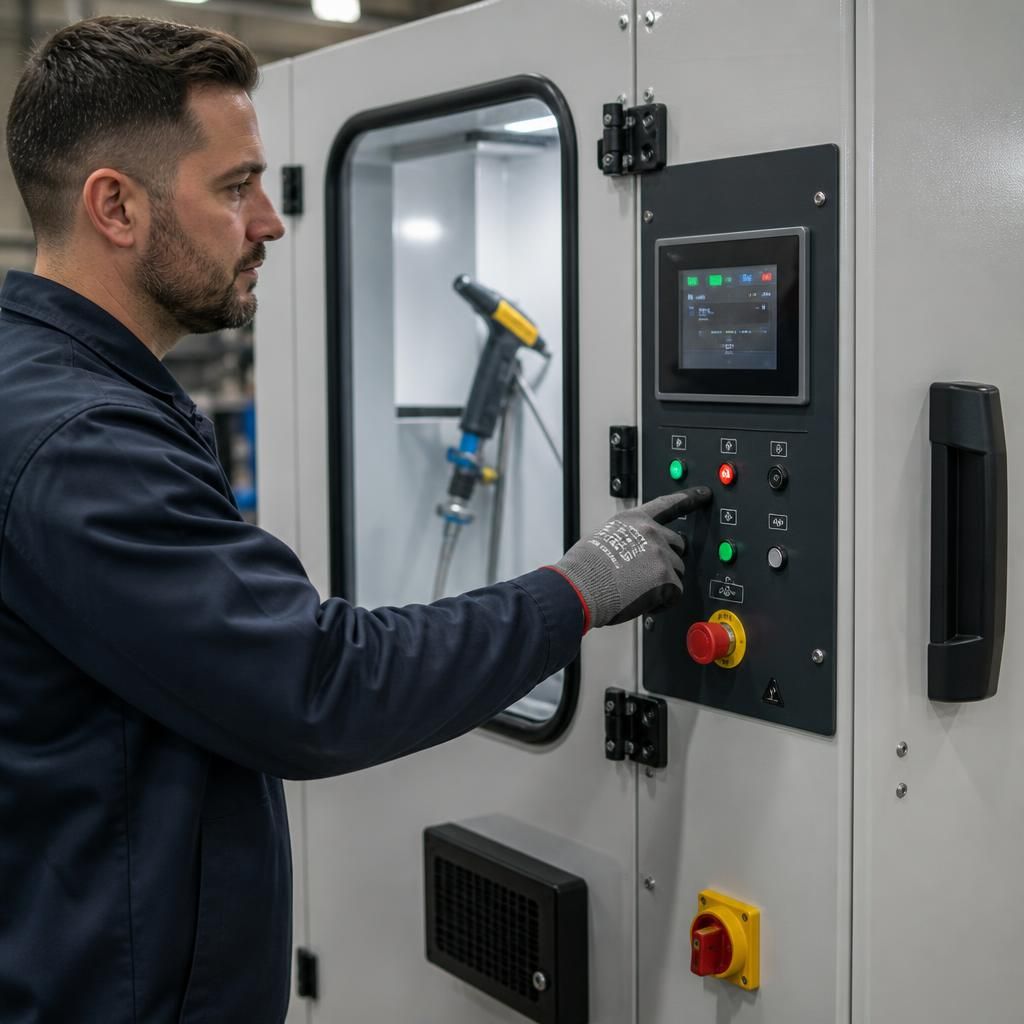
Control interfaces should make safe operation unambiguous. When comparing mini powder coating machines, assess whether the control panel clearly separates start, stop, reset and isolation functions, and whether alarms identify the cause of a fault rather than simply indicating that production has stopped. A clear status display can help operators recognise conditions such as open access doors, loss of extraction or an interrupted safety circuit before work continues.
Check how the machine behaves after a power failure, emergency stop or detected fault. It should not restart unexpectedly when power is restored or a guard is closed. Resetting should require a deliberate operator action from a position where the relevant working area can be checked, helping prevent unplanned movement, spraying or heating during recovery.