

What safety measures should be taken when handling powder coating pretreatment chemicals?
Handling powder coating pretreatment chemicals safely requires following the product’s safety data sheet and risk assessment, using suitable personal protective equipment and preventing skin, eye and inhalation exposure. Keep chemicals labelled and securely stored, provide effective ventilation, and dispose of residues and containers through the appropriate controlled waste route.
Safe handling of powder coating pretreatment chemicals depends on controlling the whole process: select compatible equipment, control how solutions are transferred and mixed, prevent incompatible substances from coming into contact, and prepare for spills or exposure before work begins. These controls are particularly important because acidic, alkaline and conversion-treatment products can cause burns, harmful fumes, violent reactions or damage to nearby equipment if handled incorrectly.
Control the process before chemicals arrive
- Identify the hazards associated with each product and decide whether a less hazardous alternative or a ready-diluted formulation could perform the required pretreatment task.
- Define who is authorised to receive, move, dilute, replenish and test each chemical. Unauthorised or untrained personnel should not carry out these activities.
- Set written procedures for chemical transfer, bath replenishment, concentration checks, cleaning and maintenance. Procedures should cover normal operation as well as foreseeable deviations, such as an incorrectly prepared solution or a failed dosing pump.
- Keep an up-to-date inventory so that incompatible products are not ordered unnecessarily or left unidentified in the work area.
Use compatible plant and containers
Tanks, pipework, pumps, hoses, valves and bunding must be suitable for the particular chemical and its working concentration. A material that is satisfactory for an alkaline cleaner may deteriorate rapidly when exposed to an acid or oxidising product. Check compatibility with the chemical supplier or equipment manufacturer rather than relying on appearance alone. Inspect vessels, seals and connections for swelling, cracking, corrosion, leaks or crystallised residue, and remove defective equipment from service.
Provide secondary containment around drums, intermediate bulk containers and treatment tanks where a leak could reach people, drains or incompatible chemicals. Keep containers stable during movement and use suitable lifting and handling equipment; never move a container by dragging it across the floor or by using a damaged pallet.
Prevent dangerous mixing
- Keep acids, alkalis, oxidising products and reducing agents physically segregated according to their chemical compatibility.
- Use dedicated transfer equipment where cross-contamination could cause a reaction or compromise the treatment bath.
- Never pour an unknown residue into a different container or drain. Identify it first and follow the site’s controlled waste procedure.
- When dilution is permitted, add the chemical to water slowly and in the specified order. Adding water to a concentrated corrosive product can generate heat and cause splashing.
- Do not mix different pretreatment products, cleaners or residues unless the process instructions explicitly require it.
Use clear, durable identification for process tanks, dosing lines and temporary containers. This is not a substitute for checking the product, but it reduces the likelihood of selecting the wrong chemical or connection point during replenishment.
Manage transfer and dosing operations
Prefer closed or low-splash transfer systems over manual pouring, particularly for concentrated products. Pumps and dosing equipment should be operated within their rated limits, with connections secured before flow begins. Open a container cautiously, release any pressure in a controlled manner and keep the opening directed away from the operator. Do not use compressed air to force liquid from a drum unless the container and method are specifically designed and approved for that purpose.
Keep transfer routes clear and avoid positioning hoses where they can be crushed, snagged or mistaken for another line. After use, close containers and isolate dosing lines in accordance with the operating procedure. Check for drips at couplings and under pumps, since small leaks can create corrosive residues and deteriorate flooring or metalwork over time.
Provide emergency controls
Work areas should have clearly identified emergency arrangements appropriate to the chemicals in use. This normally includes accessible eyewash and body-flushing facilities, a suitable spill kit, alarm or communication arrangements, first-aid provision and a defined route to medical assistance. Emergency equipment must be kept unobstructed and maintained so that it can be used immediately, rather than stored in a locked chemical area.
Staff should know the difference between a minor, controllable spill and an incident requiring evacuation or specialist response. A spill procedure should state who raises the alarm, how the area is isolated, which materials may be used for containment, and how contaminated absorbents and damaged containers are secured afterwards. Do not use water on a spill unless the chemical-specific procedure permits it; water can spread some products or intensify a reaction.
If chemical enters the eyes or contacts the body, immediate flushing is generally critical. The affected person should follow the site emergency procedure and obtain medical assessment where required. Contaminated clothing should be removed safely, avoiding transfer to unaffected skin, and the incident should be recorded and investigated rather than treated as routine housekeeping.
Maintain housekeeping and hygiene
- Keep floors, walkways and access to emergency equipment free from containers, hoses and residues.
- Clean deposits using the approved method; do not brush, blow or spread dried chemical residue into the air.
- Do not eat, drink, smoke or store food in chemical handling areas.
- Wash hands and any exposed areas using the site’s specified facilities before leaving the work zone, even where no visible contamination is present.
- Inspect nearby structures, racking and electrical equipment for corrosion caused by splashes or vapour.
Train, supervise and review
Training should be practical as well as theoretical. It should cover container movement, dilution and dosing, compatibility, emergency actions, equipment checks and the consequences of bypassing controls. New or inexperienced workers should be supervised until they can demonstrate the correct procedure. Contractors and maintenance personnel also need information about chemical hazards before entering the treatment area.
Review the controls after a spill, near miss, equipment change, chemical substitution or change in production method. Record inspections, maintenance and training, and investigate recurring leaks or bath problems. A repeated incident may indicate that the transfer system, layout or procedure needs redesign rather than additional reminders.
For a powder coating operation, these measures should be integrated with the pretreatment line’s process controls so that safe chemical handling does not depend solely on individual care. A documented system covering compatibility, transfer, emergency response, housekeeping, training and review provides a more reliable safeguard for personnel, equipment and the surrounding workplace.
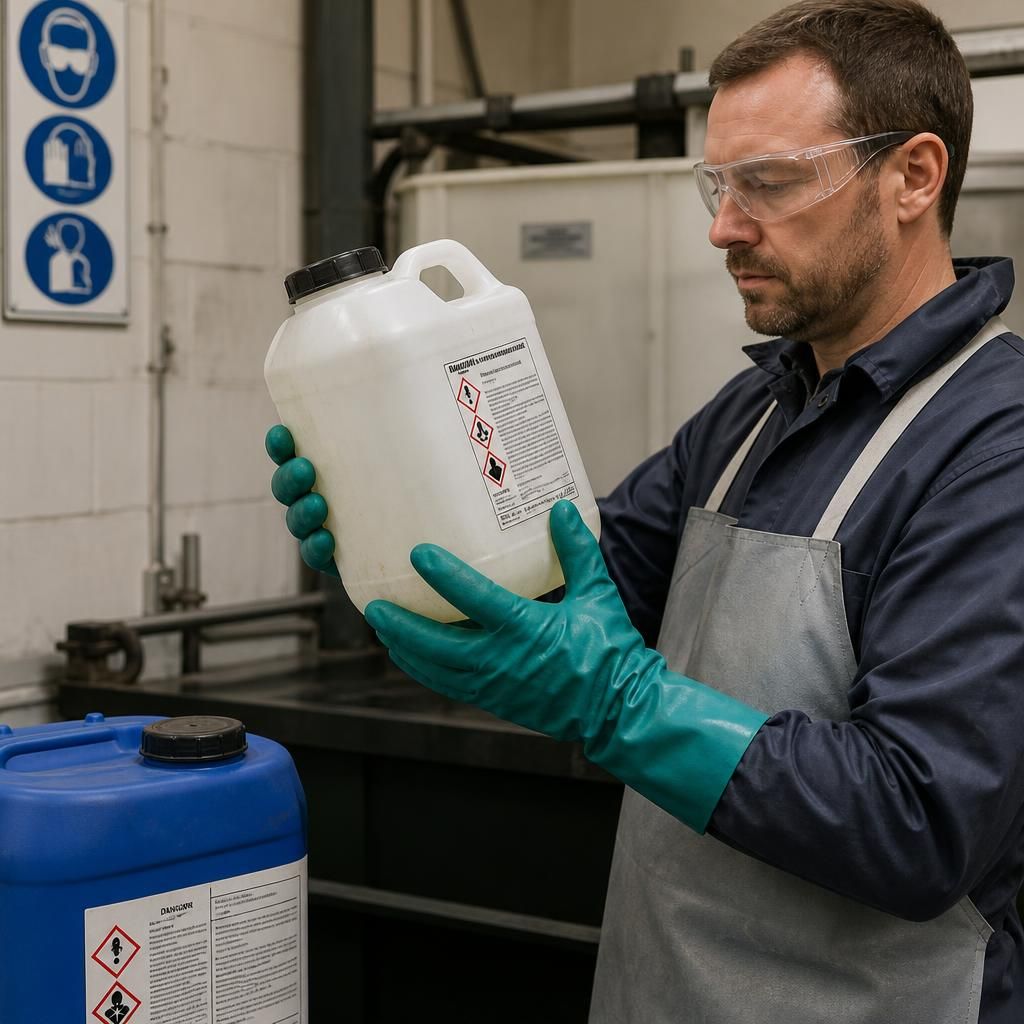
Personal protective equipment (PPE) must be selected for the specific pretreatment chemical and task, rather than treated as a standard uniform. The product safety data sheet should identify suitable chemical-resistant gloves, eye or face protection, protective clothing and footwear. Where exposure cannot be adequately controlled by enclosure or ventilation, respiratory protection may also be required under the site’s risk assessment.
Inspect PPE before use for tears, degradation or contamination, and replace disposable items or damaged equipment promptly. Chemical-resistant gloves should be removed without touching contaminated outer surfaces, while reusable PPE must be cleaned and stored according to the manufacturer’s instructions. PPE supplements, but does not replace, effective process controls and safe handling procedures.