

What safety considerations should be taken into account when selecting shot blasting media for powder coating applications?
Select shot blasting media by assessing its dust generation, hazardous-substance profile, particle breakdown and compatibility with the metal and coating process. Confirm the media’s safety information, provide suitable extraction and ventilation, and specify appropriate personal protective equipment (PPE) to control inhalation, eye, skin and noise risks.
Safe selection of shot blasting media requires more than choosing an abrasive that removes existing coatings. The media must be suitable for the equipment, substrate and operating conditions, while controlling risks from rebound, breakage, contamination, fire, handling and waste. A documented assessment should be completed before production blasting begins, particularly where components will move into a powder coating line.
Assess the media’s physical behaviour
Particle shape, hardness, density and size influence how the media behaves when propelled at a surface. Angular media can cut more aggressively, whereas rounded media may be less likely to form sharp fragments, but the correct choice depends on the substrate and the required preparation. Excessively hard or coarse media can damage thin sections, distort edges or create excessive rebound. Media that is too fragile may fracture during use, producing irregular particles and changing the blasting characteristics as the work continues.
Check that the selected grade is appropriate for the blasting cabinet, room or automated plant. The equipment manufacturer’s limits for abrasive type, operating pressure, wheel speed, nozzle configuration and reclaim system should be followed. Guards, screens, interlocks and inspection windows must remain suitable for the chosen media. A media that is technically suitable for a metal surface may still be unsafe if it causes abnormal wear to hoses, nozzles, seals or recovery equipment.
Consider rebound and component geometry
Workpieces with corners, recesses, perforations or curved sections can redirect abrasive unpredictably. The risk is higher where operators must reach around fixtures or where components are loaded close to access points. Select a media and process combination that gives adequate preparation without requiring unnecessarily aggressive settings. Fixtures should hold parts securely, and the planned blast direction should prevent components from shifting or striking one another.
Small parts also need suitable containment. Loose components can become projectiles or enter machinery, while media trapped in cavities may be released during handling, coating or assembly. Drainage holes, threaded openings and enclosed sections should be considered during both the blasting and post-blast inspection stages.
Check fire and ignition risks
Some blasting media, residues and removed coatings can create a combustible mixture or carry contamination from previous work. Organic media require particular consideration because their fire behaviour differs from that of mineral or metallic abrasives. The selection assessment should therefore cover the media itself, the coating being removed, deposits on the component and the design of the extraction and recovery equipment.
Keep ignition sources away from accumulated residues, and ensure that the plant’s earthing, electrical equipment and fire controls are appropriate to the materials being processed. Do not mix media types or introduce unfamiliar material into a recovery system without checking compatibility. Powder coating operations also involve fine coating powders, so blasting residues and coating materials should be kept under controlled housekeeping arrangements and not allowed to accumulate around equipment.
Prevent contamination and unintended exposure
Media can carry residues from previously blasted parts, including old coating fragments, oils, corrosion products or substrate material. This creates both a handling concern and a process-control issue: contaminated abrasive may transfer unwanted material to a new component or become unsuitable for reuse. Separate media streams should be used where different substrates or coatings could contaminate one another.
Before selection, establish whether the media can be reclaimed safely and how its condition will be checked. Screening, separation and inspection may be needed to remove broken particles and detached coating. If a media is not suitable for reuse, it should be placed in clearly identified containers rather than left in open piles or returned to the clean supply.
Plan storage, handling and disposal
- Store new media in sealed, labelled containers that protect it from moisture and accidental mixing.
- Use stable storage arrangements so bags, drums or bulk containers cannot topple during movement.
- Check handling methods for heavy or awkward containers and avoid transferring media in a way that damages packaging.
- Keep clean and spent media physically separate.
- Identify whether spent abrasive contains removed coating or metal residues that alter its waste classification.
Waste should be assessed according to its actual contents rather than being treated as ordinary abrasive simply because the original media was non-hazardous. A waste contractor or competent environmental adviser can help determine the appropriate classification where removed coatings or substrate residues are present.
Use a controlled approval process
Safety information supplied with the media should be reviewed alongside the equipment instructions and the site’s risk assessment. The assessment should record the selected grade, intended application, operating limits, inspection arrangements, recovery method, emergency controls and disposal route. A controlled trial on representative components is preferable to changing media across a full production run without confirming how the abrasive behaves.
Operators should be trained in the specific media being used, including signs of excessive breakdown, abnormal equipment wear, unsafe rebound and contamination. Reassess the choice if the substrate, removed coating, component geometry, blasting equipment or recovery arrangement changes. This approach links media selection to the complete blasting system rather than treating the abrasive as an isolated consumable.
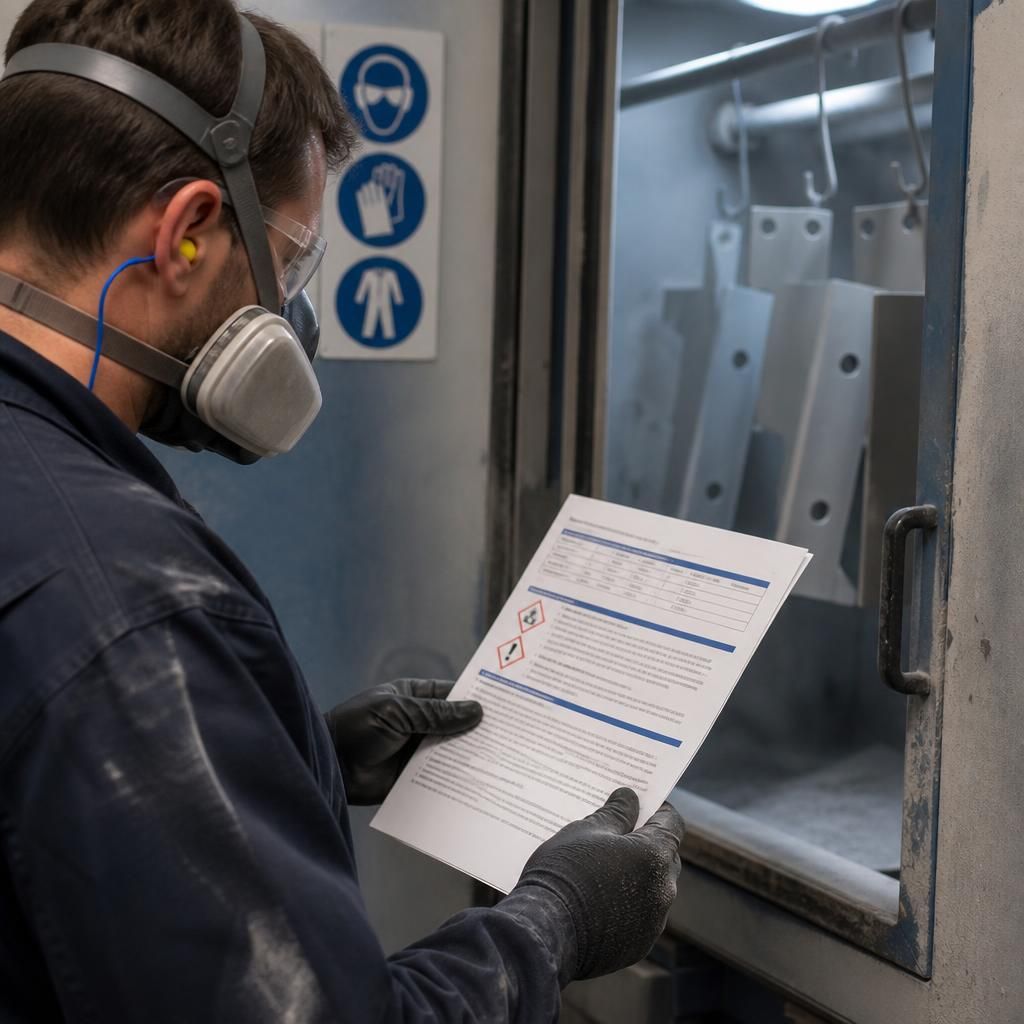
Safety information for blasting media should be checked against the site’s COSHH assessment before the abrasive is approved. Review the safety data sheet and technical information for composition, dust hazards, required controls, storage and disposal. Do not assume that a media described as low-dust or recyclable is automatically suitable; its risk depends on how it breaks down, the coating residues it removes and the equipment in which it is used.
Where the assessment identifies a potential inhalation hazard, specify suitable respiratory protective equipment and ensure it is selected, maintained and fit-tested through the site’s established control procedures. Exposure controls should be reviewed if the media, operating method or materials being removed change. This provides a more reliable basis for selection than judging safety from the media name or surface finish alone.