

What role does customisation play in ensuring the effectiveness of sandblasting and powder coating for specific industrial applications?
Customisation makes sandblasting and powder coating effective by matching surface preparation and coating specifications to the component’s metal, geometry, operating environment and required finish. Adjusting the blasting media and profile, powder formulation, coating thickness and application method helps achieve suitable adhesion, corrosion protection, wear resistance and appearance for the intended industrial use.
Customisation makes sandblasting and powder coating effective by turning a general finishing process into a controlled specification for a particular component, assembly and service duty. It covers not only the coating material, but also preparation standards, masking, racking, application sequence, curing, inspection and the records needed to reproduce the result across production batches.
The coating specification should begin with the component’s function. A cover used indoors does not present the same requirements as a fabricated part exposed to moisture, road contaminants, abrasion or repeated handling. Components may therefore need different priorities, such as corrosion resistance, impact resistance, low friction, electrical insulation, chemical resistance or a defined visual appearance. Identifying these priorities prevents a finish being selected simply because it is attractive or commonly used when it may not be suitable for the part’s actual duty.
Customisation is also important where one assembly contains several functional surfaces. Areas that are visible may require a consistent colour and texture, while mating faces, threaded holes, sliding surfaces, earth points and close-fit interfaces may need to remain free from coating. A clear drawing or finishing schedule can identify:
- surfaces to be coated and surfaces to remain untreated;
- holes, threads, bores and contact points that require masking;
- acceptable film build on critical faces;
- permitted coating on edges, returns and concealed areas;
- racking or hanging points that can be touched up or hidden during assembly; and
- the required appearance, including colour, gloss and texture.
Component design and preparation need to be considered together. Deep recesses, narrow channels, folded returns and closely spaced features can make it difficult to clean every surface or apply powder evenly. Weld spatter, sharp edges, burrs, oil, labels and previous coatings can also affect the final finish. A tailored preparation plan may specify additional cleaning, edge treatment, removal of contaminants or changes to how parts are positioned. This is particularly relevant for fabricated items where the condition of the metal varies between sections of the same component.
Masking and racking are practical areas where customisation directly affects the finished part. Incorrect masking can leave powder on a tolerance-critical surface, while poorly positioned hooks can create visible marks or prevent a complete coating around an edge. The method should allow electrical contact for application equipment without placing marks in a visible or functional area. For repeat work, agreed rack positions and masking methods also help make parts more consistent from one batch to the next.
Dimensional tolerances may determine the acceptable coating build. Powder coating adds material to the surface, so a finish that is appropriate for a broad structural face may not be appropriate around a bearing seat, threaded connection or accurately fitted enclosure. Where dimensions are critical, the specification should state which surfaces are excluded, how masking is to be applied and whether measurements are required after coating. This allows the finishing process to support assembly rather than create avoidable rework.
Parts can also require a planned sequence when they include different materials, sub-assemblies or areas with different finishing requirements. Coating components individually may protect interfaces more effectively than coating a fully assembled item. Conversely, coating an assembly together may be appropriate where a continuous appearance is required. The decision should account for access, masking, handling, cure exposure and the possibility that joining or assembly will damage the finish.
Curing should be treated as a component-specific process rather than a fixed time alone. The relevant condition is the temperature reached by the metal, not simply the temperature displayed by the oven. Part thickness, mass, shape and loading pattern can affect how quickly the component reaches the required cure condition. A suitable process therefore considers the largest or most thermally demanding parts in the batch and uses an agreed cure schedule for the selected powder. Under-curing can affect the coating’s performance, while excessive heat can damage the substrate, distort a component or affect an existing treatment.
Customisation also supports quality control by defining what will be checked and how results will be judged. Depending on the application, checks may include:
- visual uniformity, colour, gloss and texture;
- coverage of edges, corners, recesses and concealed faces;
- film thickness on representative or critical areas;
- adhesion and cure-related testing where specified;
- freedom from runs, pinholes, contamination and excessive orange peel; and
- dimensional checks on masked or close-tolerance features.
Acceptance criteria should distinguish between a genuine functional defect and a minor appearance variation in a concealed area. This is especially useful for industrial parts that are assessed according to engineering performance rather than showroom appearance. Photographs, marked-up drawings, inspection notes and retained sample panels can help establish a shared reference before production begins.
Batch work benefits from a defined repeatability plan. Parts should be supplied in a condition that is consistent from batch to batch, with the same identification of material, preparation requirements, masking points and finish. Changes to the substrate, design, powder specification or loading arrangement should be reviewed rather than treated as immaterial. When a coating is being introduced for the first time, a trial part or sample panel can be used to confirm colour, texture, coverage, masking and assembly fit before larger quantities are processed.
Effective customisation therefore depends on communication between the designer, manufacturer, coating provider and end user. Drawings should show functional surfaces and tolerances; purchase information should identify the intended duty; and any existing coating, treatment or contamination should be disclosed. The coating provider can then identify preparation or application constraints before the parts enter production. For manufacturers, fabricators, construction firms and automotive businesses, this specification-led approach reduces ambiguity and makes the finish easier to assess against the component’s real purpose.
In practice, the most effective specification is not necessarily the most complex. It is one that records the surfaces, performance requirements, appearance standard, masking method, cure requirements, inspection criteria and packaging or handling needs that matter to the application. That level of customisation gives sandblasting and powder coating a clear technical purpose and provides a repeatable basis for evaluating the finished component.
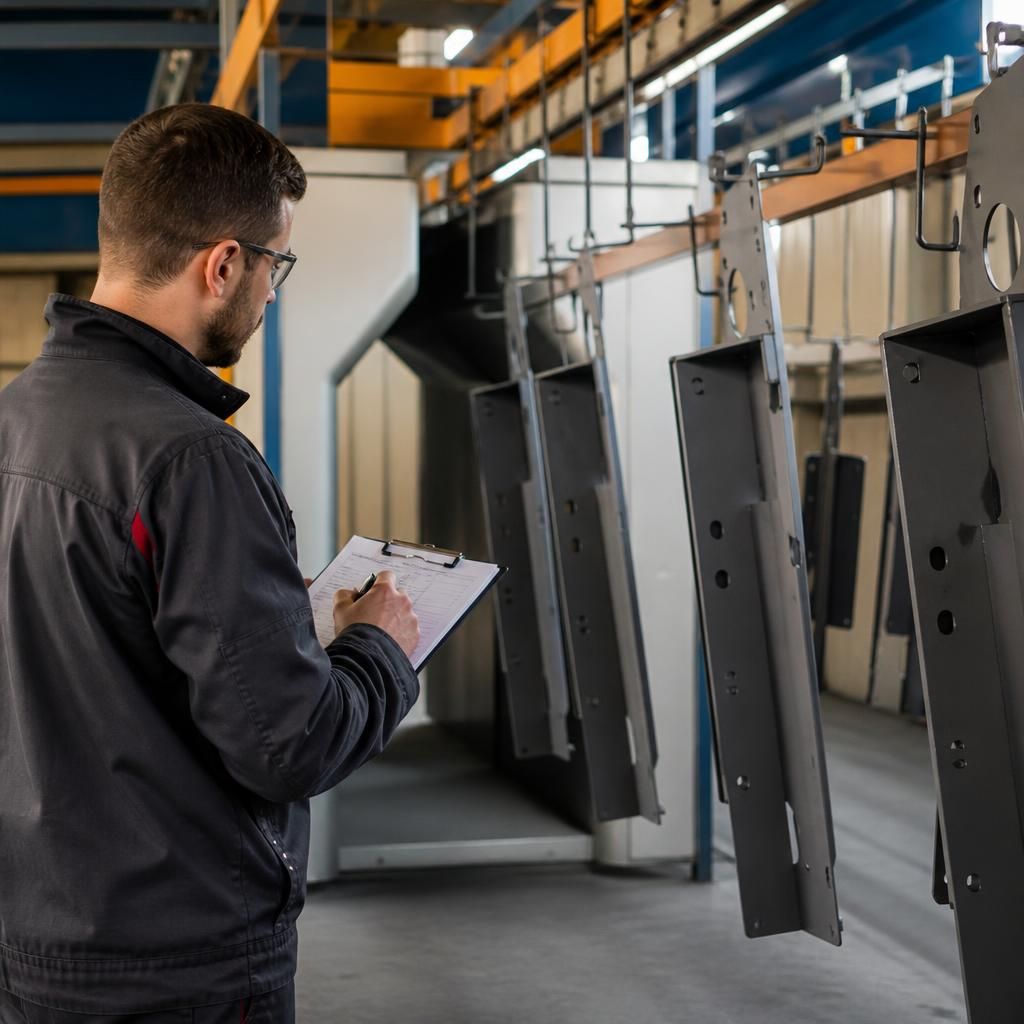
Customisation is particularly important when an industrial component needs a coating system rather than a single decorative finish. The selected powder must be compatible with the substrate, any primer or pre-treatment, the blasting profile and the conditions the component will face in service. Treating these elements as one specification helps prevent a strong-looking surface from failing because the individual stages were not suited to one another.
For example, a component exposed to moisture, chemicals or repeated abrasion may require a different coating arrangement from an indoor part subject mainly to handling. The specification can define the required protection, the compatible products, the target finish and the areas where additional protection is needed. It should also record whether repairs, touch-ups or recoating are permitted, since not every powder coating system can be overcoated or locally repaired in the same way.
This approach makes the finished result easier to assess against its intended use. Instead of judging effectiveness by colour or surface appearance alone, the coating can be evaluated against the relevant exposure, adhesion, durability and maintenance requirements for the application.
Discuss Your Custom Sandblasting and Powder Coating Requirements
Discuss your component drawings, service conditions and finishing requirements with the powder-coating.co.uk team to identify a suitable sandblasting and powder coating specification. Providing details of critical surfaces, tolerances and intended use will help establish the appropriate preparation and finish for your application.