

How can I assess the impact of different shot blasting media on the surface texture and quality of my metal components?
Assess the impact of shot blasting media by comparing the resulting surface profile, cleanliness and visual uniformity on representative metal samples. Media type, hardness, shape and size determine how aggressively the surface is textured, so the best choice is the one that removes contamination without causing excessive roughness, distortion or embedded residue before powder coating.
The most reliable way to assess shot blasting media is to run a controlled trial on representative components, then compare measurable surface characteristics and powder coating performance. The assessment should cover the resulting surface profile, surface cleanliness, coating coverage, adhesion and appearance, rather than relying on visual inspection alone.
Begin by selecting test pieces made from the same metal, with similar dimensions, condition and pre-existing contamination as the production components. Record the original condition of each sample, including mill scale, rust, old coating, weld spatter, sharp edges and areas that may be vulnerable to distortion. Divide the samples between the media options and keep other variables consistent, including blasting pressure, nozzle distance, angle, travel speed and exposure time. This makes it easier to attribute any difference to the media rather than to the process.
- Surface profile: Measure the resulting texture using a suitable surface-profile gauge, replica tape or a calibrated electronic instrument. The profile should be compatible with the powder coating system: an insufficient key may reduce mechanical adhesion, while an unnecessarily deep profile can affect coverage and increase the amount of coating required to mask the substrate.
- Cleanliness: Inspect the surface for remaining rust, scale, paint, oxides, grease and blasting dust. A prepared surface should be free from visible contaminants and should not show patches of untreated material, shadowing or embedded particles.
- Surface integrity: Check for peening, sharp raised edges, warping, denting, excessive rounding of corners and damage around welds or thin sections. These defects can create coating-thickness variation or interfere with component fit.
- Residue and contamination: Look for media trapped in holes, threads, joints and recesses. Where different metals or coating systems are processed, confirm that the media is not introducing a contaminant that could affect adhesion, colour or corrosion resistance.
- Visual consistency: Compare the samples under consistent lighting. Differences in sheen, roughness, streaking or patchiness can indicate uneven blasting or an unsuitable combination of media and equipment settings.
Media hardness is important because harder particles generally remove firmly bonded material more readily, but can also produce a more aggressive impact on softer alloys or delicate sections. Softer media may be appropriate where the objective is to remove light contamination without substantially changing the substrate. The particle shape also affects the result: angular particles tend to cut into the surface, whereas rounded particles are more likely to peen or smooth it. Particle size influences both the depth of the texture and the ability to reach narrow details.
Assess the samples after blasting and again after powder coating. A surface that looks acceptable before coating may still produce poor results if the texture is inconsistent or if dust remains in recesses. After curing, inspect the finish for thin coverage on peaks, cratering, pinholes, blistering, visible roughness, colour variation and areas where the coating has failed to wet the substrate properly. Adhesion testing on the trial panels can help distinguish a preparation problem from a powder or curing problem.
For a meaningful comparison, document the following for each trial:
- the media material, particle grade and condition;
- the blasting pressure and equipment settings;
- the nozzle type, stand-off distance and movement pattern;
- the condition and profile of the prepared metal;
- the method used to remove dust before coating;
- the powder type, applied thickness and curing conditions; and
- the appearance and adhesion results after curing.
Use the results to establish an acceptance range rather than choosing the most aggressively textured sample. The preferred media is the one that consistently achieves the required level of preparation while preserving dimensional accuracy, producing a uniform surface and remaining compatible with the powder coating process. If the components vary significantly in thickness, geometry or contamination, one media setting may not suit every part; separate trials or process stages may be necessary.
Quality control should continue during production. Check the media for breakdown, moisture and contamination, monitor blasting equipment for wear and repeat profile and cleanliness checks at an appropriate frequency. Changes in worn nozzles, recycled media or air pressure can alter the surface result even when the nominal media specification remains unchanged.
Where the metal, existing coating or required finish is particularly sensitive, a specialist powder coating provider can review trial components and recommend a preparation process based on the substrate and intended service conditions. This approach provides a defensible link between the selected media, the measured surface condition and the finished coating quality.
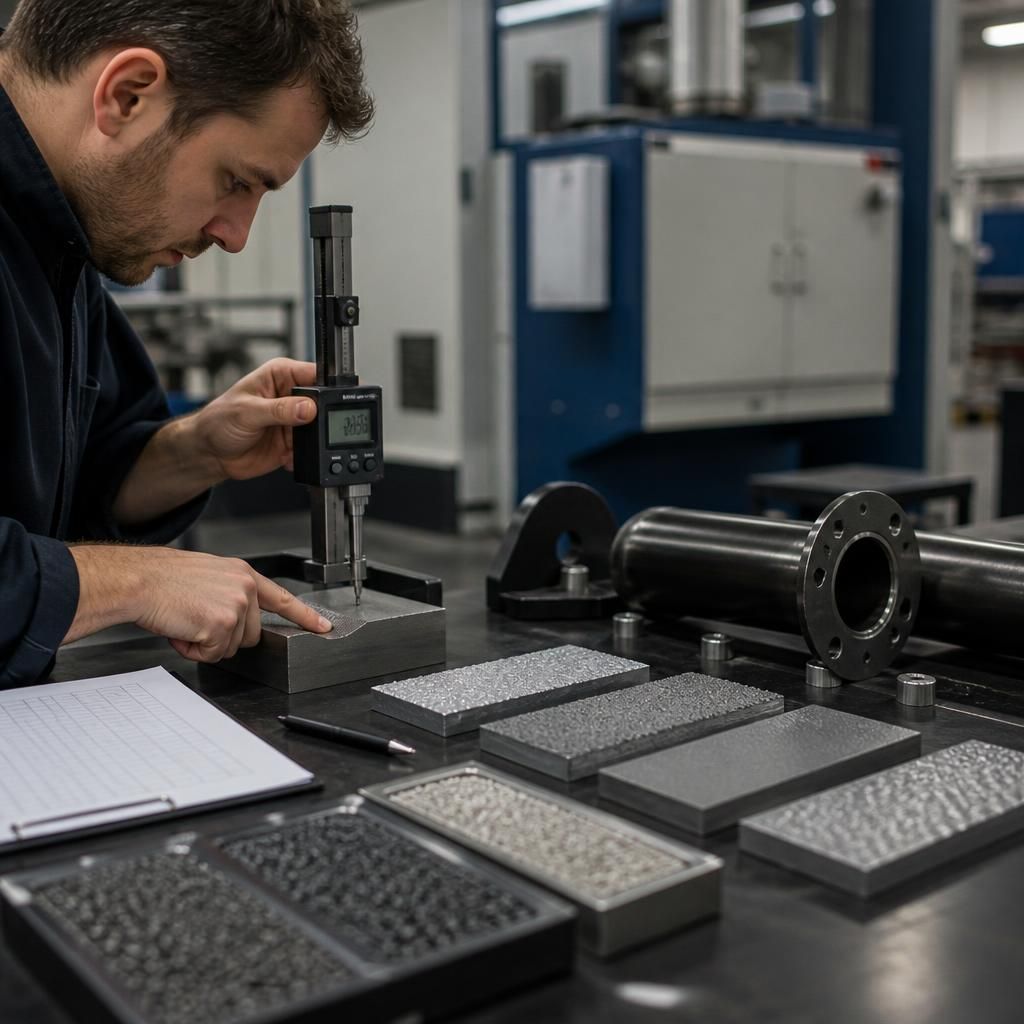
Do not assess blasted texture from a single roughness value. An average roughness measurement can conceal the shape of the surface, including isolated high peaks, deep valleys or an uneven pattern. For powder coating, the profile’s consistency and relationship to the intended coating thickness are often more informative than a higher reading alone.
Compare measurements from several representative areas and record whether the surface has a regular, evenly distributed key. A magnified inspection can help identify sharp peaks or deep cavities that may not be obvious during a general visual check. This makes it easier to distinguish a controlled coating anchor from an unnecessarily harsh texture and supports a more reliable media selection.