

What specific industries benefit most from the unique properties of black powder coated sheet metal and why?
Construction, automotive, manufacturing and metal fabrication benefit most from black powder coated sheet metal because it combines a consistent architectural finish with durable protection against corrosion, weathering, abrasion and routine handling. It is particularly suitable for visible panels, enclosures, equipment housings, vehicle components and fabricated parts where appearance and service performance are both important.
Black powder coated sheet metal is most valuable in industries that need a consistent visual finish alongside resistance to handling, weathering and everyday wear. Construction, automotive, manufacturing and metal fabrication use it extensively for visible panels, housings, guards, brackets and enclosures, although the suitability of the finish depends on the coating specification, metal substrate, preparation and service environment.
Construction and architectural products
Construction benefits from black powder coated sheet metal where metalwork forms part of a building’s visible design. It is used for items such as façade components, cladding details, screening, flashings, doors, trims, balustrade elements and external enclosures. Black provides a defined, contemporary appearance that can be coordinated with other building materials, while the cured coating creates a continuous finish over the prepared metal.
The main advantage in this sector is the combination of appearance and practical service performance. External components may be exposed to rain, atmospheric pollutants, sunlight and repeated contact during installation and maintenance. A correctly specified architectural-grade powder coating can help the metal resist these conditions, but colour retention and gloss stability should be checked where the component will receive strong or prolonged ultraviolet exposure. Black surfaces can also become hotter in direct sunlight than lighter colours, which may affect dimensional movement, touch temperatures or the performance of adjacent materials.
Automotive and transport manufacturing
Automotive businesses benefit where sheet metal parts need a clean, uniform finish that can withstand assembly, handling and use. Typical applications include brackets, underbody components, battery or equipment covers, protective panels, interior metalwork and parts associated with commercial vehicles or specialist equipment.
Powder coating is well suited to repeat production because the finish can be applied consistently across batches when the preparation, film thickness and curing conditions are controlled. The coating can also provide resistance to scuffing and routine abrasion, which is useful for components that are moved through production, fitted by hand or exposed to road debris. Parts subject to fuel, oils, brake fluids, salts, heat or stone impact require a specification tested for those particular conditions rather than relying on colour alone.
Automotive components may also have tight dimensional or masking requirements. Threads, bonding faces, earth points, machined bores and areas intended for welding may need to remain free from coating. These details should be identified before processing to prevent interference during assembly.
General manufacturing and equipment production
Manufacturers use black powder coated sheet metal for machine guards, control-panel surrounds, equipment cabinets, access covers, frames and housings. In these applications, the finish protects the fabricated part while giving different components within a product range a consistent appearance.
Black is often selected for equipment that must look unobtrusive or visually robust. It can also provide a useful contrast against labels, indicators, screens and metallic hardware. The practical benefit is not simply colour: a properly cured coating can reduce damage from routine contact and make the surface easier to keep presentable than unfinished steel. Where the enclosure is used in a workshop, plant room or production area, the coating system should be chosen for likely exposure to oils, cleaning chemicals, moisture and impact.
Electrical and industrial enclosures require additional consideration. The powder coating must not obstruct electrical contact points, hinges, locks, cable entries or bonding arrangements. If the enclosure is intended for outdoor use, corrosion protection at cut edges, joints and fixing points is as important as the visible face finish.
Metal fabrication and component supply
Fabricators benefit when a single coating process can provide a repeatable finish across folded sheet, laser-cut parts, brackets, panels and welded assemblies. Black is a practical choice for fabricated products that will be seen by end users or installed alongside other black metalwork.
The quality of the result depends heavily on preparation. Weld spatter, sharp edges, oil, mill scale, rust and fabrication residues can affect adhesion and appearance. Complex assemblies may also create areas where pretreatment is difficult or where powder cannot reach effectively. For that reason, design for coating should be considered before manufacture, including drainage holes, accessible surfaces, suitable edge geometry and clear masking requirements.
Agricultural, plant and commercial equipment
Black powder coated sheet metal can also suit agricultural machinery, material-handling equipment, storage systems and commercial fixtures where parts experience frequent handling and exposure to dust, moisture or general industrial contamination. It is most appropriate for components where a hard, uniform finish is preferred over the appearance of bare metal or wet-applied paint.
These sectors often combine indoor and outdoor service conditions. The coating specification should therefore account for ultraviolet exposure, water retention, soil or chemical contact, impact and cleaning methods. A standard decorative powder may not be suitable for severe industrial or agricultural exposure without an appropriate pretreatment system and a coating designed for that environment.
Why these industries benefit most
- They use metal components that are handled, assembled or exposed to abrasion during their service life.
- They often require a repeatable finish across batches and multiple component shapes.
- They value a controlled appearance for products, buildings, equipment and customer-facing installations.
- Many applications need protection for sheet metal without adding a thick, visibly uneven wet-paint layer.
- Black can provide a recognisable finish across separate parts, although it does not by itself determine corrosion resistance or durability.
The strongest results come from matching the powder formulation and pretreatment to the environment rather than selecting black solely for its appearance. Indoor equipment, sheltered architectural parts, coastal installations, vehicle components and chemically exposed machinery can all need different specifications. Professional assessment should consider the substrate, component design, expected exposure, required gloss level, masking points and maintenance method before coating begins.
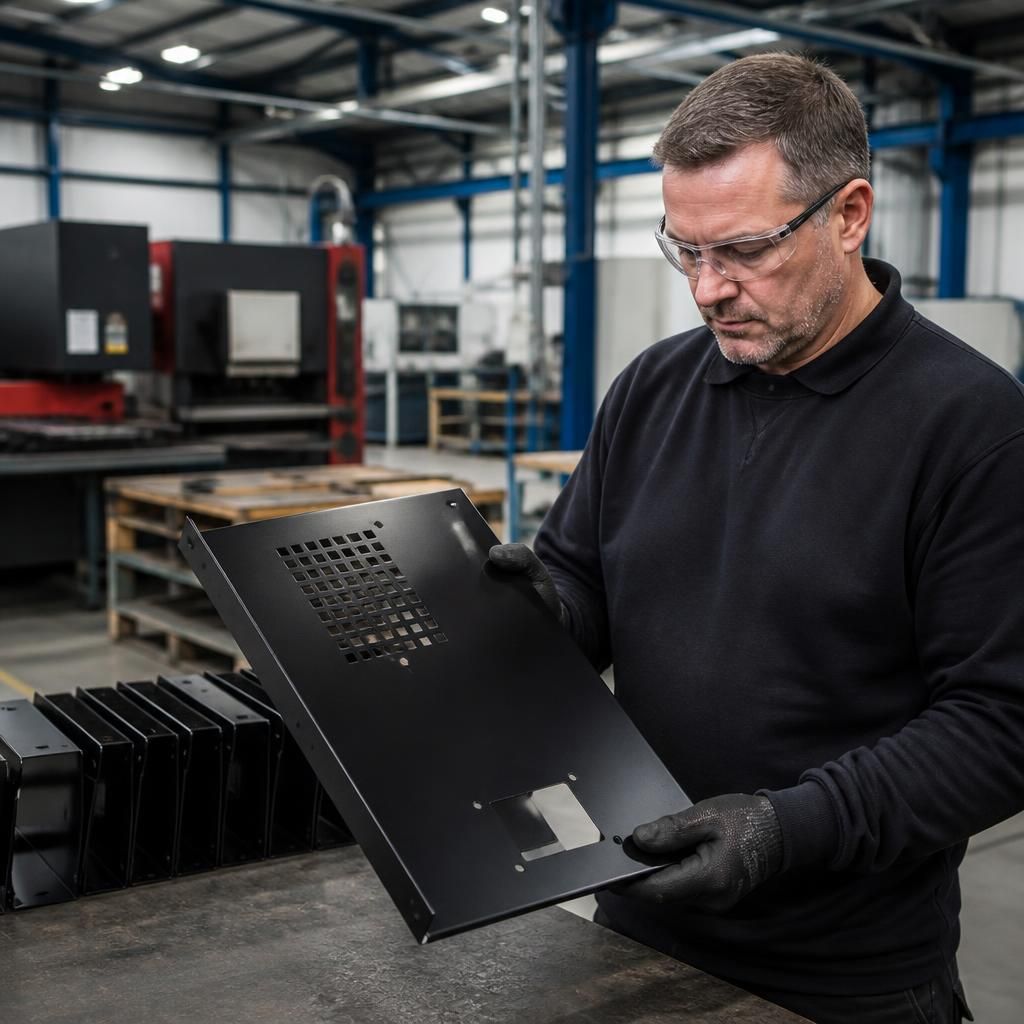
Black powder coated sheet metal is particularly valuable where equipment must present a controlled, professional appearance throughout its working life. Plant manufacturers, vehicle-equipment producers and fabricators often use a common black finish across panels, access covers and support parts so replacements and related assemblies appear visually consistent, even when they are produced separately.
This makes the finish useful for products that are installed in customer-facing settings or supplied as part of a wider equipment range. The coating specification still needs to reflect the component’s actual exposure, but the black finish can provide a practical visual standard across different sheet-metal shapes and assemblies.