

What are the specific advantages of choosing a shiny black powder coat finish over other protective coating options for metal components?
A shiny black powder coat provides metal components with a hard, uniform surface that resists corrosion, abrasion and everyday wear more effectively than many conventional paint finishes. It also delivers a consistent gloss appearance, strong edge coverage and a clean, professional finish without the runs, brush marks or unevenness associated with liquid paint application.
A shiny black powder coat finish offers a combination of visual consistency, surface protection and production efficiency that many liquid paints and other metal finishing methods do not provide in the same way. It creates a smooth, reflective appearance while forming a bonded polymer layer over the prepared metal, making it suitable for components where presentation and practical protection are both important.
Its main advantages include:
- Consistent appearance: Powder is applied as a dry, finely controlled coating and then cured to form an even finish. This helps produce a repeatable black gloss across batches, which is valuable when components must match within an assembly or product range.
- A professional visual finish: Shiny black has a clean, contemporary appearance that suits machinery, architectural metalwork, automotive components, furniture frames, enclosures and fabricated parts. Compared with bare steel, galvanised surfaces or heavily textured finishes, it provides a more refined appearance without requiring a separate decorative layer.
- Good opacity and colour definition: Black powder generally provides strong visual coverage over correctly prepared metal. It can conceal minor colour variation in the substrate and gives designers a neutral finish that works with bright metal, contrasting colours and branded components.
- Resistance to routine handling: Once fully cured, the coating is less susceptible to the scuffing and marking associated with many conventional liquid paint systems. This is useful for parts that are handled during assembly, transport or installation, although the exact performance still depends on the powder formulation, preparation and curing conditions.
- Efficient repeat production: Powder coating is well suited to batch work because the same specified colour and gloss level can be applied across multiple components. It also avoids the drying stages associated with many wet-paint processes, allowing coated parts to be handled after the coating has been properly cured.
- Reduced risk of application defects: Unlike brush or roller application, powder does not leave brush marks, and it does not contain liquid solvent that can evaporate unevenly during application. Correctly applied powder can therefore provide a more controlled finish on suitable metal components.
- Greater design flexibility than some alternative finishes: A shiny black surface can be specified alongside different gloss levels, textures or other powder colours where a product requires visual contrast. It can also be used on components with practical shaping that would be difficult to finish consistently by hand.
Compared with liquid paint, powder coating is often preferred where a tougher factory-applied finish and repeatable appearance are required. Liquid paint can remain useful for heat-sensitive substrates, on-site work or situations requiring very specific repair and colour-matching arrangements, so the choice should reflect the component and operating conditions rather than appearance alone.
Compared with plating or anodising, a shiny black powder coat can offer a simpler decorative route for many steel and fabricated components. Plating and anodising alter or build the surface through specialist chemical or electrochemical processes and may be selected for particular metal types, dimensional requirements or technical properties. Powder coating is generally considered when the priority is a coloured protective layer with a controlled gloss appearance.
The finish is not automatically the right choice for every application. High temperatures, prolonged ultraviolet exposure, chemicals, heavy impact, sharp edges and constant outdoor use may require a particular resin system, primer or specialist protective powder. Glossy black can also make dust, fingerprints and fine surface marks more visible than a matt or textured finish. For that reason, the specification should consider the metal substrate, pretreatment, service environment, desired gloss level and cleaning regime.
For B2B metal components, the strongest case for a shiny black powder coat is its balance of appearance, repeatability and practical protection. The result depends on thorough surface preparation, suitable powder selection and correct curing; these factors should be agreed with the coating provider before production, especially where components will face demanding industrial or external conditions.
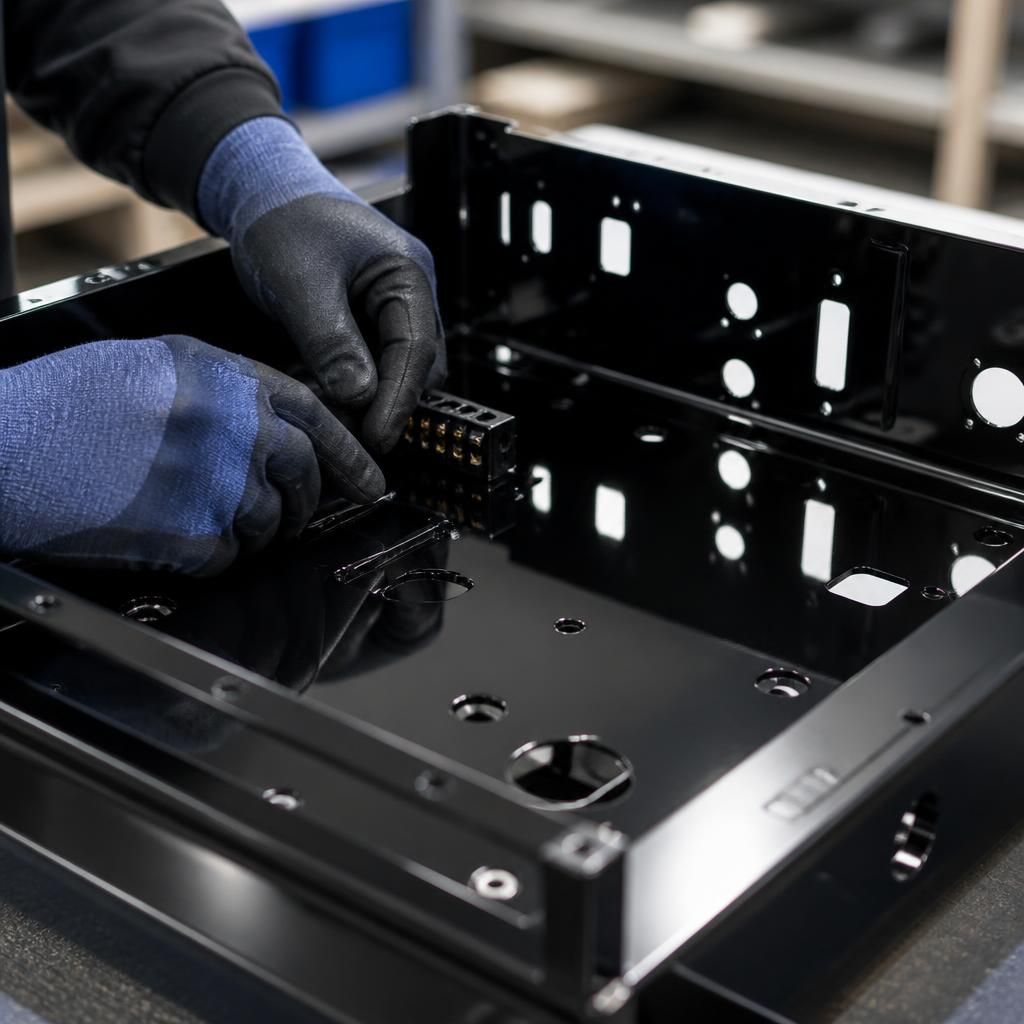
Where the coating system is specified for it, a shiny black powder coat can provide electrical insulation as well as surface protection. The cured polymer layer separates the metal substrate from contact with conductive surfaces, making this useful for suitable enclosures, brackets and component housings.
This benefit comes from the powder formulation, film thickness and curing quality rather than the black colour or gloss level itself. It should therefore be confirmed against the component’s voltage, contact, thickness and operating requirements; powder coating should not be treated as a substitute for a separately specified insulation system where electrical safety is critical.
Discuss your shiny black powder coat requirements
Discuss your metal components and operating conditions with the powder-coating team to identify whether a shiny black powder coat is the appropriate protective finish. They can advise on the required preparation, powder specification and gloss level for your application.