

What factors should be considered when selecting the type of abrasive material for surface preparation in electrostatic coating?
Select an abrasive material according to the substrate, existing coating or contamination, required surface profile, component geometry and the finish specified for the electrostatic coating. Also consider the abrasive’s hardness, particle size, recyclability, dust generation and risk of embedding or damaging the metal, then confirm that the resulting surface is clean, suitably keyed and free from residue.
The abrasive material should be selected as part of the complete surface-preparation process, not in isolation. In addition to the metal and the required key, the decision should account for chemical cleanliness, compatibility with the pre-treatment system, the blasting equipment, contamination control, operator safety, waste handling and the way the prepared surface will be protected before electrostatic powder is applied.
Consider the required level of cleanliness. Different coating specifications require different degrees of removal of mill scale, corrosion products, old coatings and other residues. The abrasive must be capable of achieving the specified cleanliness consistently without leaving a surface that appears clean but contains soluble salts, oil residues or abrasive dust. Where components are intended for demanding external or corrosive environments, the preparation specification should define how cleanliness will be checked rather than relying only on visual inspection.
Check compatibility with chemical pre-treatment. Some powder-coating systems include rinsing, conversion coating or another pre-treatment after blasting. The abrasive must not introduce substances that interfere with those stages. Residual salts, reactive particles or absorbed process chemicals can affect rinsing, conversion-layer formation and subsequent coating performance. The chosen media should therefore be assessed alongside the full preparation sequence, including drying and the time between each stage.
Assess the risk of abrasive residue. Residue may remain in recesses, joints, holes or around weld details even when the main surface has been cleaned. A suitable material should be practical to remove using controlled air cleaning, vacuuming or another approved method. Compressed air used for final cleaning must itself be free from oil and moisture, because a clean abrasive cannot compensate for contaminated air.
Match the abrasive to the blasting equipment. The media must work effectively with the available blast pot, wheel system, nozzle, recovery equipment and filtration arrangement. Its flow characteristics affect metering, hose wear, nozzle wear and the stability of the blasting pattern. An abrasive that performs well in one installation may be unsuitable where the equipment cannot maintain a consistent feed or separate spent material effectively.
Account for the component’s construction. Heat-sensitive assemblies, thin sections, welded fabrications and parts containing seals or enclosed cavities may require a less aggressive process or additional masking and cleaning controls. The issue is not only the material removed from the surface; blasting can transmit heat, vibration and impact through the component. The abrasive choice should support the dimensional and functional tolerances of the finished part.
Review corrosion control between preparation and coating. Once a surface has been blasted, it can be more vulnerable to moisture and handling contamination. The selected process should fit the planned movement of the parts through inspection, pre-treatment and powder application. If the abrasive or preparation method leaves the surface prone to rapid oxidation, the process may require tighter environmental control or a revised sequence to prevent the prepared condition being lost.
Consider environmental and health controls. Abrasive selection affects airborne particulate, noise, waste classification, recovery requirements and the level of respiratory and personal protection needed. Reusable media may reduce disposal volumes, while single-use materials can be appropriate where cross-contamination must be tightly controlled. The decision should be based on the entire operating system, including extraction and waste handling, rather than on the purchase price of the abrasive alone.
Control cross-contamination. Media used on carbon steel, stainless steel, aluminium or previously coated parts should not be transferred between incompatible applications without suitable segregation and cleaning. Foreign particles can create corrosion risks, visible defects or problems during later finishing. Separate storage, clearly identified blast equipment and controlled media-recovery arrangements help preserve the intended surface condition.
Verify the result with process checks. Before approving an abrasive for regular production, test it on representative components and inspect the prepared surface using the checks required by the coating specification. These may include visual cleanliness assessment, surface-profile measurement, dust evaluation, soluble-contamination testing and inspection for embedded particles. The process should also be reviewed after changes to the abrasive, equipment settings, component design or pre-treatment chemistry.
For batch work, consistency is particularly important. The abrasive specification, preparation settings, cleaning method and acceptance criteria should be recorded so that different loads receive the same treatment. A technically suitable abrasive is the one that delivers a controllable, clean and compatible surface through the whole preparation sequence, while meeting the component’s quality, safety and environmental requirements.
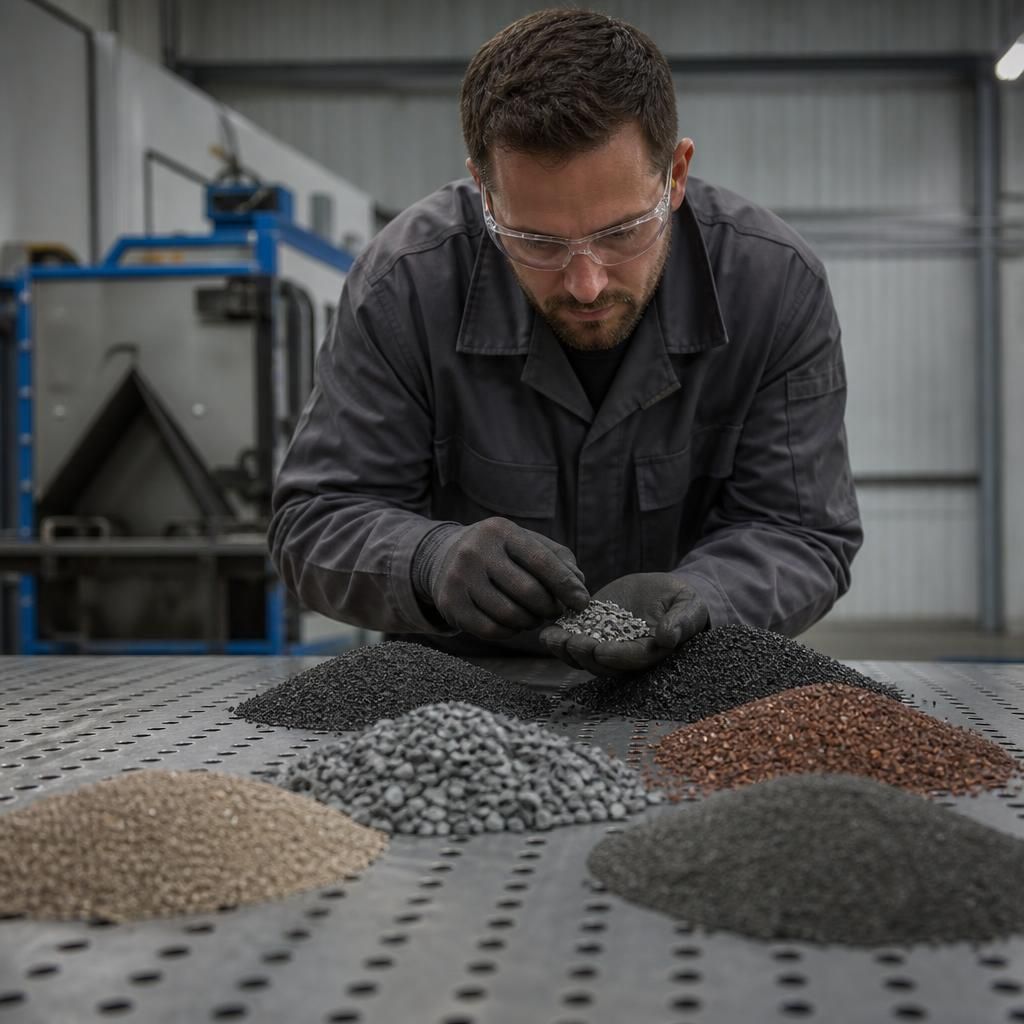
Particle shape is an important abrasive-selection factor because it influences how the surface is prepared, not just how quickly contamination is removed. Angular particles cut into the substrate and create a more pronounced mechanical key, while rounded particles produce a less aggressive impact and may be more suitable where excessive roughness or distortion must be avoided.
The chosen profile should suit the powder coating system and the component’s appearance requirements. An overly sharp or deep profile can leave peaks that are difficult to cover consistently, particularly on thin sections or visible faces. A controlled, even texture is therefore preferable to maximum roughness. Test the selected media on a representative area and compare the resulting profile, surface appearance and coating coverage before approving it for production.
Discuss your abrasive material requirements
Discuss your component material, existing finish, required surface profile and coating specification with our team to identify suitable abrasive material and preparation controls. Provide drawings or representative parts where relevant so the proposed process can be assessed against the component’s geometry and finish requirements.