

What are the specific benefits of electrostatic application in maintaining the quality and consistency of large-scale powder coating projects?
Electrostatic application charges powder particles so they are attracted to and adhere evenly across grounded metal components. In large-scale projects, this supports consistent film coverage, repeatable finishes and efficient use of coating material across batches.
Electrostatic application improves the quality and consistency of large-scale powder coating by making the deposition process more controlled and repeatable. Charged powder is directed towards suitably grounded metal workpieces, allowing coating operators to manage application parameters more consistently across production runs and reduce variation between individual components.
More consistent film build
Large projects often involve many components that must meet the same appearance and performance requirements. Electrostatic application helps maintain a more uniform layer of powder across accessible surfaces, reducing the risk of visibly thin or heavy areas caused by inconsistent spray technique. This is particularly important where parts are inspected side by side or assembled into a single finished product.
Improved repeatability between batches
Once the relevant settings have been established for a particular component, the application process can be reproduced for subsequent batches. Gun voltage, powder flow, spray distance, air pressure, component positioning and conveyor movement can be monitored and adjusted as part of a defined process. This limits reliance on individual operator technique and makes it easier to identify whether a variation has come from the application stage rather than from the material or the component itself.
Better coverage of edges and profiles
The electrical attraction between the powder and the grounded workpiece can help powder reach edges, corners and changes in profile that are more difficult to coat consistently with a purely mechanical spray pattern. This can support a more continuous finish on fabricated parts and reduce the likelihood of exposed areas caused by the spray being aimed only at the broadest faces.
Electrostatic attraction is not a substitute for correct gun positioning. Recesses, narrow cavities and areas shielded by other sections of a component can create a Faraday cage effect, where the electrical field makes powder penetration more difficult. Skilled application therefore combines electrostatic settings with suitable spray angles, gun movement and, where necessary, adjusted voltage or manual techniques.
More controlled appearance across a production run
Variations in powder deposition can affect colour density, gloss and surface texture after curing. Keeping the application conditions stable helps minimise these differences, which is especially relevant for visible panels, enclosures, frames and components that need to match one another. Consistency also depends on the powder specification, substrate condition, curing profile and handling process, so electrostatic application forms one part of a wider quality-control system.
Reduced risk of application-related defects
A controlled electrostatic process can help limit defects associated with uneven spraying, including excessive build, weak coverage and inconsistent overlap between passes. Applying the correct quantity in a controlled manner also supports a more predictable curing result, as the deposited layer is less likely to vary substantially from one area to another. Inspection can then focus on measurable issues such as coverage, appearance, adhesion and film thickness rather than correcting avoidable application variation.
Greater process control for high-volume work
At large scale, small inconsistencies can be repeated across a substantial number of parts. Electrostatic equipment provides a practical way to standardise the application stage through repeatable settings, planned component presentation and regular checks of grounding and equipment condition. Reliable grounding is essential: poor contact, contamination or unsuitable hanging arrangements can weaken the electrical attraction and lead to uneven deposition.
For the strongest results, electrostatic application should be supported by consistent pretreatment, clean and correctly prepared surfaces, appropriate racking, controlled powder storage and a validated oven cycle. Parts should also be checked at suitable stages of production so that issues are identified before they affect an entire batch. In this way, the electrostatic method contributes not only to the finished appearance but also to the repeatability and traceability of a large-scale coating process.
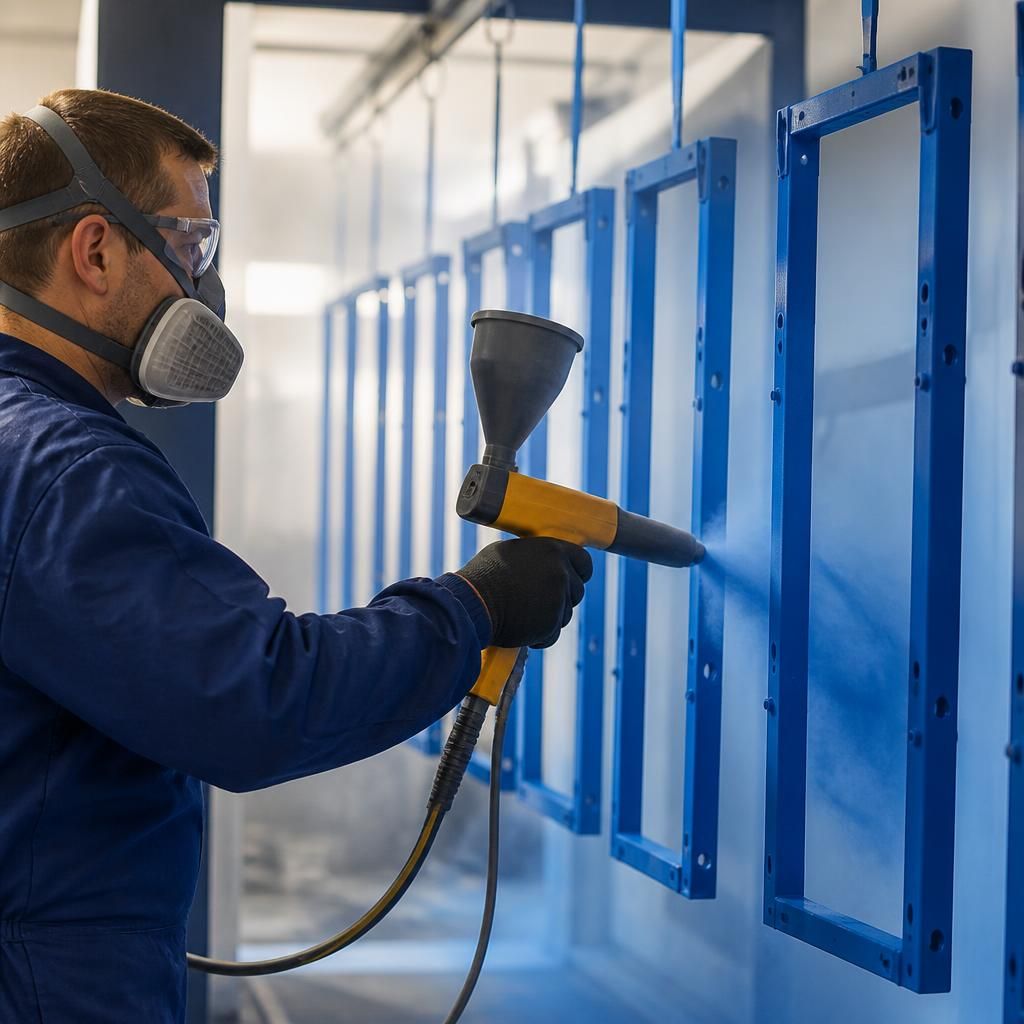
Electrostatic application can also support a more controlled coating environment by directing charged powder towards the grounded component instead of allowing as much of the spray to remain airborne. In a large-scale operation, this helps limit loose powder settling on nearby surfaces, fixtures or freshly coated parts, where it could contribute to surface contamination or an unwanted texture.
This benefit depends on suitable powder settings, effective grounding and correctly managed recovery equipment. Operators must still control booth cleanliness and prevent incompatible powder residues from entering the process. When these conditions are maintained, the application stage produces a cleaner and more predictable route from spraying to curing, supporting consistent finish quality across a production run.
Discuss Electrostatic Application for Your Large-Scale Powder Coating Project
If you are planning a large-scale powder coating project, contact Powder-coatings.co.uk to discuss your component sizes, batch volumes, substrate and finish requirements, and assess whether electrostatic application is suitable.