

How can the choice of powder coating finish impact the performance and visual appeal of steel components?
The choice of powder coating finish affects how a steel component withstands wear, moisture, chemicals and handling, as well as how it looks in service. Gloss level, texture, colour and coating formulation can therefore influence both functional performance and the component’s final appearance.
The selected powder coating finish can affect both the service performance and the perceived quality of a steel component. It influences how the coating behaves at edges, interfaces and contact points, how easily the surface can be cleaned, and whether the finished part meets the required visual standard. The right choice depends on the component’s environment, design tolerances, handling requirements and intended appearance.
Surface texture and cleaning: A smooth finish generally creates fewer places for dust, oil and moisture to collect, which can be advantageous on components that require regular cleaning. Textured finishes can provide a more distinctive appearance and may disguise minor visual irregularities in the underlying steel, but their surface profile can make deposits more difficult to remove. Where hygiene, washdown or frequent inspection is important, the ease of cleaning should be considered alongside appearance.
Gloss level and perceived quality: Gloss, satin and matt finishes reflect light differently. High-gloss surfaces can give a sharp, bright appearance but may make scratches, dents and preparation marks more noticeable. Lower-sheen finishes reduce reflected glare and can provide a more restrained industrial appearance, although they may show certain marks or contamination in a different way. The choice should be assessed against the component’s lighting conditions and how closely the finish will be viewed.
Film thickness and component fit: Powder coating adds a measurable layer to the steel. This is normally straightforward on general structural parts, but it requires greater control where components include threaded holes, close-fitting interfaces, sliding faces, hinges or precision mounting points. Excess coating around edges, apertures or mating surfaces can affect assembly. Masking, racking and an agreed coating specification help keep these areas within the required tolerance.
Edges, corners and recessed areas: The geometry of a component affects how evenly a finish can be applied. Sharp edges, deep recesses, narrow slots and internal corners can be more difficult to coat consistently than broad, accessible faces. A suitable specification should therefore consider edge preparation, access for application and the required coverage in less visible areas, rather than judging the finish only from the main external surface.
Cure and coating performance: Powder must be cured according to the requirements of the selected formulation and the steel component’s mass and geometry. Correct curing supports the coating’s adhesion, hardness and resistance to service conditions. Under-cure can leave the film below its intended performance, while excessive heat exposure may affect the finish or the component itself. The steel’s thickness, thermal mass and any assembled materials should be considered when establishing the application process.
Colour consistency and repeat work: Visual appeal also depends on consistency between parts. Large batches, replacement components and assemblies containing several coated pieces may show differences if the specification does not define the colour reference, sheen, texture and acceptable variation. Components should be assessed under suitable lighting, particularly where adjacent parts need to appear uniform. The same finish can also look different on flat sheet, folded sections and intricate fabrications because the surface reflects light differently.
For steel components exposed to outdoor conditions, the finish should be selected as part of a wider protection system rather than as a purely decorative layer. The coating formulation, steel preparation, pre-treatment, film build and curing process all contribute to the result. A finish that looks appropriate in a sample may not be suitable for the component’s actual exposure, so the specification should identify the expected environment and the level of protection required.
A practical selection process is to define:
- the component’s indoor or outdoor service environment;
- exposure to moisture, cleaning agents, oils, chemicals, abrasion and handling;
- the required level of gloss, texture, colour and visual uniformity;
- any dimensional limits around holes, threads, joints and mating surfaces;
- areas that need masking or must remain free of coating; and
- inspection requirements for coverage, defects, colour and finish consistency.
For manufacturers and fabricators, providing accurate drawings, steel grade information, masking requirements and end-use conditions allows the coating specification to be matched to the component rather than chosen for appearance alone. A Midlands powder coating specialist can advise on suitable finishes for batch and specialist steel components, with collection and delivery options available across the Midlands and surrounding areas.
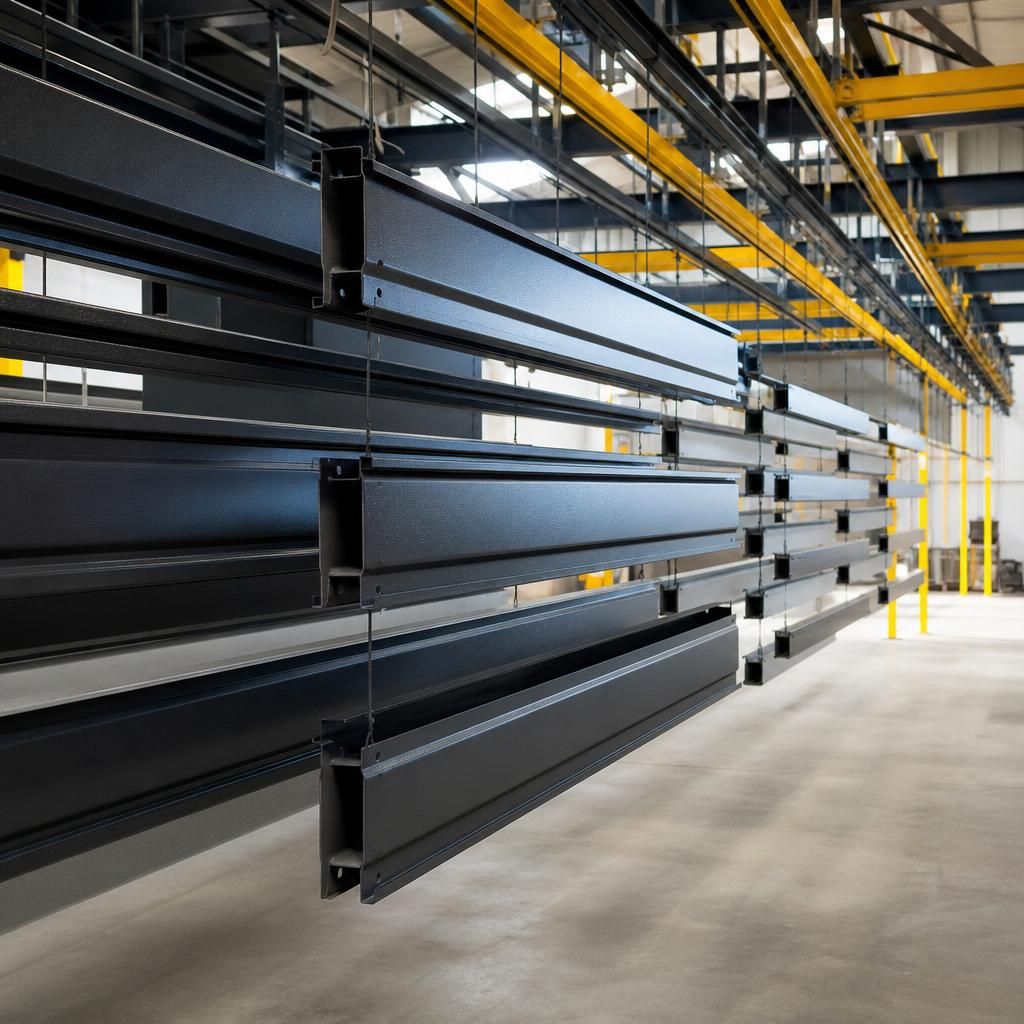
The coating chemistry, not just its colour or sheen, influences how a steel component performs and looks over time. Resin systems are selected according to exposure: epoxy-based powders are commonly suited to interior applications where chemical and mechanical resistance are important, while polyester-based formulations are often specified for external components because they provide better resistance to ultraviolet exposure. The correct choice helps reduce premature chalking, fading or loss of finish.
Exposure to oils, cleaning agents, solvents, moisture and abrasion should be considered before approving a finish. A visually attractive coating may deteriorate if its formulation is unsuited to the service environment, affecting both protection and colour stability. Comparing the expected exposure with the powder manufacturer’s technical data allows the finish to be selected for lasting performance as well as initial visual appeal.