

What are the industry standards and best practices for cleaning metal surfaces before applying phosphate steel treatment in powder coating preparation?
Before phosphate treatment, metal surfaces should be thoroughly degreased and cleaned to remove oil, grease, dirt, mill scale and corrosion products, using a controlled process suited to the substrate. Best practice also includes clean-water rinsing, preventing recontamination or flash rust, inspecting the surface, and maintaining the cleaning and phosphate stages according to documented process specifications.
Industry best practice treats cleaning before phosphate treatment as a controlled, substrate-specific process rather than a single washing operation. The objective is to provide a chemically active steel surface, free from residues that could interfere with conversion-coating formation, while keeping the process within documented limits for chemistry, temperature, contact time, rinsing and handling.
Relevant standards and specifications
There is no single cleaning standard that applies identically to every powder-coating line. The applicable requirements normally come from a combination of the coating system specification, the chemical supplier’s technical data, the component manufacturer’s requirements and recognised surface-preparation standards. Standards such as ISO 8501-1 can support visual assessment of steel condition, while the ISO 8502 series provides methods for assessing surface contamination such as dust and soluble salts. ISO 9717 is relevant to phosphate conversion coatings and helps define the characteristics of the finished treatment.
These standards should be used as part of a documented process rather than as a substitute for a site-specific specification. Steel grade, fabrication method, storage history, geometry and the intended corrosion-protection performance all affect the suitable cleaning sequence.
Use a cleaning method suited to the steel and its condition
- Alkaline cleaning is commonly used to remove process oils and greases. The cleaner must be compatible with the steel and operated at the concentration and temperature specified by its supplier.
- Acid cleaning or pickling may be required where oxide layers or corrosion products cannot be removed by alkaline chemistry alone. It needs close control because excessive acid exposure can attack the substrate, increase hydrogen-embrittlement risk in susceptible steels or leave an unsuitable surface for phosphating.
- Mechanical preparation, such as abrasion or blasting, can be appropriate for localised scale, heavy corrosion or tightly bonded residues. It should not introduce abrasive contamination or create a profile that is inappropriate for the specified coating system.
- Combined processes are often needed on fabricated parts, particularly where weld areas, heat-affected zones, cut edges and formed sections have different surface conditions.
Cleaners should be selected with the complete pretreatment sequence in mind. A product that removes oil effectively may still be unsuitable if it leaves a film, reacts adversely with the phosphate bath or is difficult to remove during rinsing. Where different metals or plated components are present, the chemistry should be checked for compatibility rather than assuming that a steel-cleaning process is suitable for every material in the assembly.
Control the process variables
Best-practice cleaning lines record and control bath concentration, pH where relevant, temperature, spray pressure or immersion conditions, and exposure time. Falling cleaner strength, excessive loading with oils or solids, and unstable temperature can all reduce consistency. Automatic dosing, regular titration and scheduled bath maintenance provide more reliable control than judging the bath by appearance alone.
Equipment also matters. Spray nozzles should provide adequate coverage, filters and pumps should be maintained, and part orientation should allow cleaner to reach recesses, internal corners and overlapping features. Trapped solution in hollow sections can later drain onto the phosphate coating or powder film, so drain holes, racking position and part rotation should be considered during preparation.
Manage rinsing and water quality
Rinsing is a process stage in its own right. The water system should prevent cleaner carry-over into the phosphate stage and should be monitored for contamination as the rinse becomes loaded. Where the specification demands a particularly clean surface, conductivity, pH or other water-quality checks may be included in the control plan. The final rinse arrangement should be compatible with the phosphate chemistry and the required corrosion performance.
Rinse stages should be designed to minimise dead zones and drag-out. Parts should be positioned so that solution drains fully between tanks or spray zones, and clean sections of the line should not be contaminated by dirty return flow. This is especially important for complex fabrications with ledges, enclosed sections or threaded features.
Prevent process-induced defects
Cleaning must not damage the steel or create a new preparation problem. Excessive alkalinity can darken or attack some surfaces, aggressive acid treatment can etch the substrate, and poor rinsing can leave salts that disrupt phosphate formation. Contact with bare hands after cleaning can also transfer oils back onto the surface, so clean gloves, suitable racking and controlled handling are expected in a well-managed process.
Parts should move from cleaning through treatment without unnecessary delay or exposure to contamination. If the cleaned steel develops visible oxidation before phosphating, the cause should be investigated and the sequence corrected rather than relying on the phosphate stage to compensate.
Verify cleanliness before phosphating
Verification should combine visual checks with tests appropriate to the specification. A clean surface should show even wetting rather than water breaking into isolated beads, although this simple observation is only an indicator and not a complete acceptance test. Depending on the risk and coating requirement, checks may also include wipe tests, surface-salt testing, residue checks, bath analysis and inspection of representative parts.
Inspection should cover difficult areas, not just easily accessible faces. Welds, corners, edges, holes and areas beneath brackets can retain contamination or cleaning solution. Findings should be recorded against the relevant batch or process run so that recurring problems can be traced to the material, fabrication, cleaning stage or equipment.
Link cleaning controls to the phosphate and powder-coating specification
The cleaned surface is ready for phosphating only when it meets the acceptance criteria defined for the complete coating system. Phosphate coating weight, appearance, uniformity and corrosion performance depend on the condition created by the preceding cleaning stages. The powder-coating specification may also require limits for flash rust, soluble residues, surface salts or time between pretreatment and application.
For industrial work, the most defensible approach is a written process control plan covering chemical products, operating ranges, bath checks, rinse management, inspection methods, corrective actions and records. Trial panels or representative components can be used when a new steel grade, fabrication method or chemical sequence is introduced. This establishes that the cleaning process supports phosphate formation and the subsequent powder coating, rather than assessing each operation in isolation.
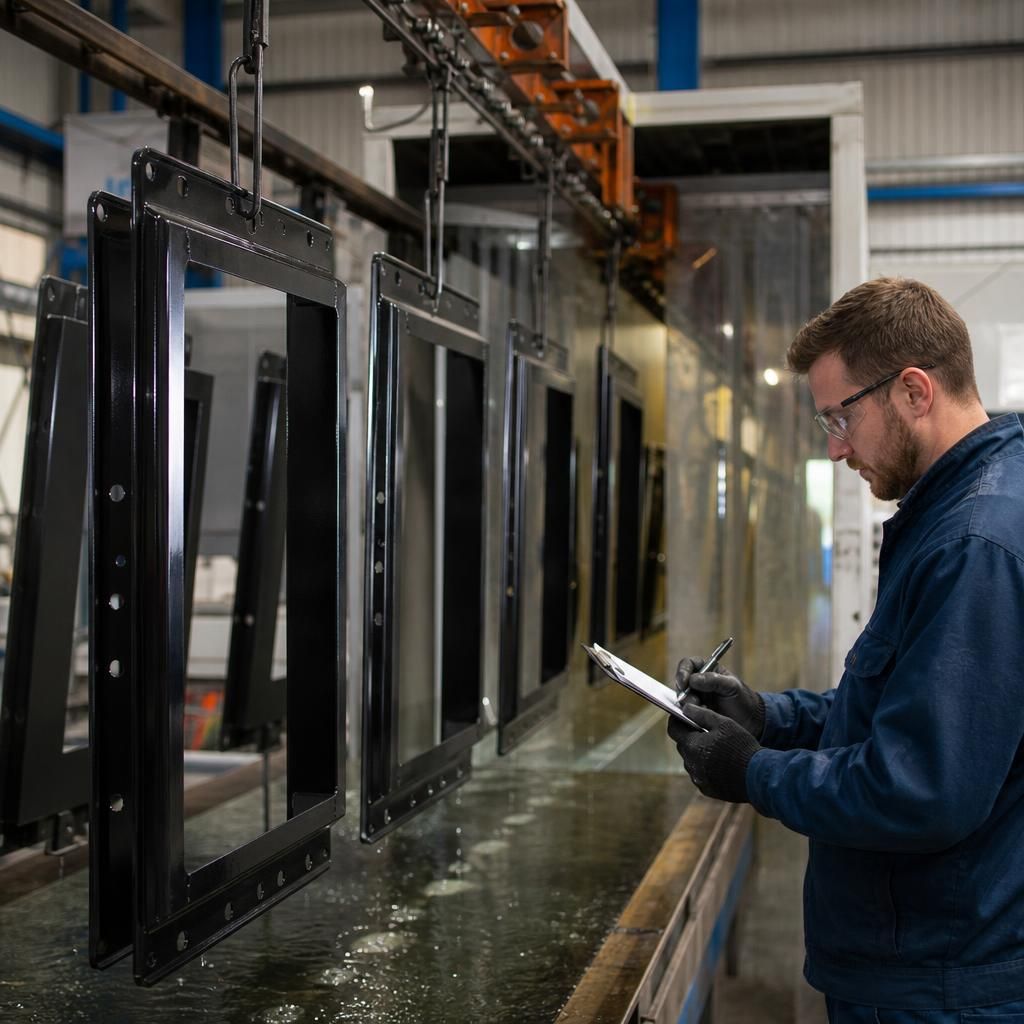
After cleaning, the steel should be treated as a controlled intermediate product rather than as finished work-in-progress. A clear hand-off standard between cleaning and phosphate treatment helps prevent acceptable parts from being mixed with components that need further preparation.
- Identify each batch or load against its cleaning process and inspection status.
- Define the conditions under which cleaned parts may be held before phosphating, including protection from dust, handling contamination and oxidation.
- Set a re-cleaning or re-inspection rule if parts are touched, exposed to contamination or fail the agreed acceptance checks.
- Keep non-conforming components segregated so they cannot enter the phosphate stage unintentionally.
This approach gives operators a consistent release decision and creates traceability when a phosphate coating or subsequent powder finish shows an unexplained defect.