

What safety precautions should be followed during the sandblasting process to ensure environmental compliance and worker safety?
Safe sandblasting requires a documented risk assessment, trained operators, suitable respiratory and personal protective equipment, enclosed or controlled blasting areas, and effective dust extraction to prevent exposure and environmental release. Operators should also inspect equipment, contain spent media and debris, prevent contamination of drains or soil, and store and dispose of waste in line with applicable environmental requirements.
Environmental compliance and worker safety during sandblasting depend on controlling the complete process: identify the substrate and existing coating, restrict access, prevent hazardous exposure, manage noise and static, and document the handling of used abrasive and removed material. The controls should be selected for the specific metal, coating and blasting method rather than treating every job as ordinary surface preparation.
Assess the coating before blasting. Existing paint or corrosion products may contain hazardous substances such as lead, chromium compounds or other metals. Where the coating history is uncertain, arrange suitable sampling or obtain information from the asset owner before work begins. The results determine the required control measures, waste classification and whether specialist procedures are needed. Do not blast unidentified coatings on the assumption that they are harmless.
Control access and protect nearby activities. Establish a clearly marked exclusion zone around the blasting operation, with suitable barriers and warning notices. Keep unprotected personnel away from rebound, flying debris, compressed-air lines and contaminated dust. Consider adjacent workshops, roads, ventilation intakes, watercourses and neighbouring premises when positioning the work area. Outdoor blasting should be stopped or adapted if wind, rain or other conditions could carry abrasive or contaminants beyond the controlled zone.
Use appropriate blasting equipment and operating controls. The blast pot, hoses, couplings, nozzle and compressed-air supply must be compatible with the operating pressure and abrasive. Couplings should be secured against accidental separation, and the system should include a functioning dead-man control that stops blasting when the operator releases it. Remote shut-off arrangements are particularly important where the nozzle operator cannot immediately reach the equipment. Hoses and connections should be routed to reduce trip, crushing and vehicle-damage risks, while pressure must be released before adjustments or disconnection.
Static electricity can accumulate during abrasive blasting. Bonding and earthing arrangements should be suitable for the equipment and work environment, with ignition sources controlled where flammable vapours, combustible residues or other fire hazards may be present. The compressor intake should be positioned so that it does not draw in exhaust fumes, solvent vapour or contaminated air. Equipment should be operated in accordance with the manufacturer’s instructions and the site’s applicable safe-working procedures.
Manage dust at source. Select an abrasive and process that achieve the required surface profile without creating unnecessary hazardous dust. Abrasive containing respirable crystalline silica requires particular caution because inhalation can cause serious long-term lung disease; alternatives should be considered where technically suitable. Use the lowest practical blasting pressure and an appropriate nozzle size for the required finish, since excessive energy can increase dust, rebound and substrate damage. Air monitoring or exposure assessment may be appropriate where the material being removed presents a significant inhalation risk.
Address noise, vibration and physical strain. Blasting can produce high noise levels and significant hand-arm vibration, especially during extended nozzle operation. A noise and vibration assessment should identify whether exposure limits, job rotation, equipment selection or health surveillance are required. Operators should also be protected from awkward postures, hose reaction forces, manual handling of blast pots and difficult access around large components. Lifting aids and stable work platforms reduce the likelihood of musculoskeletal injuries.
Plan for emergencies. Operators and nearby workers should know how to stop the air supply, isolate the blast pot and summon assistance. The site should have procedures for hose failure, loss of containment, eye or skin contact, suspected inhalation, fire and damage to nearby property. First-aid arrangements should reflect the hazards of high-pressure air, flying particles, hazardous coatings and compressed equipment. Compressed air must never be directed at a person or used to clean contaminated clothing or skin.
Keep environmental controls auditable. Record the material blasted, the abrasive used, the quantity of waste produced, any contamination identified and the route by which waste leaves the site. Waste should be kept in clearly labelled, secure containers, separated where different materials cannot be mixed safely, and protected from rain or wind. Reusing abrasive is only suitable where its condition and contamination status have been assessed; spent material containing removed paint or metal residues must not be treated as clean abrasive.
UK waste requirements generally place a duty on the producer to describe waste accurately, use an authorised carrier and retain the appropriate transfer or consignment documentation. The exact classification depends on the coating, substrate and abrasive, so it should be confirmed from the material assessment rather than guessed. Any accidental release should be recorded, isolated and reported through the site’s environmental procedure where required.
Before work starts, the responsible person should confirm that the control measures remain effective, that operators understand the method statement, and that changes to the coating, component size, abrasive or work location trigger a fresh review. After blasting, the area should be checked for residual abrasive, contaminated dust and damage to surrounding surfaces before barriers are removed or the component moves to the next stage of coating preparation.
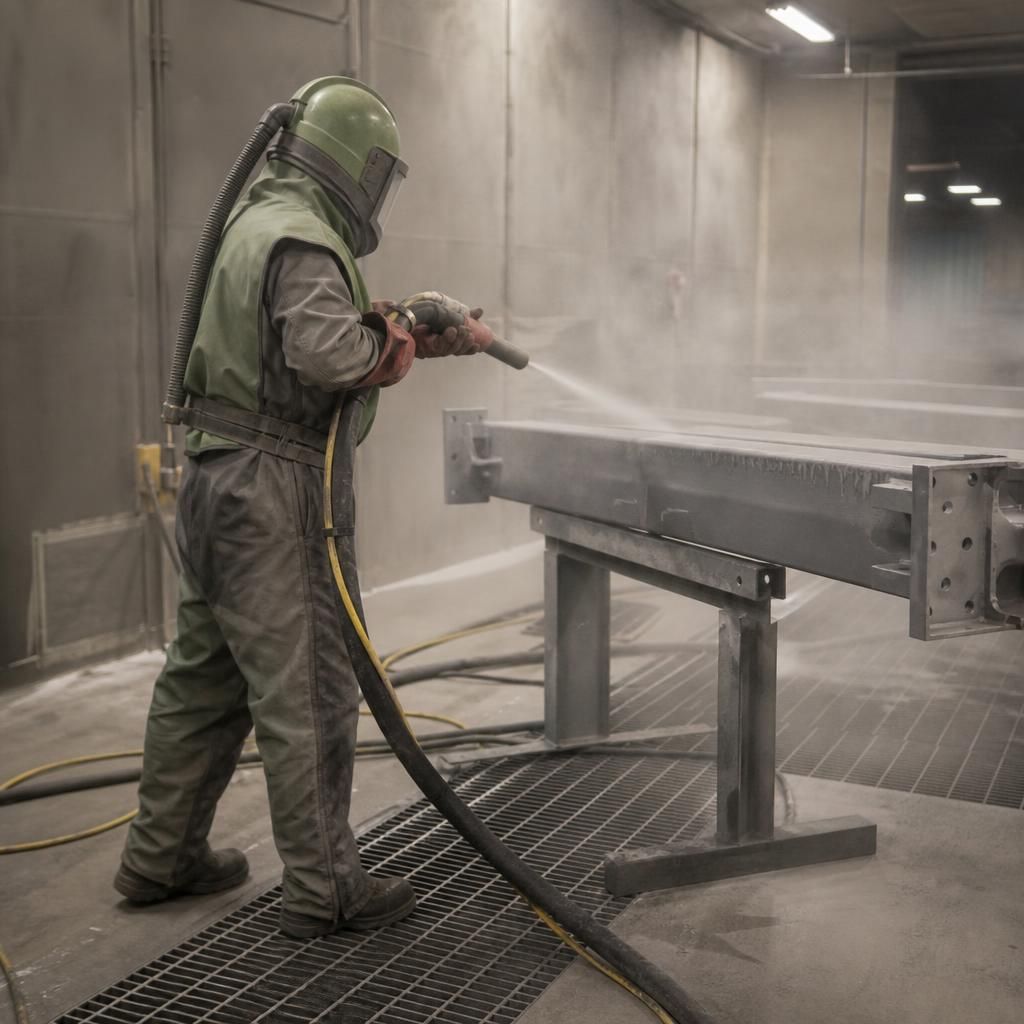
Decontamination controls prevent abrasive, dust and removed coating residues from spreading beyond the blasting area or being carried home on clothing and equipment. A controlled transition between the work zone and clean areas should be included in the method statement, particularly where existing coatings may contain hazardous substances.
- Provide a defined clean area for storing personal belongings, food and drinks, separate from contaminated workwear and equipment.
- Keep blasting clothing and footwear within the controlled area where practicable, and clean or remove them using methods that do not redistribute dust into the air.
- Require workers to wash their hands and face before eating, drinking or leaving the site.
- Prevent contaminated clothing, abrasive and tools from entering offices, vehicles or other clean work areas without suitable cleaning or containment.
- Use housekeeping methods that capture residues rather than dispersing them; dry sweeping and unfiltered compressed air can spread fine contamination.
These arrangements should be checked during the work, not only after blasting has finished. Any contamination found outside the controlled area should be contained, cleaned using the site’s approved procedure and recorded where it could affect worker exposure or environmental release.
Discuss Your Sandblasting Safety and Compliance Requirements
Discuss your sandblasting safety and compliance requirements with the Powder-coatings.co.uk team, including the component, existing coating and proposed work environment. This helps establish suitable preparation controls before the work is planned.