

Which blasting media provides the most eco-friendly solution for rust removal while maintaining effectiveness?
Garnet is often the most balanced eco-friendly blasting medium for rust removal, combining effective cutting action with low dust and the potential for reuse. Recycled glass is another sustainable option, particularly where a less aggressive abrasive is suitable, but the best choice depends on the rust severity and metal substrate.
The most eco-friendly blasting media is not determined by the abrasive alone. It is the option that removes corrosion effectively while creating minimal dust, waste and surface damage, and that can be used efficiently for the particular metal and coating specification. In many rust-removal applications, garnet provides a strong environmental compromise; recycled glass can be appropriate where a less aggressive action is sufficient.
Assess the complete lifecycle rather than the material label. An abrasive may be described as natural, recycled or low-toxicity, but its overall environmental effect also depends on how much is consumed, whether it can be recovered, how much dust it produces, how it is transported and how the spent material must be handled. A medium that removes rust quickly with limited surface damage may have a lower total impact than a seemingly greener alternative that requires several passes or generates a large volume of waste.
Garnet is often suitable for heavily corroded steel and ironwork because its angular particles provide a useful cutting action. This can reduce the need for prolonged blasting and help remove tightly bonded rust, mill scale and existing coating residues. Its performance still depends on particle size, blasting pressure, nozzle distance and the condition of the component. Excessive pressure can increase dust, embed abrasive or produce an unnecessarily rough profile, so equipment settings should be matched to the substrate and the subsequent coating system.
Recycled glass is a practical choice when the corrosion is moderate or the substrate needs a gentler treatment. Its use can divert processed glass from disposal, but its environmental advantage depends on the specification and application method. It may be consumed more quickly than a harder abrasive in demanding work, meaning that the total quantity used matters more than the fact that the material originated from recycled content. It should therefore be selected for jobs where its cleaning performance is sufficient rather than used automatically for every type of rust.
Other media can be appropriate in narrower circumstances:
- Steel grit is durable and can be recycled through suitable blasting equipment, making it relevant for repeated work on robust steel components. Its weight, impact energy and potential for a sharper surface profile make careful control important.
- Glass beads produce a comparatively smooth finish and are useful where the objective includes cleaning and finishing rather than aggressive removal. They are less suited to deeply bonded rust that requires substantial cutting action.
- Walnut shell is a relatively soft option for delicate cleaning, but it is generally not the first choice for firmly adhered rust on structural or heavily fabricated steel.
- Sodium bicarbonate can be useful where water-soluble residue and a relatively soft cleaning action are desirable. It is normally a specialist choice rather than a general replacement for a high-cut abrasive.
Dust control is a major part of environmental performance. Dry blasting can release fine particulate matter from the abrasive, rust and old coatings. Extraction, suitable containment and correctly selected personal protective equipment help control that dust and prevent it spreading beyond the work area. Wet or vapour-assisted processes may suppress airborne dust in suitable applications, although they introduce water management, drying and corrosion-control requirements that must also be considered.
Reuse and recovery should be planned before blasting begins. Reusable media can sometimes be collected, screened and returned to the blasting process, but its practical recovery depends on the equipment, enclosure and contamination level. Once abrasive is mixed with rust, paint, oil or other residues, it may need to be treated as controlled waste. If an old coating could contain hazardous substances, the coating debris must be assessed and managed according to the applicable waste requirements rather than treated as clean abrasive.
The surface profile is another environmental consideration because it affects the powder-coating system applied afterwards. An excessively rough or uneven profile can increase powder use, create coverage problems or require additional preparation. Conversely, insufficient cleaning or an unsuitable profile can compromise adhesion and lead to premature coating failure, creating avoidable rework and further waste. The chosen abrasive should therefore leave a clean, suitably keyed surface without removing sound metal unnecessarily.
For a practical selection, compare each candidate against the following points:
- the severity and type of corrosion;
- the metal substrate and its sensitivity to impact or heat;
- the surface profile required by the intended coating;
- the abrasive’s dust characteristics and containment requirements;
- whether the medium can be collected, screened and reused;
- the likely volume and classification of spent material; and
- the energy, water and additional preparation required to achieve the result.
In summary, garnet is commonly the most balanced option for demanding rust removal, while recycled glass can offer a lower-impact route for less aggressive work. The genuinely eco-friendly decision comes from matching the abrasive to the substrate and corrosion, controlling the process accurately, recovering material where feasible and ensuring that contaminated waste is managed correctly. For industrial components being prepared for powder coating, a blasting specification should be agreed around the required cleanliness and surface profile rather than selecting media on sustainability claims alone.
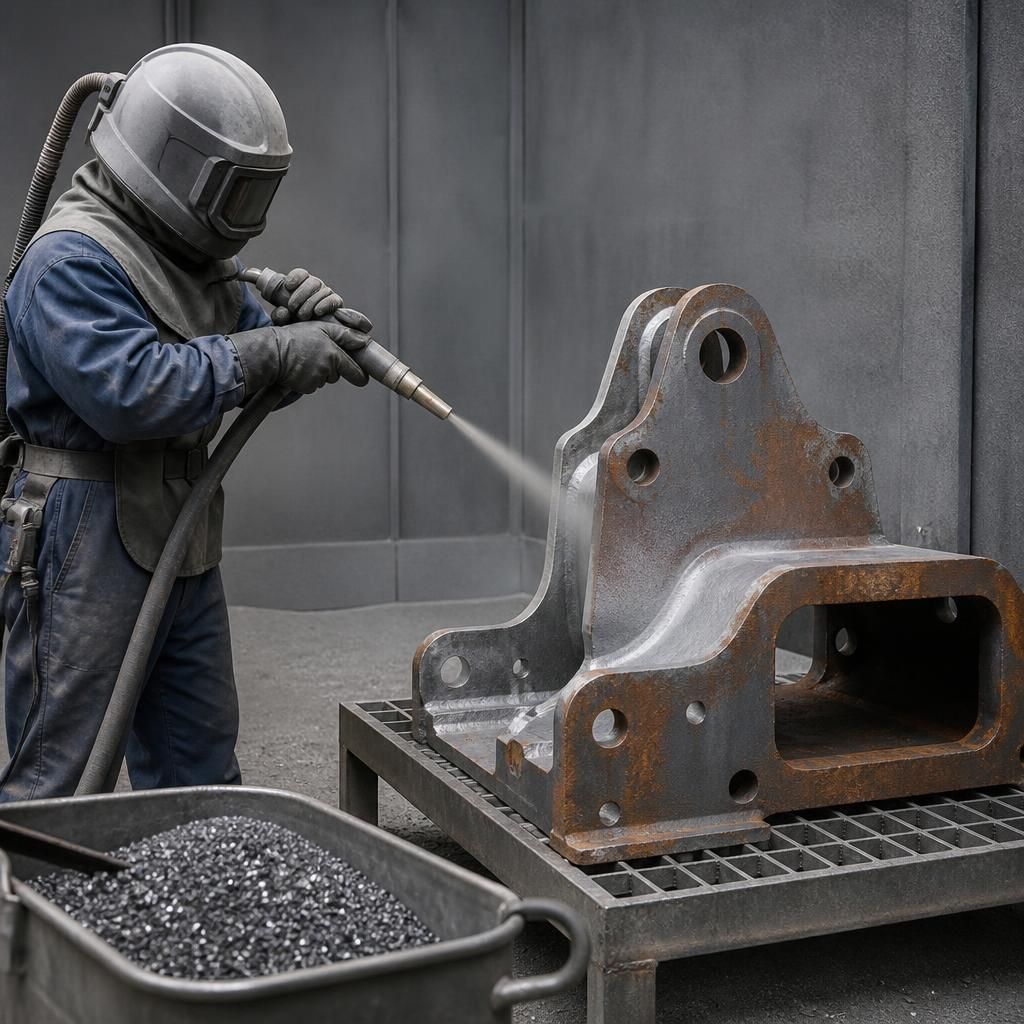
For repeated blasting of robust steel components, reusable steel grit can provide a lower-waste solution than a single-use abrasive. Its durability allows it to pass through suitable recovery and separation equipment, so usable particles may remain in the blasting cycle rather than being replaced after one operation. This can make it environmentally preferable where the same type of work is carried out regularly in a controlled facility.
Its suitability depends on the component and the required finish. Steel grit is too aggressive for some thin or delicate metalwork, and its impact can create a sharper surface profile than required. The sustainable choice is therefore the medium that achieves the specified cleanliness in the fewest suitable passes while remaining compatible with the recovery system, rather than simply the abrasive with the most favourable environmental description.