

What benefits does Interpon D1036 Matt offer for bespoke aluminium projects in terms of customisation and finish quality?
Interpon D1036 Matt gives bespoke aluminium projects scope for custom colours while maintaining a consistent, refined matt appearance. Its durable finish helps achieve a high-quality result across made-to-measure components and coordinated project elements.
Interpon D1036 Matt supports bespoke aluminium projects by combining specification flexibility with a controlled architectural appearance. Its value is not limited to selecting a colour: the coating can help designers coordinate aluminium components with the wider building scheme while retaining the clean visual definition expected from a professionally finished metal surface.
For custom projects, the finish can be considered as part of the overall design specification rather than treated as a final afterthought. This is useful where aluminium panels, trims, frames, fabricated sections or other coordinated components need to sit within the same visual scheme. Colour selection should be agreed against an approved sample, particularly where adjacent materials, lighting conditions or different component profiles may affect how the finished shade is perceived.
- Design coordination: a specified coating colour can link separate aluminium elements across one project, supporting a unified appearance.
- Controlled sheen: the matt surface reduces strong reflected highlights compared with a higher-gloss finish, which can give façades and fabricated features a more restrained appearance.
- Clear component definition: the surface allows profiles, lines and formed details to remain visually legible without an overly reflective finish competing with the design.
- Specification clarity: defining the coating, colour, sheen and approved sample in the project documentation gives fabricators and finishers a clear reference for quality control.
Finish quality depends on more than the product name. Aluminium must be appropriately prepared, and the coating needs to be applied and cured in accordance with the relevant technical requirements. The condition of the metal, the cleanliness of the surface, coating coverage, cure control and handling after application all influence the final result. On bespoke components, these controls are especially important because folds, corners, apertures and changes in profile can make defects or uneven coverage more noticeable.
A sample or trial piece is valuable before full production. It allows the project team to assess the selected shade and matt appearance on the intended aluminium substrate, under representative lighting and alongside nearby materials. It also provides a practical reference for checking later components. Where parts are produced in separate batches, retaining the approved sample and recording the agreed specification helps reduce uncertainty during inspection.
The matt finish can be particularly suitable when the design requires a low-key surface rather than a strongly reflective one. However, matt coating should not be used to conceal poor fabrication or preparation: scratches, contamination, dents and uneven substrate treatment can still affect the appearance. Good detailing, suitable pre-treatment and careful handling remain essential to achieving the level of finish expected from a bespoke aluminium project.
In practical terms, Interpon D1036 Matt is most effective when the coating is selected early, samples are approved before manufacture and the same requirements are communicated to everyone involved in fabrication, coating and installation. That approach makes the customisation decision measurable and gives the finished aluminium work a defined visual standard against which it can be assessed.
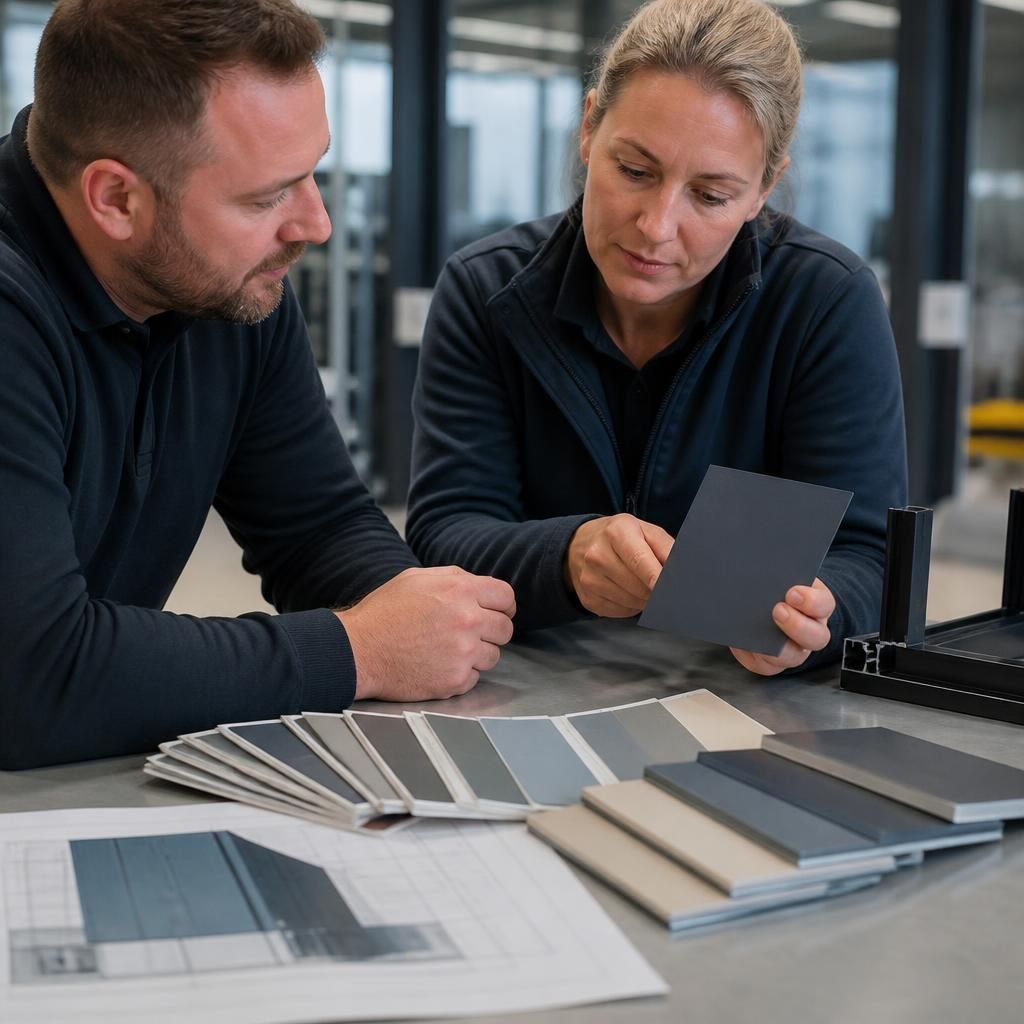
A key consideration when specifying Interpon D1036 Matt is that the matt sheen affects how the chosen colour is perceived. Compared with a glossier surface, it generally produces softer highlights, so the same colour reference may appear different when viewed on another finish, substrate or under different lighting. Colour decisions should therefore be assessed using a physical sample with the specified matt coating rather than relying solely on screen images or gloss-finish references.
This approach helps bespoke aluminium projects achieve a more reliable visual match between the intended design and the completed components. It is particularly relevant where colour forms part of a wider architectural palette, because surrounding glass, stone, cladding and painted surfaces can alter how the aluminium shade is seen. Recording the approved colour reference together with the matt finish gives the project team a clearer basis for reviewing later production.