

What factors should be considered when selecting a finish thickness for RAL 2000 powder coat to balance appearance and protection for aluminium applications?
Select the RAL 2000 powder coat thickness by balancing the required visual finish with the aluminium component’s exposure to moisture, abrasion, chemicals and weathering. The specification should consider the powder manufacturer’s recommended application range, the component’s shape and edges, the required colour and texture uniformity, and whether additional thickness could cause defects such as poor flow, uneven coverage or loss of detail.
Finish thickness for RAL 2000 powder coat should be selected as a specified dry film thickness range, rather than treated as a case of applying as much powder as possible. The suitable range must provide consistent colour and texture while remaining compatible with the aluminium component’s service duty, dimensional tolerances, coating system and inspection requirements.
Start with the required performance specification. The coating thickness should be linked to the performance level required by the project, the relevant industry or customer specification, and the conditions in which the component will be used. A decorative indoor component may require a different specification from aluminium used externally, in a plant environment or as part of a heavily handled assembly. Thickness is only one part of the protective system; suitable aluminium pre-treatment, correct powder selection and complete curing are also essential. Increasing film build cannot compensate for inadequate preparation or an incorrectly cured coating.
Separate appearance requirements from protective requirements. RAL 2000 is a defined colour, but the visual result also depends on gloss level, surface texture, substrate condition and the consistency of the film. A film that is too thin may produce uneven opacity, visible variation over the aluminium or an inconsistent appearance around profiles and formed sections. A film that is unnecessarily thick can alter the intended texture, soften fine detail and make surface imperfections more noticeable. The target should therefore be a controlled, even film within the powder manufacturer’s technical range, not simply the highest achievable reading.
- Colour uniformity: assess whether the part must match other RAL 2000-coated components, particularly where parts are manufactured in separate batches or have different geometries.
- Gloss and texture: specify the required finish alongside the thickness, since smooth, textured and low-gloss surfaces can give different visual impressions even when the measured film build is similar.
- Edge and profile coverage: consider whether the component includes returns, recesses, apertures or narrow sections that may receive a different film build from broad, accessible faces.
- Dimensional control: allow for the coating on mating faces, slots, threads, holes, bearing seats and close-fitting interfaces. Excess film can interfere with assembly or alter clearances.
- Functional surfaces: identify areas that require electrical contact, bonding, sliding movement, sealing or heat transfer, and define whether they need masking or a separate coating allowance.
Consider the aluminium alloy and substrate condition. Different aluminium components can vary in surface profile, porosity, extrusion marks, machining marks and susceptibility to visible surface variation. A thicker film may conceal some minor visual differences, but it will not reliably remove deeper defects and may make changes in surface texture or orange-peel more apparent. The required finish should be agreed with reference to the actual component, not only a flat test panel.
Account for manufacture and handling. The selected thickness should remain practical for racking, transport, assembly and subsequent use. Areas that are repeatedly handled or exposed to contact may need a specification based on the complete coating system and the expected type of wear, rather than an arbitrary increase in powder thickness. Components with tight tolerances may need uncoated zones, controlled masking or a drawing note identifying critical dimensions.
Use measurement and acceptance criteria. Dry film thickness should be checked using a suitable calibrated gauge and a defined measurement procedure for coated aluminium. The specification should state the target range, the locations to be checked and how readings are to be assessed. Measurements should cover representative faces and any areas where geometry or access could influence the result. Visual inspection should be considered alongside gauge readings, checking for colour consistency, craters, pinholes, runs, excessive texture, poor edge coverage and other finish defects.
Where appearance is particularly important, a representative sample or first-off component can be used to confirm the agreed RAL 2000 appearance before a production batch proceeds. This allows the customer and coater to assess the colour, gloss, texture, coverage and fit of the finished part together. The approved sample should be viewed under consistent lighting and retained as a reference where repeat production or multiple component types are involved.
In practical terms, the best specification is a controlled thickness range supported by the powder system’s technical data, the component drawing, the service conditions and agreed inspection criteria. It should be thick enough to deliver the required protective performance and opacity, but not so thick that it creates dimensional problems, visual defects or inconsistent curing. For aluminium applications, appearance and protection are most reliably balanced when film build is considered as part of the complete preparation, application and quality-control process.
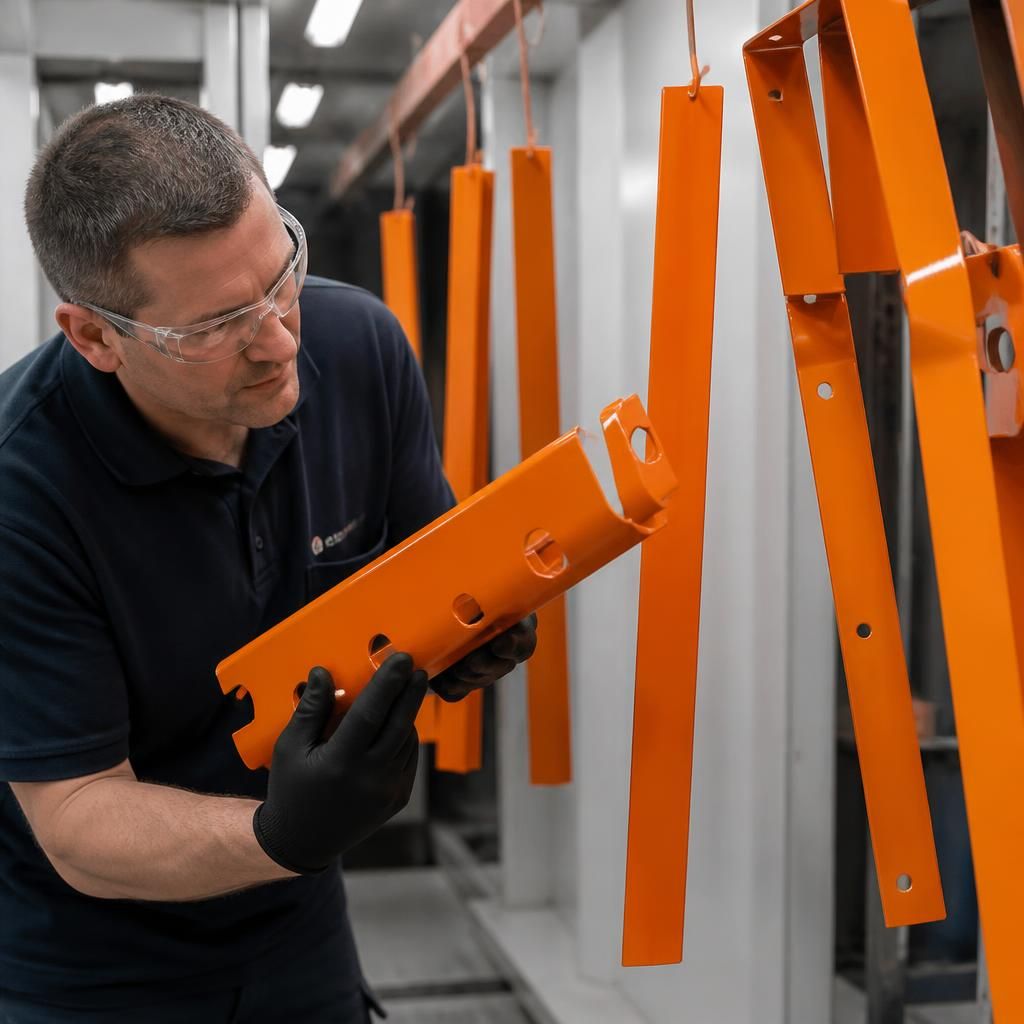
The protective value of a RAL 2000 powder coat on aluminium depends not only on film thickness, but also on how the component is designed and exposed. Joints, folded sections, cut edges, fastener locations and enclosed recesses can retain moisture or contaminants, creating areas where a thicker visible film will not resolve the underlying risk.
When setting the specification, review drainage, contact with dissimilar metals, concealed faces and areas subject to repeated wetting or abrasion. These details may require design controls, masking or a defined coating system rather than simply increasing the finish thickness. This approach helps ensure that the selected film build supports the component’s actual service conditions without affecting fit or appearance.
Discuss Your RAL 2000 Powder Coat Thickness Requirements
Discuss your aluminium component, service conditions and finish requirements with the powder-coating team to establish a suitable RAL 2000 film thickness range and inspection approach. Provide drawings or representative parts where possible so the specification can account for critical dimensions, geometry and appearance.