

What are the best practices for preventing rust spotting and ensuring long-term durability in powder coat primer applications?
Prevent rust spotting in powder coat primer applications by removing corrosion and contaminants thoroughly, preparing the metal correctly, and applying a primer suited to the substrate and exposure conditions. Long-term durability depends on consistent film coverage, controlled curing to the powder manufacturer’s specification, and inspection for thin areas, pinholes or damage before the coated component enters service.
The most effective way to prevent rust spotting in powder coat primer applications is to control the whole corrosion-protection system, from component design and fabrication through to coating, handling and service. Rust commonly develops at crevices, welds, sharp edges, drainage points and damaged areas where moisture remains trapped or the protective film is locally weakened.
Design components to avoid water retention. Before coating, review the part for features that can hold water or create uncoated recesses. Where practical:
- Provide suitable drain and ventilation openings in hollow sections.
- Avoid unsealed overlaps, narrow crevices and deep recesses that cannot be cleaned or coated effectively.
- Use radiused edges rather than extremely sharp corners, which are more likely to receive a thinner protective film.
- Prevent direct contact between dissimilar metals where this could promote galvanic corrosion.
- Ensure joints, fasteners and contact surfaces are compatible with the intended exposure conditions.
Fabrication quality is equally important. Weld spatter, slag, sharp burrs and rough transitions can create local corrosion sites beneath or alongside the coating. Welds should be continuous where the design requires a sealed joint, and fabrication defects should be corrected before the component enters the coating process. Particular care is needed around brackets, folded returns, threaded areas and interfaces that will be assembled after coating.
Control moisture and the risk of flash rust. A prepared steel surface should not be allowed to remain exposed to damp conditions before primer application. Condensation can form even when the metal feels dry, especially where the component is colder than the surrounding air. Store prepared parts in a clean, dry environment, allow them to reach suitable processing conditions and avoid moving them between areas where condensation may occur. If visible discolouration or flash rust develops, the surface should be reassessed rather than coated over.
Match the primer system to the substrate and exposure. Bare mild steel, galvanised steel and previously coated components present different corrosion-control requirements. The primer must be chemically compatible with the substrate, any conversion treatment and the intended topcoat. The selection should also reflect whether the finished part will face indoor humidity, outdoor weather, road salt, industrial chemicals, abrasion or repeated wet-and-dry cycling. A primer that performs adequately in a dry internal environment may not be suitable for a heavily exposed component.
For demanding applications, the coating specification should define the complete system rather than naming the primer alone. It should cover the substrate condition, pretreatment, primer and topcoat compatibility, target film build, curing requirements, acceptable appearance and inspection methods. Any change to the substrate, pretreatment chemistry or topcoat should be checked for compatibility before production work proceeds.
Pay particular attention to edges and complex geometry. Electrostatic application can make recessed areas, internal corners and closely spaced features more difficult to coat consistently. The component should be positioned and earthed so that the powder can reach the required surfaces without excessive build-up or shielding. Racking points should be planned in areas that will not compromise corrosion protection, and contact marks should be repaired where they expose metal.
Do not judge durability solely from the visible face of a component. Inspect welds, returns, holes, undersides, fixing points and areas around racking contacts. A coating can appear uniform on accessible faces while leaving vulnerable locations with insufficient protection. Where the part design makes inspection difficult, agree the inspection approach before coating rather than relying only on a final visual check.
Verify the process with documented checks. A practical quality-control record can include:
- Substrate identity and condition before processing.
- Confirmation that fabrication residues and treatment residues have been removed.
- Primer and topcoat batch details, application settings and production sequence.
- Film-thickness readings taken at representative high-risk locations.
- Visual inspection of edges, recesses, welds and contact points.
- Adhesion or porosity testing where the specification and substrate make those checks appropriate.
- Records of any repair, rework or deviation from the agreed coating specification.
Film thickness should be checked as a distribution across the component, not just at one convenient flat area. Excessive build can cause its own problems, including poor appearance, cracking or curing difficulties, while low-build areas may provide an easier route for moisture and corrosion. The correct acceptance range should come from the coating system specification and the service conditions.
Control curing by the metal temperature and the actual production load. The time shown on an oven controller does not necessarily represent the time at which the component has reached the required curing condition. Large, heavy or densely loaded parts can heat differently from small parts. Where durability is critical, curing verification should account for component mass, rack arrangement and oven loading, with records retained as part of the process control system. Under-cured or over-cured material can reduce the expected performance of the complete coating system.
Handling and storage after coating can undo otherwise effective corrosion protection. Use clean supports and suitable separators, avoid dragging parts across one another and protect coated surfaces from standing water, condensation and contamination. Components should not be stacked in a way that traps moisture against edges or contact points. If coating is damaged during transport or assembly, the repair should be made with a compatible system after the area has been cleaned back to sound material.
Finally, establish an inspection and maintenance procedure for components used in corrosive environments. Early rust staining at a cut edge, fastener, weld or impact mark should be investigated before it spreads beneath the coating. The appropriate repair depends on whether the defect is superficial contamination, local coating damage or underfilm corrosion. Removing the cause, preparing the affected area properly and restoring a compatible protective layer is more reliable than simply painting over the visible mark.
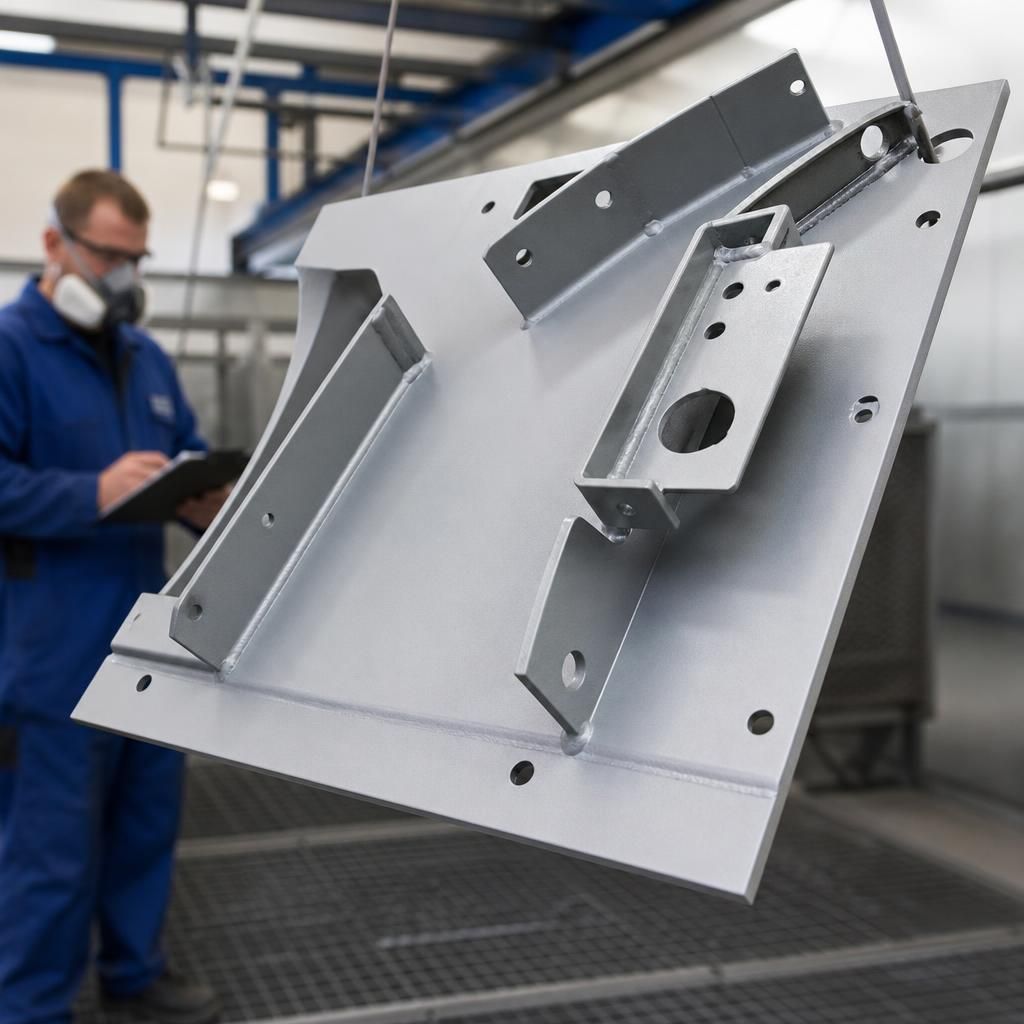
A representative trial panel is a practical way to verify powder coat primer durability before processing a full production batch. The panel should use the same metal substrate, pretreatment, primer, topcoat and curing process as the finished components, rather than a convenient flat test piece that does not reflect production conditions.
Include features that may influence corrosion protection, such as welds, folded edges, recesses, holes and racking contact areas. After curing, assess the panel for coverage, film build, adhesion and visible defects, and carry out any agreed performance testing for the intended service environment. This approach can identify incompatibility, inadequate coverage or curing issues while the coating specification can still be adjusted without compromising an entire batch.
Discuss Your Powder Coat Primer Requirements
Discuss your powder coat primer requirements with the team, providing details of the substrate, component design, exposure conditions and required finish. This will help establish a suitable corrosion-protection system and inspection approach for your application.