

How does the powder coating process for electrical insulation maintain component performance across various environmental conditions?
Electrical insulation powder coating maintains component performance by forming a continuous, cured polymer layer that separates conductive surfaces and shields the metal from moisture, heat and other environmental stresses. Suitable powder selection, thorough surface preparation and controlled curing help the coating retain its adhesion, insulation properties and physical integrity as conditions change.
Electrical insulation powder coating maintains component performance across changing environmental conditions when the coating system, component design and application controls are matched to the intended service environment. The finished coating must continue to provide stable electrical separation while resisting the particular combination of temperature variation, humidity, chemicals, ultraviolet exposure, abrasion and mechanical movement that the component will experience.
Environmental conditions that affect performance
- Temperature: Repeated heating and cooling cause the metal substrate and coating to expand and contract. A suitable system must tolerate this thermal cycling without cracking, lifting or losing its mechanical integrity. The actual operating temperature, peak exposure and duration of exposure should be considered rather than relying only on a general indoor or outdoor classification.
- Humidity and condensation: Moisture can reduce surface resistance if it reaches an unsuitable area, contaminates the component or collects around joints and recesses. Part geometry, drainage and the absence of uncoated vulnerabilities are therefore important alongside the insulating layer.
- Chemical exposure: Oils, cleaning agents, fuels, solvents and process chemicals can soften, swell or otherwise damage a coating that is not designed for them. The chemical environment should be identified before coating so that resistance requirements are included in the specification.
- Ultraviolet exposure: Exterior components may be exposed to sunlight as well as rain and temperature changes. A coating selected for the application should retain its relevant physical properties under the expected exposure, rather than being chosen solely for colour or appearance.
- Abrasion and impact: Handling, vibration, installation and contact with adjacent parts can damage the coating. Resistance to wear and impact is particularly relevant where the insulating surface may be rubbed, struck or used as part of an assembly.
How the process supports consistent results
Performance starts with the condition of the metal. Oil, rust, scale, old finishes and other contaminants can create weak areas beneath the coating. Cleaning and preparation establish a suitable surface for the powder system and help reduce defects that could develop during service. Any blasting, chemical preparation or pre-treatment must be appropriate for the substrate and the required finish.
Powder application must also account for the component’s shape. Recesses, internal corners, sharp edges, welds, holes and complex assemblies can receive powder differently from broad, accessible faces. Areas that are difficult to reach may be more vulnerable to thin coverage, while sharp features can affect the distribution of the deposited powder. Masking is used where electrical contact, threads, mating faces or dimensional tolerances must remain free from coating.
The curing stage converts the deposited powder into its finished coating. The relevant consideration is the metal part’s achieved temperature and the time required at that temperature, not simply the oven’s displayed air temperature or the time a part spends in the oven. Components with different thicknesses can heat at different rates, so cure verification should reflect the actual workpiece. Insufficient or uneven curing may affect the coating’s hardness, adhesion and resistance to the service environment; excessive heat can also be unsuitable for some substrates, inserts or assemblies.
Electrical reliability depends on more than coating thickness
A thicker layer is not automatically a better insulator. Excessive thickness can affect dimensions, assembly fit, heat transfer and the operation of moving or mating parts. Uniform coverage, a clean surface and the absence of pinholes, craters, inclusions, exposed edges and impact damage are generally more important than thickness considered in isolation.
Electrical design requirements must be assessed separately from the coating process. Clearances, creepage distances, contact points, sharp edges, voltage, current, heat generation and the location of the coated part all influence the insulation arrangement. Powder coating may form part of that arrangement, but it does not replace appropriate component design, isolation distances, earthing or other protective measures.
Checks before a component enters service
- Confirm the intended temperature range and likely thermal cycling.
- Identify moisture, condensation, chemicals, sunlight, abrasion and impact risks.
- Check that the powder system is suitable for the substrate and operating environment.
- Inspect coverage around edges, recesses, welds, holes and other difficult features.
- Verify that masked areas, contact points and dimensional requirements remain usable.
- Use agreed inspection or electrical tests where the application requires evidence of coating continuity or insulation performance.
These checks help distinguish a coating that merely appears sound from one that is appropriate for the component’s working conditions. During service, damaged areas should be assessed rather than concealed, particularly where a scratch, chip or exposed edge could affect electrical separation or allow corrosion beneath the coating. Correct specification, controlled preparation, suitable application and inspection together give electrical insulation powder coating the best chance of retaining component performance as environmental conditions change.
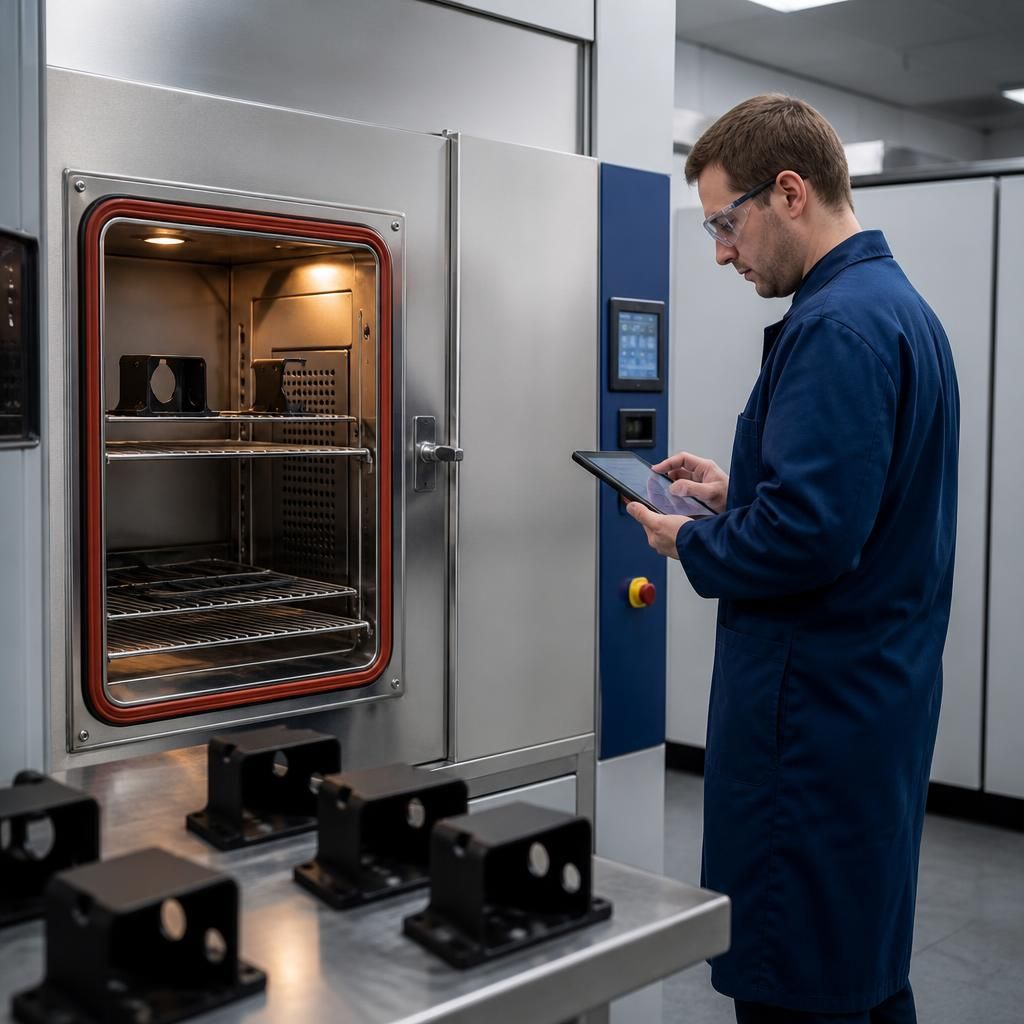
Environmental validation checks whether the insulation remains effective after exposure to the conditions it will encounter in service. Rather than assessing a newly cured coating only at room temperature, representative coated parts can be conditioned through the expected temperature and humidity range before evaluating dielectric strength, surface resistance and physical condition. Testing should also consider transitions between conditions, because condensation or rapid thermal change can reveal weaknesses that a single steady-state test may miss. This evidence helps confirm that the selected powder and application process are suitable for the component’s complete operating environment.
Discuss Your Electrical Insulation Powder Coating Requirements
Discuss your electrical insulation powder coating requirements with the team, including the component design, operating environment and any inspection or electrical performance criteria. This information can help establish whether the proposed coating system is suitable for the application.