

How do batch sizes and order volumes affect the pricing of powder coated aluminium?
Larger batches of powder coated aluminium often reduce the average cost per component because preparation, colour changes and equipment set-up are spread across more parts. Smaller or irregular orders can carry a higher unit price, while the final quotation also depends on component size, finish requirements, handling and whether parts can be processed together.
Batch size affects powder coated aluminium pricing because suppliers assess the total work involved in preparing, processing, checking and despatching an order, not simply the number of components. A larger, consistent production run may be priced more efficiently per item, whereas a small or fragmented requirement can attract a higher unit cost because the work involved is divided across fewer parts.
Total order volume versus release volume
The quantity required over the life of a project is not always the quantity priced for each production release. For example, one consolidated order is commercially different from the same total number of components supplied in several smaller consignments. Each release may involve order administration, production planning, identification, inspection, packaging and despatch. These activities can make frequent small releases more expensive than a single consolidated batch, even when the overall annual requirement is substantial.
When requesting a quotation, it is therefore useful to state both the total expected requirement and the quantity needed per delivery. Suppliers can then assess whether the work should be priced as one production batch, several planned batches or a repeat order with agreed specifications.
Why consistent batches are easier to price
Order volume has the greatest pricing benefit when the components are consistent. Parts with the same alloy, dimensions, preparation requirements, coating specification and packing method can usually be treated as one repeatable production group. This makes the labour, inspection process and packaging requirements easier to define.
A nominally large order may not receive the same treatment if it contains many unrelated components. Different profiles, fixing methods, masking arrangements or inspection requirements can divide the work into separate production groups. The relevant measure is therefore not only the number of aluminium parts, but how many distinct part types and processing instructions are included.
Minimum charges and pricing structures
Powder coating quotations may use different pricing structures, depending on the job. Common approaches include a charge per component, per batch, by surface area, by weight or a combination of these. A minimum production or handling charge is also common for small orders, because certain costs arise even when only a limited number of parts are supplied.
This means that doubling the quantity will not necessarily double the quotation, and reducing the quantity will not necessarily reduce the price in direct proportion. Some costs remain broadly fixed for a particular order, while others increase with the number of parts or the amount of material processed. The quotation should make clear whether charges apply to the complete order, each part type or each separate delivery.
Repeat orders and retained specifications
Regular production work can be easier to budget when the component specification remains unchanged. A repeat order can be quoted against an established description of the aluminium, coating system, colour, masking points, acceptance standard and packing method. This reduces uncertainty when comparing one release with the next, although the price can still change if the quantity, specification or delivery arrangement changes.
Businesses with ongoing demand should distinguish between a forecast and a firm order. A forecast can help indicate likely volume, but it does not necessarily provide the same pricing basis as a confirmed batch. If demand is uncertain, it may be worth asking for separate pricing for the initial order and subsequent repeat releases rather than assuming that a projected total will be treated as one guaranteed volume.
How to compare quotations fairly
- Compare the same number of components and the same number of part types.
- State whether the quantity is supplied in one delivery or split into multiple releases.
- Provide the expected frequency of repeat orders where the work is ongoing.
- Check whether the quotation includes inspection, packaging, collection or delivery arrangements.
- Ask whether a minimum charge applies to the order or to each separate batch.
- Confirm how shortages, rejects, replacements and additional pieces will be handled.
It is also important to compare the effective unit price rather than looking only at the headline batch total. A larger order may have a lower price per component but create additional storage, cash-flow or inventory costs for the purchaser. Conversely, smaller releases may cost more per part but reduce the need to hold finished stock. The lowest coating price is not automatically the lowest overall procurement cost.
For an accurate assessment, provide the supplier with the quantity per part number, total expected volume, required release pattern and any planned repeat orders. This allows the price to reflect the actual production arrangement rather than an assumed batch size. For manufacturers and fabricators, documenting these details at the enquiry stage is particularly useful when comparing quotations or reviewing whether consolidating future orders would improve cost control.
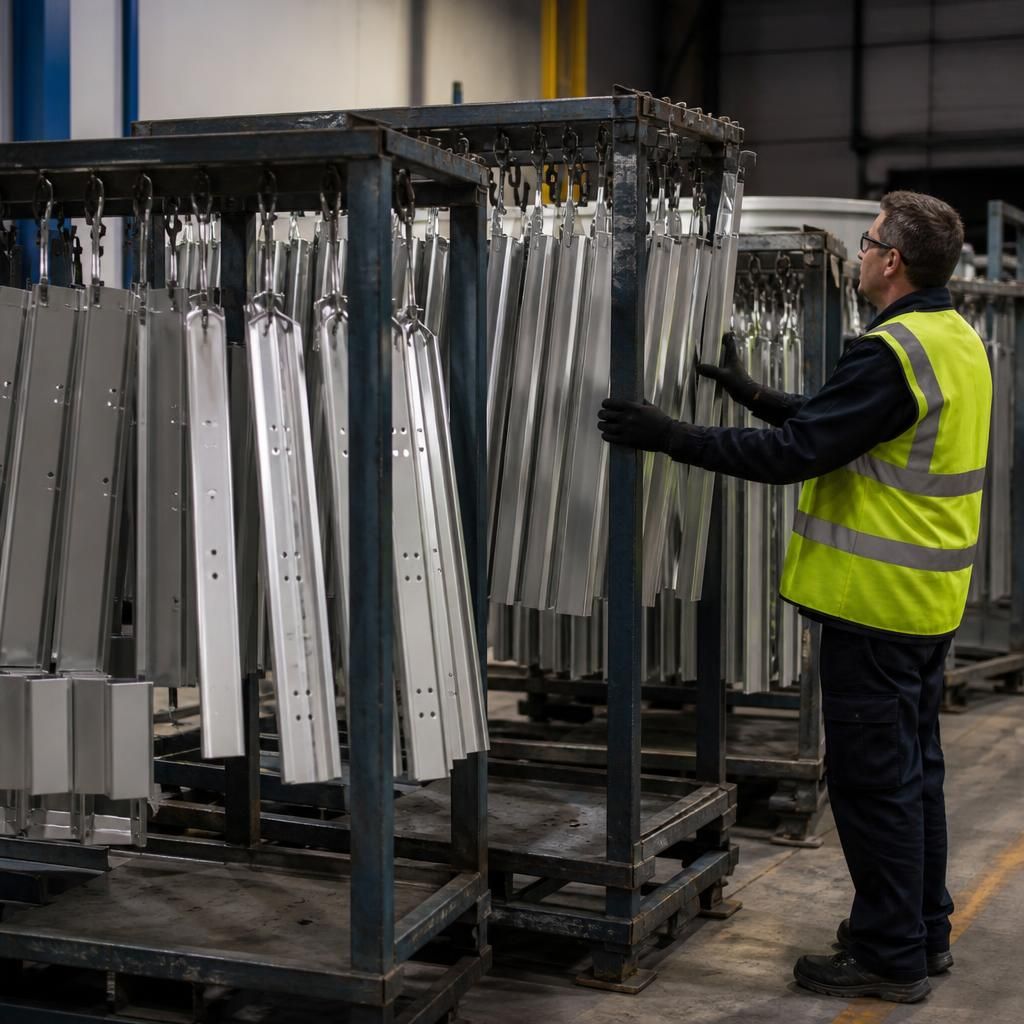
Order volume is assessed alongside how efficiently the aluminium components use the coating equipment. A batch containing many small parts may be processed differently from the same number of large sections, because rack space, oven capacity, hanging points and manual handling affect the amount of work involved. The number of pieces alone therefore does not determine the unit price.
When requesting a quotation, provide the dimensions and approximate weight of each part type, together with the quantity required. This helps the coater establish how the parts can be loaded and whether the stated volume represents a practical production batch. It also gives a more reliable basis for comparing prices where different suppliers may be allowing for different loading and handling arrangements.