

What environmental and safety standards must automated powder coating lines comply with to ensure regulatory adherence?
Automated powder coating lines in the UK must be designed and operated in line with requirements including COSHH, DSEAR and, where explosive atmospheres may arise, ATEX principles, alongside PUWER requirements for safe machinery, guarding, extraction and emergency controls. Environmental compliance also requires appropriate management of airborne emissions, powder recovery, waste classification and disposal, with the site’s permits, risk assessments, inspection records and staff training reflecting the specific installation.
Compliance for an automated powder coating line is not established by a single certificate. The operator must demonstrate that the complete installation, including conveyors, ovens, spray equipment, controls, ventilation, recovery equipment and associated electrical systems, is suitable for its intended materials and production conditions. Requirements apply at design, commissioning, operation, maintenance and modification stages.
Machinery conformity and design documentation should be established before the line is put into service. The supplier or integrator should identify the machinery supplied, complete a documented risk assessment and provide the applicable declaration of conformity, operating instructions and information on residual risks. Where the installation is assembled from several machines, responsibility for the safety of the integrated system must be clear rather than divided between suppliers.
- Guarding, access doors and interlocked panels should prevent access to moving or hot parts during operation.
- Control systems should prevent unexpected start-up after a fault, power interruption or opened access point.
- Safe isolation arrangements should cover electrical, pneumatic, hydraulic, thermal and stored mechanical energy.
- Maintenance access should be designed into the line, rather than relying on operators to work around production equipment.
The line’s control system also needs to be assessed for foreseeable failures. For example, a fault in a temperature sensor, conveyor position sensor or extraction proving switch should not allow an unsafe sequence to continue unnoticed. Safety functions should be tested during commissioning and after relevant changes, with test results retained as part of the technical record.
Product and chemical information is another important part of regulatory control. Powder coatings, pretreatment chemicals, cleaners and maintenance substances should be supported by current safety data sheets and correctly labelled under the applicable GB chemical classification and labelling requirements. The site should maintain an inventory of materials used on the line, check compatibility between chemicals and equipment, and review whether a less hazardous product or process is reasonably practicable.
Environmental compliance depends on the actual installation and its location. Before construction or expansion, the operator should establish whether the process requires an environmental permit, local authority approval, registration or a relevant exemption. This assessment can depend on the coating materials, pretreatment stages, fuel use, oven arrangements, throughput and discharge routes. Permit conditions may impose additional requirements for monitoring, operating limits, maintenance and reporting, so generic industry practice cannot replace a site-specific review.
Where the process produces wastewater, the discharge route must be confirmed with the relevant sewerage undertaker or environmental regulator. Pretreatment chemicals, contaminated rinse water, sludge and filter media may require separate controls. Clean drainage and process drainage should not be assumed to be interchangeable, and spill containment should be capable of preventing chemicals from reaching drains or soil.
Waste management should follow the waste hierarchy and keep different waste streams identifiable. Powder overspray, contaminated filters, used blasting or preparation media, chemical containers, sludge and maintenance residues may have different classifications and handling requirements. Businesses should use authorised waste carriers and facilities, retain the required transfer documentation and ensure that waste descriptions accurately reflect the materials involved. Reuse or recovery of powder is only appropriate where the recovered material remains suitable for the intended finish and the process is controlled.
Fire safety arrangements should be coordinated with the building’s wider fire risk assessment. The review should consider combustible powder deposits, ignition sources, hot surfaces, ovens, electrical equipment, storage quantities and the effect of line layout on escape routes. Cleaning methods should remove deposits without creating additional ignition or dust hazards. Fire detection, extinguishing provisions, emergency isolation and staff procedures should be compatible with the specific coating materials and equipment.
Worker protection extends beyond the automated cycle. Operators, setters, cleaners and maintenance engineers may face different risks during loading, colour changes, filter replacement, fault finding and manual cleaning. The employer should define safe operating procedures for each task, provide suitable personal protective equipment where residual risks remain, and verify that workers understand alarms, isolation points, restricted areas and abnormal operating procedures. Health surveillance or exposure monitoring may be appropriate where the risk assessment indicates it, rather than being treated as an automatic requirement for every line.
Commissioning should include a practical handover, not only a demonstration that the conveyor runs. The commissioning record should confirm safety-function tests, oven controls, ventilation interlocks, electrical checks, noise considerations, waste arrangements and operator instructions. Any outstanding defects or temporary safeguards should have an owner and a defined resolution process before routine production begins.
Finally, compliance must be maintained when the line changes. Altering the powder, oven temperature, conveyor speed, extraction arrangement, software, guarding or recovery equipment can invalidate the original assessment. A formal management-of-change process should determine whether new testing, documentation, approval or staff instruction is needed. Periodic review is particularly important after incidents, near misses, abnormal emissions, significant maintenance or changes to the range of coated components.
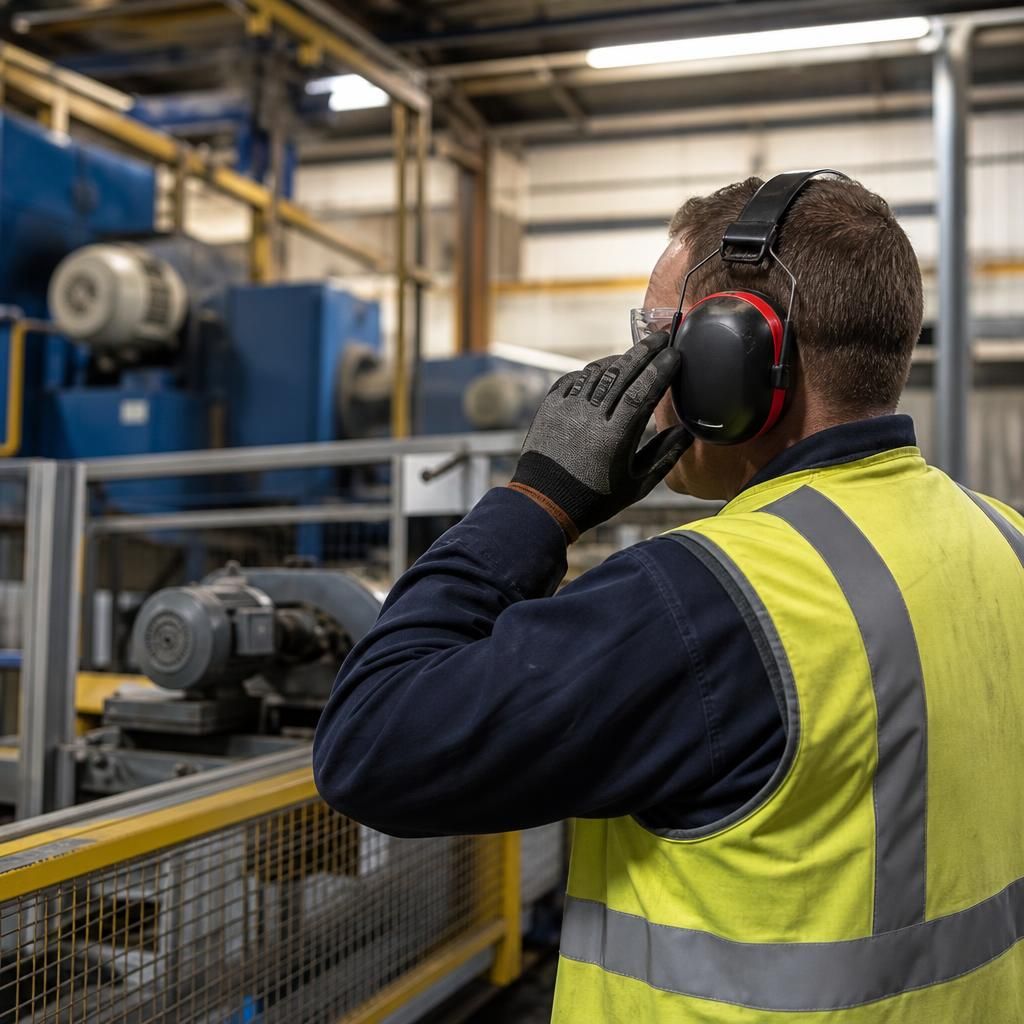
Noise is a separate safety consideration when assessing an automated powder coating line. Conveyors, extraction fans, powder-recovery equipment, compressed-air systems and ovens can combine to create significant workplace exposure, even when guarding and chemical controls are satisfactory. The employer should assess noise at operator, loading, cleaning and maintenance positions under the Control of Noise at Work Regulations, taking account of both routine production and abnormal conditions.
- Specify quieter fans, nozzles and drive equipment where reasonably practicable.
- Use enclosure, isolation or acoustic treatment to reduce noise at source.
- Define hearing-protection zones where the assessment identifies a residual risk.
- Include noise information in operating instructions, training and periodic workplace reviews.
This assessment should cover tasks around the line rather than relying only on the supplier’s stated equipment noise level. Changes to extraction, compressed-air use, conveyor drives or production layout can alter exposure and should trigger a review.
Discuss your automated powder coating line’s compliance requirements
Discuss your automated powder coating line’s compliance requirements with Powder-coatings.co.uk, providing details of the components, coating materials and production arrangements involved so the relevant considerations can be reviewed before work proceeds.