

How does the 2-coat powder coating repair process ensure long-term protection for metal components in extreme industrial environments?
A 2-coat powder coating repair combines a compatible protective primer with a durable topcoat, restoring coverage and creating layered resistance against corrosion, abrasion, moisture and industrial chemicals. Thorough preparation, correct coating compatibility and complete curing help the repaired area maintain adhesion and protective performance when metal components face demanding environmental conditions.
A 2-coat powder coating repair supports long-term protection by restoring a controlled coating system rather than simply covering visible damage. The primer provides the foundation for adhesion and corrosion resistance, while the topcoat forms the external barrier against the particular combination of moisture, chemicals, wear and environmental exposure affecting the component. Its durability depends on matching the coating system to the service conditions and maintaining continuity across the repaired area.
Extreme industrial environments rarely expose metal to one hazard in isolation. A fabricated component may experience condensation, salt or chemical contamination, repeated handling, impact, abrasion and temperature changes during its working life. These factors can act together: a scratch or worn edge can allow moisture to reach the substrate, while movement or thermal expansion can enlarge the defect. A properly specified two-coat repair reduces the opportunity for local damage to develop into wider corrosion or coating failure.
Protection against corrosion
Corrosion protection depends on preventing water, oxygen and contaminants from reaching the metal. The repaired coating must therefore provide an unbroken film around the damaged section, including corners, edges, recesses and areas surrounding fixings. These locations often receive greater mechanical stress or have less coating coverage than broad, flat faces. Careful control of the repair boundary helps prevent a weak transition between the sound original coating and the newly applied system.
The repair specification should also reflect the type of corrosion risk. Atmospheric exposure, splash zones, condensation, chemical vapour and intermittent contact with liquids place different demands on a coating. A system suitable for a sheltered indoor component may not be appropriate for equipment exposed to persistent moisture or corrosive process materials. Where exposure is particularly severe, the coating manufacturer’s technical data and the operating conditions should be reviewed before selecting the primer and topcoat.
Resistance to mechanical damage
Industrial components may be struck by tools, rubbed by adjacent parts or subjected to repeated loading during handling and operation. The topcoat needs sufficient hardness and toughness for the component’s use, but hardness alone does not prevent every form of damage. The repair design should consider whether the component is exposed mainly to sliding abrasion, impact, vibration or contact with sharp materials.
A continuous, well-bonded finish helps distribute minor contact stresses across the coating instead of leaving exposed points where corrosion can begin. However, powder coating is not a substitute for changing a damaging design or handling practice. If a repaired area is repeatedly struck or scraped, the underlying cause should be addressed and the coating inspected after service.
Performance through temperature changes
Heating and cooling cause metal and coating films to expand and contract. Repeated thermal cycling can place stress on the interface, particularly where the component has sharp geometry, welded areas, thick and thin sections or dissimilar materials. A suitable repair system should therefore be selected with the component’s operating and storage temperatures in mind, rather than judged only by its appearance after application.
Temperature can also alter the behaviour of chemicals and moisture on the surface. A coating that performs well in a dry environment may face greater attack when heat accelerates chemical activity or when cooling creates condensation. The expected exposure should be described accurately when specifying the repair, including occasional temperature peaks rather than only the normal operating temperature.
Maintaining protection at the repair interface
The boundary between the existing finish and the repaired coating is a critical area. If the transition is abrupt, poorly bonded or left with a thin edge, water and contaminants can work beneath the coating. The repair should be integrated into sound surrounding material, with the edge treated so that it does not create a raised lip or exposed line vulnerable to lifting and abrasion.
Welds, folded edges, drilled holes and enclosed sections also require attention because they can retain moisture or create coating-thickness variations. Where practical, the component’s geometry and drainage should be considered alongside the coating work. This is particularly important for large industrial assemblies that cannot easily be turned or inspected once installed.
Inspection and service control
Long-term performance is supported by checking the repaired area before the component returns to service. Inspection should consider visual continuity, coverage at edges and recesses, surface defects, adhesion and coating thickness where the specification requires it. The result should be assessed against the requirements for the component, not merely against colour or gloss.
Records of the repair system, substrate condition, environmental exposure and inspection findings can help with future maintenance decisions. They make it easier to distinguish normal surface wear from a developing failure and to identify whether a defect is isolated or linked to a wider operating issue.
Routine examination remains worthwhile even when the repair is designed for demanding conditions. Early attention to chips, blistering, lifting, rust staining or unusual wear can prevent a small defect from exposing a larger area of metal. Cleaning methods should also be compatible with the coating; harsh chemicals, abrasive tools and trapped deposits may shorten the useful life of the finish.
There are limits to what a two-coat repair can achieve. Continuous immersion, prolonged exposure to aggressive chemicals, extreme temperatures or severe mechanical abuse may require a different coating specification, additional protection or a review of the component design. The most reliable approach is to define the operating environment first, then select and apply a compatible repair system that meets those conditions. For industrial metal components, this combination of correct specification, sound repair detailing and planned inspection is what allows protection to remain effective over the working life of the finish.
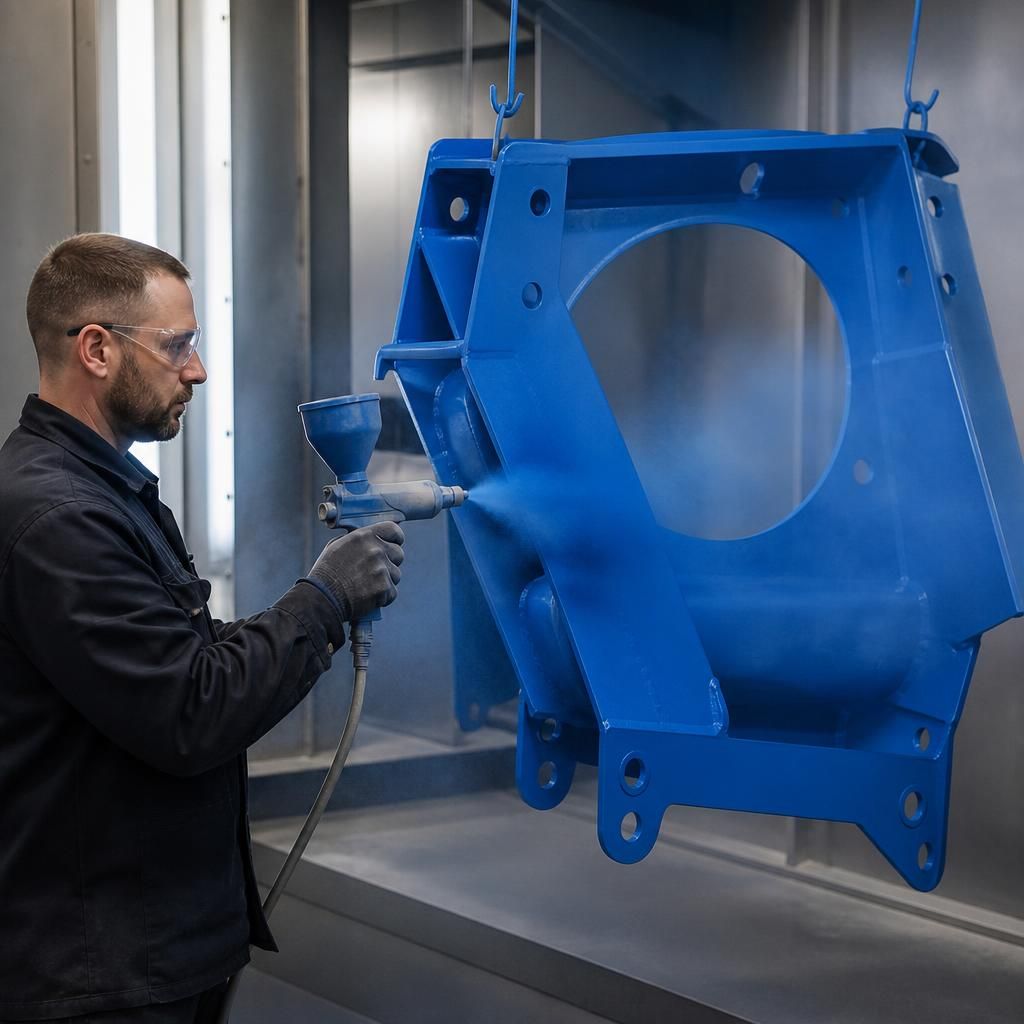
The long-term protection of a 2-coat powder coating repair depends on achieving the correct cure through both layers and a sound bond between them. During curing, each powder film must reach the temperature and time specified for the system so that it develops its intended mechanical and chemical resistance.
This is particularly important for large or complex components, where metal thickness, geometry and heat distribution can affect the actual coating temperature. The primer must be sufficiently cured to provide a stable base, while the topcoat must fuse correctly without compromising the intercoat bond. Applying the system according to its technical requirements helps prevent defects such as poor adhesion, soft film, brittleness or premature loss of protection in demanding service conditions.
Discuss Your 2-Coat Powder Coating Repair Requirements
Discuss your component’s substrate, existing coating and service environment with the powder-coating.co.uk team to establish whether a 2-coat repair system is suitable. Provide details of the damaged areas, component geometry and expected exposure so the repair requirements can be assessed accurately.