

What safety precautions should be observed during the powder blasting process to ensure worker protection and compliance with regulations?
Powder blasting should be carried out under a documented risk assessment with effective enclosure, dust extraction, equipment controls and trained operators. Suitable respiratory, eye, hearing and skin protection, safe abrasive handling, equipment inspections and compliance with relevant UK requirements such as COSHH and PUWER help protect workers and control exposure.
Safe powder blasting depends on controlling the hazards created by high-velocity abrasive, displaced coating, dust, compressed air and noise. Worker protection is best achieved by combining physical separation, controlled operating procedures, suitable personal protection, exposure monitoring and clear emergency arrangements, rather than relying on protective clothing alone.
Control access to the blasting area. The blast room or designated work zone should be physically separated from other activities, with warning signs and access limited to authorised personnel. Doors, viewing panels and seals should be checked so that abrasive and contaminated air cannot escape into adjacent work areas. No one should enter a blasting enclosure while blasting is taking place. Where entry is necessary, the process should be stopped, pressure released and the equipment isolated before access is permitted.
Operators should also establish a clear communication method before starting work. This is particularly important where the operator is inside a blast room or wearing hearing and respiratory protection. A visible stop signal, reliable two-way communication or an external emergency stop should allow blasting to be halted without delay. A second person may be required to monitor operations where the operator could become isolated or visibility is restricted.
Manage compressed-air and stored-energy hazards. Blast hoses, couplings and control lines should be secured against separation, with whip checks or equivalent safeguards where appropriate. Hoses should be routed to prevent trip hazards, sharp bends and damage from vehicles or hot surfaces. Compressed air must never be directed at a person, used to clean clothing or used to blow dust from skin. Before maintenance, clearing a blockage or changing an abrasive supply, the system should be shut down, depressurised and isolated using a suitable lock-off procedure.
Operators should use the correct nozzle, hose and abrasive combination for the equipment and workpiece. A nozzle should never be left unattended while pressurised. Damaged hoses, worn couplings, blocked nozzles and faulty dead-man controls require immediate removal from service. These controls are important because a loss of grip or a failed control can turn the nozzle into an uncontrolled source of high-energy impact.
Reduce exposure to hazardous dust. The abrasive and the coating being removed should be assessed before work begins. Safety data sheets can identify inhalation hazards, harmful additives and precautions for storage, handling and disposal. Abrasives that may generate respirable crystalline silica require particular caution; silica sand should not be used for blasting where its use is prohibited, and a lower-hazard substitute should be selected where practicable. Old paint or surface coatings may also contain hazardous substances, so the coating should not be disturbed without suitable knowledge of its composition and a COSHH assessment where required.
Dust must not be allowed to accumulate on ledges, beams, lighting or other surfaces. Cleaning should use methods that do not redistribute fine particles, such as suitable industrial vacuum equipment or controlled wet cleaning where compatible with the process. Dry sweeping and uncontrolled compressed-air cleaning can re-suspend settled dust and increase exposure. Waste abrasive and removed coating should be collected in closed, labelled containers and handled according to its classification.
Use personal protection as the final layer of control. The selection should match the abrasive, coating residue, task duration and results of the exposure assessment. A blasting helmet or supplied-air respiratory system may be necessary for the operator, while people nearby may require different respiratory protection depending on the measured or assessed exposure. Respiratory equipment must be compatible with other items, correctly fitted, maintained and subject to the required face-fit arrangements where tight-fitting masks are used.
Protective clothing should prevent abrasive rebound from reaching the skin and should be checked for holes, open cuffs and worn fasteners. Gloves must provide suitable protection without reducing control of the nozzle. Safety footwear should resist impact and provide secure footing. Eye and face protection may still be needed for workers handling parts, clearing the area or carrying out cleaning outside the main blast enclosure. Used clothing should be removed in a way that avoids spreading dust, and workers should wash before eating, drinking or leaving the work area.
Control noise and physical strain. Abrasive blasting can create damaging noise from the nozzle, compressed air and impact on the workpiece. Hearing protection should be selected for the measured or assessed noise level, worn correctly and maintained under the Control of Noise at Work Regulations where applicable. Noise-control measures may include enclosing the process, isolating noisy equipment and keeping non-essential personnel away from the area.
Large or awkward components should be positioned using suitable lifting equipment rather than manual handling beyond a worker’s capability. Components must be stable before blasting, and stands, clamps or turntables should prevent unexpected movement. Floors should be kept free from spent abrasive and coating debris because contamination can create slip hazards, particularly around access points and handling areas.
Check the workpiece and process before blasting. Hollow sections, sealed vessels and components with trapped liquid or pressure require special assessment. Heat, impact or pressure may cause concealed contents to expand or escape. The operator should identify sharp edges, fragile sections, spring-loaded parts and areas where abrasive could become trapped. Items should be positioned so that rebound is directed away from people and so that the operator does not need to reach into an unsafe line of fire.
Before starting, the responsible person should confirm that the enclosure, communication system, emergency stop, hose connections, nozzle control, lighting and protective equipment are suitable for the planned task. Findings should be recorded where the organisation’s procedures require it. Any defect affecting containment, control or worker protection should be corrected before operation, not managed by asking the operator to take extra care.
Prepare for incidents and health monitoring. Workers should know how to respond to a burst hose, loss of containment, respiratory equipment failure, eye contamination, injury or suspected exposure. First-aid arrangements should reflect the risks of impact injuries, dust in the eyes and skin contamination. Eye injuries should receive prompt assessment rather than being treated by rubbing the eye, and suspected inhalation of hazardous dust should be reported and medically assessed.
Employers should review exposure assessments when the abrasive, coating, equipment or method changes. Health surveillance may be appropriate where a risk assessment identifies a residual risk to respiratory health, skin or hearing. Training records, maintenance records, incident reports and near-miss findings provide evidence that controls are being used and help identify recurring problems. Serious incidents may also require reporting under applicable UK workplace reporting requirements.
In practice, compliance is demonstrated by a documented system that links the risk assessment to the actual blasting method: the area is controlled, the equipment is safely isolated, dust and noise exposure are managed, protective equipment is correctly used, waste is contained and workers understand the emergency procedure. These arrangements should be reviewed whenever the substrate, old coating, abrasive or blasting equipment changes.
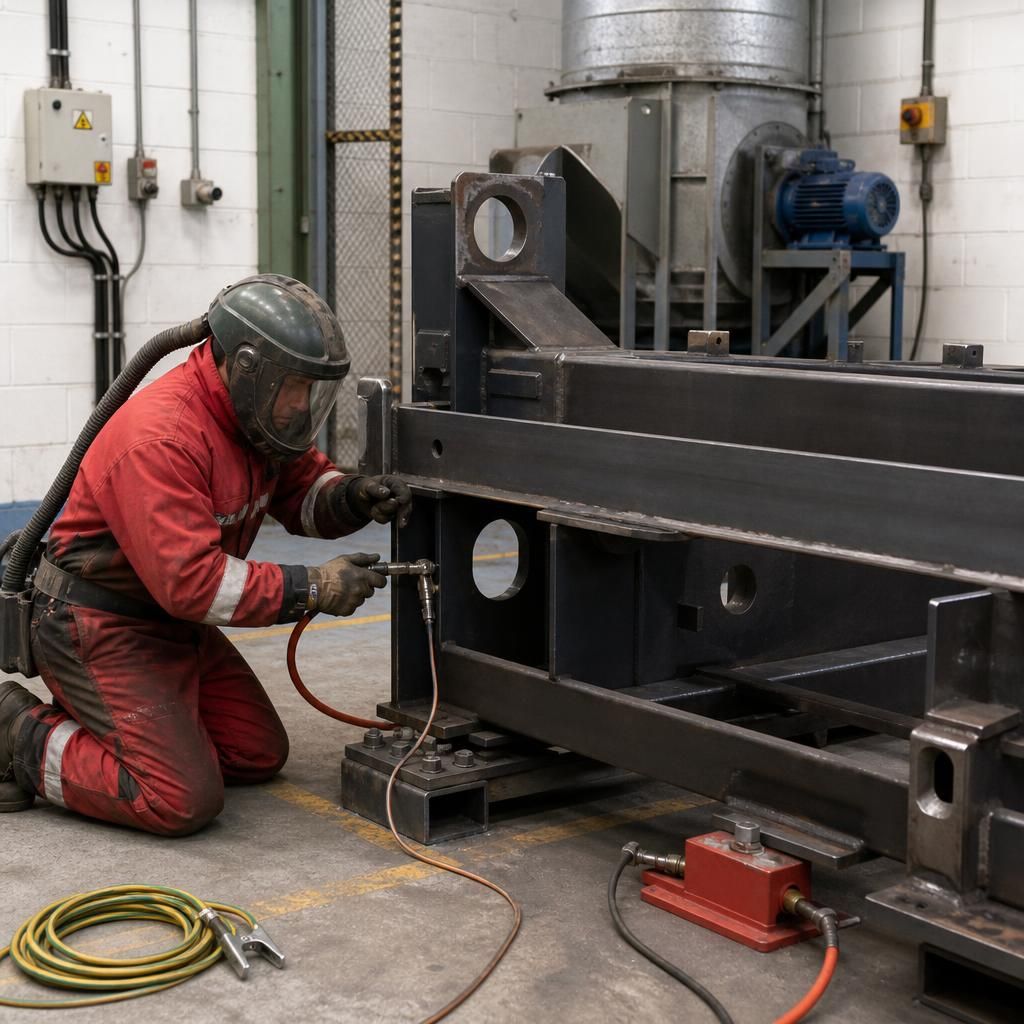
Assess electrostatic and ignition risks before blasting. Abrasive striking metal can generate static charge, while residues from coatings, solvents or other substances may introduce an ignition risk. Where the assessment identifies this possibility, the workpiece, blast equipment and extraction system should be suitably bonded and earthed, and potential ignition sources controlled. Flammable materials should be removed from the area, and any requirements under the Dangerous Substances and Explosive Atmospheres Regulations 2002 considered. These precautions should be confirmed before the process begins and reviewed if the coating, abrasive or blasting method changes.
Discuss Your Powder Blasting Safety Requirements
Discuss your powder blasting safety requirements with Powder-coatings.co.uk, including the metal components, existing coatings and preparation method involved. This allows the appropriate worker-protection and compliance considerations to be identified before processing begins.