

What specialised techniques are employed in shot blasting to ensure the removal of old coatings without damaging complex or delicate metal components?
Specialist shot blasting protects complex or delicate metal components through controlled pressure, carefully selected abrasive media, adjusted nozzle angles and staged coating removal. Operators can also mask vulnerable areas and test the process on representative sections first, reducing the risk of distortion, edge erosion or loss of fine surface detail.
Specialised shot blasting removes aged coatings from complex or delicate metal components by adapting the process to the component’s geometry, construction and dimensional tolerances. The main safeguards are detailed pre-assessment, secure fixturing, precise blast coverage, heat control and inspection after cleaning, rather than treating every surface with the same blast cycle.
Component assessment comes first. The operator should identify thin sections, unsupported panels, cast features, sharp transitions, welds, threaded areas, bores and close-fitting interfaces before blasting begins. Existing dimensions and surface condition can be recorded where tolerances are critical. This establishes which areas can receive direct treatment and which require a more conservative approach or separate handling.
Appropriate fixturing prevents movement. Delicate parts can vibrate, flex or rotate under the force of abrasive impact. Purpose-made supports hold the component securely while distributing contact away from vulnerable faces. Good fixturing also prevents one part of a casting or fabricated assembly from striking another, and allows the operator to expose the required surfaces without repeatedly repositioning the component by hand.
Fine control of exposure is important around changing geometry. Rather than applying an identical blast pattern across the whole component, operators can use shorter passes on thin sections and concentrate work where the old coating is more firmly bonded. Recesses, corners and raised details may require separate treatment so that the surrounding metal is not subjected to unnecessary abrasion while access is gained to the coating.
Where repeatability matters, enclosed blast cabinets, defined traverse paths or automated equipment can help maintain a consistent working distance and coverage. These methods are particularly useful for batches of similar brackets, housings or fabricated parts, because the treatment can be documented and reproduced without relying solely on visual judgement. Manual intervention is still needed where the component has unusual geometry or a mixture of vulnerable and robust areas.
Heat accumulation must also be managed. Abrasive impact and the movement of air through blasting equipment can raise the temperature of a part, which may matter for thin sheet, precision assemblies, heat-treated components or metals with attached inserts. Dividing the work into short cycles, allowing the component to cool and checking for unwanted temperature rise reduces the risk of heat-related movement or changes to the substrate. This is separate from coating removal force: a suitably gentle blast can still be unsuitable if heat is allowed to build up.
Special care is required when old coatings are uneven. A thick, intact film may respond differently from a thin coating that has already lifted, while corrosion beneath the coating can make the surface appear more fragile than the surrounding metal. Operators should avoid assuming that a change in colour means the substrate is fully exposed. Cleaning should continue only where necessary, with the surface checked between passes to distinguish residual coating from the underlying metal.
Post-blast inspection confirms whether the treatment has been successful without altering the part. Depending on the component, checks may include:
- visual examination under suitable lighting or magnification;
- inspection of bores, threads, slots, joints and recessed details;
- comparison with recorded dimensions where tolerances are important;
- checking for distortion, unwanted impact marks, embedded abrasive or remaining coating;
- assessment of the cleaned surface profile before a subsequent coating process.
Edges and interfaces deserve particular attention because retained coating in these locations can affect assembly or later coating adhesion. Conversely, excessive cleaning at an edge can change the fit of a mating part. For that reason, the correct finish is not necessarily the most aggressively blasted appearance; it is a clean, suitable surface that retains the component’s functional geometry.
For high-value, thin-walled or unusually shaped items, a trial on a representative area or a comparable test piece can establish whether the proposed method is compatible with the substrate. The results can then be used to define the production procedure, inspection points and any areas that should be treated separately. This approach is especially relevant where the component combines different thicknesses, materials or surface conditions.
A specialist Midlands powder-coating operation working with manufacturers, fabricators, construction firms and automotive businesses can use these principles when preparing metal components for subsequent finishing. Collection and delivery options may also be relevant where parts are too large, numerous or awkward for a customer to transport individually, but the essential technical requirement remains a component-specific blasting and inspection process.
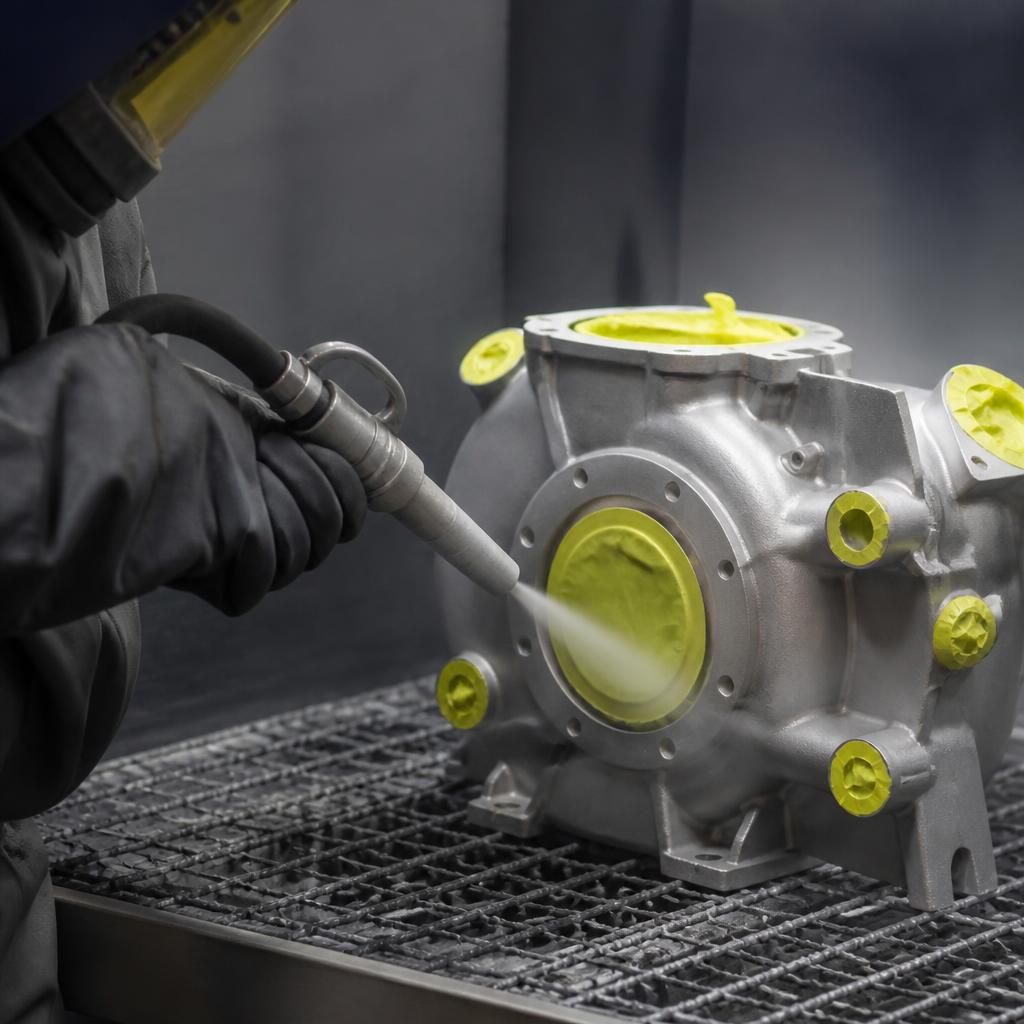
Masking protects functional areas that should not receive direct abrasive impact. Plugs, caps or temporary shields can cover threaded holes, bores, sealing faces, machined seats and close-fitting interfaces while the exposed coating is removed from surrounding surfaces.
Masking is most effective when combined with controlled, directional blasting. The operator can work towards the coating edge without driving abrasive into an opening or eroding a precision face. After cleaning, the protected areas should be checked for retained coating, abrasive particles and damage before the component is released for inspection or recoating.
Discuss Shot Blasting for Your Delicate Components
Discuss your delicate or complex metal components with a specialist to establish a suitable shot blasting approach before work begins. Providing component details, drawings or photographs can help determine the appropriate preparation and inspection requirements.