

What methods can be employed to prevent and address adhesion failures when powder coating over galvanised steel in high-demand industrial applications?
Prevent adhesion failures by thoroughly cleaning and profiling the galvanised surface, removing oils, zinc salts and loosely bonded material, then selecting a compatible pre-treatment and curing the powder within its specified parameters. If adhesion fails, identify the cause through coating and substrate inspection, remove the defective finish, re-prepare the steel and recoat only after confirming adhesion on a representative test piece.
Preventing adhesion failure on powder-coated galvanised steel depends on controlling the interface between the zinc layer and the powder, matching the coating system to the condition of the galvanising, and verifying the complete process rather than relying on visual appearance alone. In demanding industrial applications, the most effective approach combines a defined specification, controlled pretreatment, suitable powder selection, accurate curing and documented adhesion testing.
Define the substrate before selecting the coating system. Galvanised steel is not a uniform coating category. Hot-dip galvanised, electrogalvanised and previously passivated surfaces can behave differently during pretreatment and heating. The zinc layer may also vary in texture, reactivity and surface chemistry between suppliers or production batches. The coating specification should therefore record the galvanising method, any passivation or post-treatment, the required appearance, service environment and expected mechanical loading.
Where components come from more than one galvanising source, representative samples should be assessed separately. A powder and pretreatment combination that performs well on one zinc surface cannot automatically be assumed to behave identically on another. Trial panels or production-representative test pieces are particularly valuable before committing a large batch to the process.
Control the condition of the zinc surface. Storage and handling can change the surface between galvanising and powder application. Condensation, prolonged exposure to moisture, fingerprints, packaging residues and contact contamination can create an unstable interface. Components should be stored so that water cannot remain trapped between nested parts, and handling methods should avoid introducing contamination after preparation.
Galvanising defects also need to be distinguished from coating defects. Excess zinc runs, sharp nodules, ash inclusions, damaged areas and uneven deposits can create localised weak points, pinholes or thin edges. These areas should be dealt with according to the project specification before coating. If the zinc layer has been mechanically damaged or corrosion has reached the underlying steel, simply applying more powder will conceal rather than correct the problem.
Use a pretreatment proven for zinc rather than assuming a steel process is suitable. The chemical stage must be compatible with both the galvanised substrate and the selected powder system. Its purpose is to produce a stable conversion layer or equivalent receptive surface without attacking the zinc excessively. Process controls should include chemical concentration, contact time, temperature, rinse quality and drying conditions, with checks recorded at a frequency appropriate to the production risk.
Passivated or sealed galvanised surfaces require particular attention because a treatment that protects zinc during storage may also reduce the ability of the powder system to form a durable bond. The pretreatment supplier’s technical guidance should be reconciled with the galvaniser’s information, and compatibility should be demonstrated on the actual substrate. If a conversion coating is used, incomplete coverage, excessive build-up and residues carried into the oven can all contribute to failure.
Select powder for the service conditions and zinc substrate. The specification should consider more than colour and gloss. Important properties include flexibility, impact resistance, resistance to the intended chemicals and moisture, and tolerance of the heating cycle used for the component. A brittle or highly stressed film is more likely to detach when the part is bent, struck or exposed to thermal movement, even if initial adhesion appears acceptable.
Powders formulated for use over zinc-coated steel can also be selected where gas release from the substrate is a concern. Galvanised steel may release gases or moisture during heating, causing pinholes, craters or blisters. These defects can interrupt the coating interface and may be mistaken for simple adhesion loss. Powder choice, application thickness and the heating profile should be considered together to reduce this risk.
Manage application and curing as controlled variables. Inconsistent gun settings, poor earthing, excessive film build and uneven coverage can create local stress or leave vulnerable areas around edges, recesses and welds. Operators should check that the part is properly grounded, that the powder is being deposited consistently and that difficult geometries are receiving the intended coverage without excessive accumulation.
Oven control should be based on the actual metal temperature reached by the component, not only the oven’s displayed air temperature. Parts with different mass, geometry or loading patterns may heat at different rates. Under-curing can leave a weak or chemically immature film, while over-curing can embrittle or discolour the coating and reduce service performance. Profiling representative loads and retaining the results provides stronger process control than relying on a nominal conveyor setting.
Substrate temperature and condensation risk also matter before application. A surface that is visibly dry can still carry moisture if it has been stored in a humid environment or is cooler than the surrounding air. Components should be brought into a suitable controlled condition before pretreatment and coating, with the process specification defining the environmental limits.
Verify adhesion using representative testing. A visual inspection cannot confirm whether the bond will withstand handling, forming, impact or environmental exposure. Test pieces should match the production substrate, surface treatment and powder system. Depending on the application, verification may include cross-cut adhesion testing, pull-off testing, impact assessment or exposure testing. The method, acceptance criteria and conditioning period should be agreed before production rather than selected after a failure.
Testing should include areas that represent the greatest risk, such as edges, corners, weld zones, recessed features and heavier galvanised deposits. Results should be recorded alongside the powder batch, pretreatment conditions, oven profile and component batch. This makes it possible to identify whether a failure is isolated or connected to a wider process change.
Investigate a failure by identifying the fracture location. When coating detaches, inspect both the exposed zinc and the reverse side of the removed coating. A clean separation at the zinc-to-coating interface points towards substrate condition, pretreatment or compatibility. Powder remaining on the zinc with fracture within the film suggests a cohesive weakness, excessive stress or inadequate film properties. Blisters, pinholes and corrosion beneath the coating may indicate moisture, outgassing or contamination rather than a single adhesion fault.
Photographs, retained test pieces and process records help establish whether the cause was introduced during galvanising, storage, pretreatment, application, curing or subsequent handling. Corrective action should address the identified cause. Changing powder alone is unlikely to resolve a problem caused by condensation, an unstable conversion layer or an incorrect oven profile.
Repair failed work systematically. Defective coating should be removed to a sound boundary, after which the exposed zinc and steel are inspected for damage or corrosion. Any loss of zinc protection should be repaired using a method approved for the component and service environment. The revised preparation and coating process should then be applied under controlled conditions, with a representative area tested before the repaired batch is released.
For high-demand applications, a written process control plan is the most reliable safeguard. It should define the galvanised substrate, approved pretreatment route, powder characteristics, application settings, curing requirements, inspection points, adhesion tests and corrective actions. This converts adhesion from an assumption based on appearance into a measurable property supported by traceable production evidence.
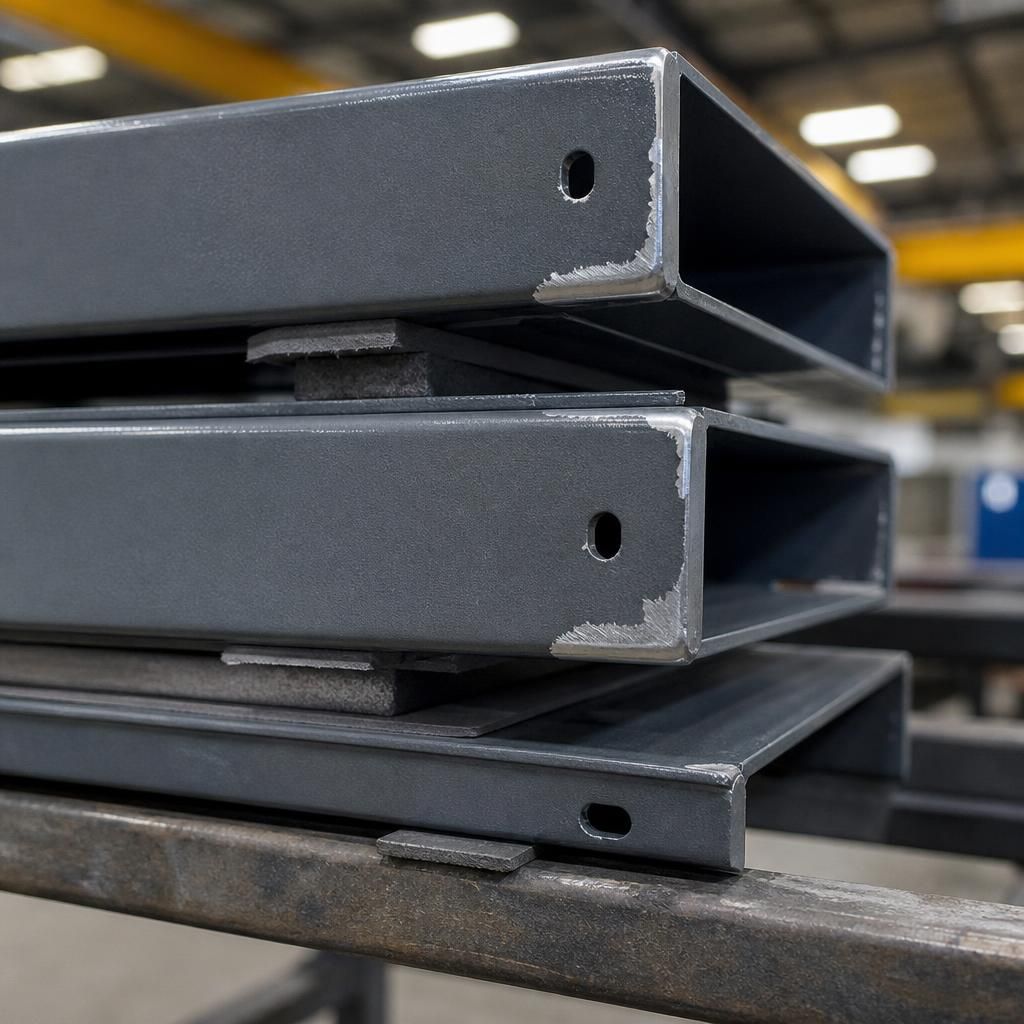
Some apparent adhesion failures are caused by damage after curing rather than by a weak bond at the galvanised surface. Dragging coated components across racks, placing sharp metal against finished faces or using unsuitable lifting points can chip or lift the film, particularly at edges and corners. Use clean, padded supports and prevent coated parts from contacting one another during handling and transport. When damage is found, inspect the surrounding coating and the exposed zinc to determine whether the defect is a local impact or evidence of wider detachment. Isolated impact damage can be repaired after removing loose material and checking the zinc protection; widespread lifting requires a full process investigation before recoating.