

What are the key factors to consider when selecting Rilsan Nylon 11 for specific metal coating projects?
Selecting Rilsan Nylon 11 for a metal coating project depends on the component’s operating environment, required corrosion and wear resistance, substrate and geometry, finish requirements, and the coating’s compatibility with the application process. Also assess preparation needs, expected service life, batch or component size, inspection requirements and total project cost before confirming that Rilsan Nylon 11 is the appropriate specification.
The most important consideration when selecting Rilsan Nylon 11 is whether its performance characteristics match the component’s actual duty, including contact, chemical exposure, movement, cleaning and handling conditions. The choice should be based on a written coating specification and representative parts or samples, rather than on the material name alone.
Define the main function of the coating
Rilsan Nylon 11 may be selected to provide a combination of protection and surface performance. Establish which requirements are critical for the project:
- resistance to corrosion caused by moisture, salts or process contaminants;
- resistance to abrasion, impact, rubbing or repeated contact;
- reduced friction or a smoother contact surface;
- electrical isolation where the component design requires it;
- protection against handling damage during assembly, transport or use; and
- a consistent decorative or colour-coded finish.
Where several of these functions apply, rank them. A specification designed mainly for appearance may not be suitable for a component subject to sliding contact or aggressive cleaning, while a heavily protective specification may require different preparation and acceptance criteria.
Consider the complete exposure profile
Do not assess the coating against a single chemical or temperature in isolation. Record the substances the part will encounter, whether exposure is occasional or continuous, the concentration involved, and whether the component will be immersed, sprayed or simply exposed to vapour. Include detergents, oils, fuels, process fluids and cleaning agents where relevant. Repeated changes between wet and dry conditions can also matter.
Mechanical duty should be recorded in the same detail. Identify points of impact, sliding interfaces, clamped areas, sharp contact points and sections that may flex. A coating that is appropriate for general corrosion protection may need a more carefully defined specification where it is exposed to concentrated wear or repeated loading.
Check interfaces and dimensional requirements
The coating must work with the way the component is assembled. Confirm whether coated faces will meet bearings, seals, threads, press fits, electrical contacts or mating parts. Coating build can affect clearances, so critical dimensions should be identified before production. Decide which areas must remain uncoated and define masking requirements for holes, bores, earth points and joining faces.
Edges, recesses, welds and internal sections should be considered when agreeing the specification. These features can influence coverage, handling and the ability to inspect the finished component. Drawings should show datum points, masking limits and any surfaces where coating continuity is especially important.
Specify the finish in measurable terms
“Nylon coated” is not a complete purchasing specification. The project should state the required colour, gloss or texture where these affect identification, appearance or function. It should also define acceptable visual variation, permissible surface marks and the areas that will be judged as visible.
Agree the required coating build and acceptance method with the applicator before parts are processed. The appropriate requirement may vary between a corrosion-focused component, a wear surface and a part with tight assembly tolerances. Any test panels or approved samples should be retained as a reference for subsequent batches.
Assess the substrate and preparation route
Rilsan Nylon 11 selection is only effective when the metal surface is suitable for the intended treatment. Identify the substrate, previous finishes, weld residues, scale, oil, corrosion and any contaminants that could interfere with adhesion or create defects. Cast, fabricated and machined parts may require different preparation controls.
Ask how the part will be cleaned, prepared and handled between preparation and coating. Contamination introduced after preparation can be as significant as the original condition of the metal. If an existing coating or conversion treatment is present, its compatibility must be established rather than assumed.
Evaluate production and handling constraints
Part presentation affects the practical result. Confirm how components will be suspended or supported, which surfaces may receive contact marks, and how the coated parts can be handled without damaging the finish. Large, heavy or awkward components may need a different loading and movement plan from small repeat parts.
For repeat manufacture, provide consistent part identification and revision information. The coating specification should state whether the same finish is required across future batches and how changes to the substrate, design or cleaning regime will be controlled. Packaging should prevent abrasion, moisture contamination and contact damage after coating.
Allow for verification and documentation
Agree in advance how conformity will be demonstrated. Depending on the application, this can include records of preparation, coating material identification, dimensional checks, visual assessment and tests relevant to adhesion, continuity or resistance to the intended duty. The important point is to select verification methods that reflect the real failure risks of the component.
Documentation requirements may be particularly important for safety-related, traceable or customer-controlled components. Establish what information must accompany each delivery, how non-conforming parts will be handled and whether approval of a sample or first-off component is needed before the full production run.
Use representative trials for uncertain applications
Where the service conditions are unusual or the consequences of coating failure are significant, a trial on representative metal is more useful than relying solely on generic material data. The sample should include the relevant substrate, preparation method, edges, recesses and mating features. It can then be assessed under conditions that reproduce the intended chemical, mechanical and cleaning exposure as closely as practical.
Ultimately, Rilsan Nylon 11 is best selected when its required protective and surface properties, dimensional effects, preparation route, quality controls and production arrangements are all compatible. A clear specification shared between the designer, purchaser and coating applicator reduces the risk of choosing a coating that appears suitable in principle but does not meet the component’s actual service requirements.
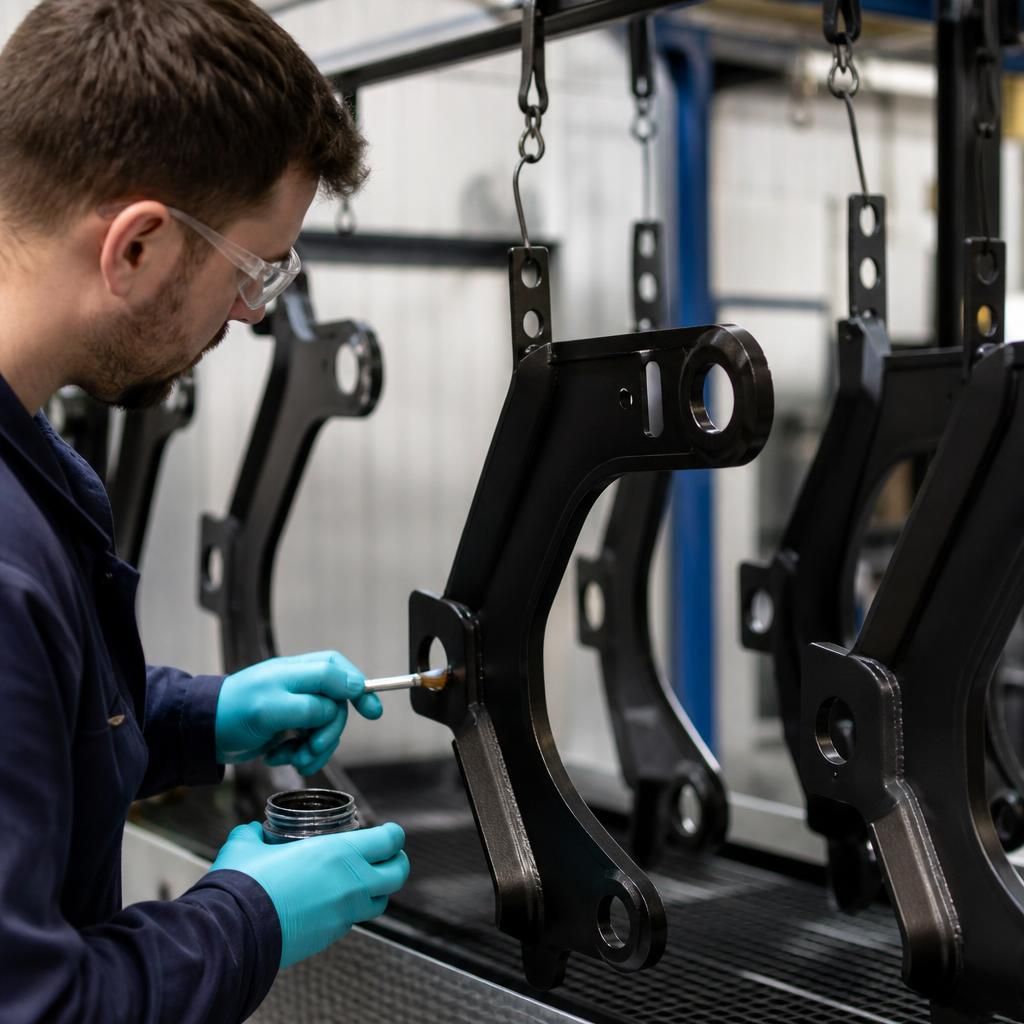
A key factor when selecting Rilsan Nylon 11 is the planned response to coating damage during the component’s service life. The specification should consider whether isolated damage can be repaired, whether the part can be removed for recoating, and what level of exposed metal would require the component to be rejected or replaced.
Before approval, confirm that any repair material and method are compatible with the original coating and the component’s operating conditions. This is particularly important for parts exposed to moisture, chemicals or repeated contact, where a small breach could develop into a wider performance problem. Agree how repaired areas will be identified, inspected and accepted, and include this information in the coating documentation. A coating that meets the initial performance requirements but has no practical damage-management plan may be unsuitable for critical or difficult-to-access metal components.