

What are the key advantages of utilising stainless steel high temp powder coatings over traditional high-temperature coatings?
Stainless steel high temp powder coatings can provide a harder, more uniform and durable finish than many traditional high-temperature coatings, while improving resistance to corrosion, abrasion and repeated heat exposure. Their dry application also produces minimal coating waste and avoids the solvent emissions associated with many liquid systems, making them suitable for robust industrial protection where the formulation matches the operating temperature.
Stainless steel high temp powder coatings offer a more controlled and repeatable way to protect stainless components than many traditional high-temperature liquid systems. Their principal advantages are consistent application, reliable film formation, reduced process complexity and the ability to specify a coating formulation around the component’s actual thermal, chemical and mechanical service conditions.
More consistent coating thickness
Powder is applied as a dry, electrically charged material that is attracted to the earthed stainless steel component. When the application is properly controlled, this can produce an even coating across accessible surfaces without the runs, sags or solvent entrapment sometimes associated with liquid application. Consistent film thickness is important for high-temperature parts because excessively thin areas may provide inadequate protection, while excessive build can affect curing, fit or heat transfer.
Consistency is particularly valuable for batch production. Components can be prepared, coated and cured using defined process parameters, making it easier to reproduce the required finish from one production run to the next. This supports inspection and quality control, as coating thickness, visual appearance and adhesion can be assessed against an agreed specification rather than relying solely on the operator’s application technique.
Reduced application complexity
Many traditional high-temperature liquid coatings require careful control of viscosity, solvent evaporation, flash-off periods and, in some systems, multiple coats or a separate primer. A suitable powder system can simplify the application sequence by forming the finished coating during one controlled curing process. This does not remove the need for correct preparation or curing, but it can reduce the number of variables that affect the final result.
The dry application also avoids the problem of liquid coating pooling in corners or retaining solvent beneath a later layer. For fabricated stainless assemblies, this can make process planning more straightforward, provided that the component geometry allows adequate powder access and the curing schedule is compatible with the complete assembly.
Better suitability for repeat industrial production
Powder coating is well suited to manufacturers and fabricators processing repeated batches of brackets, housings, guards, panels and other stainless components. Application settings can be documented and reproduced, while curing can be linked to the component’s metal temperature rather than judged only by elapsed oven time. This helps reduce variation caused by differences in component mass, thickness or loading pattern.
For larger or heavier items, the coating specification must account for how quickly the stainless steel reaches the required cure temperature. A thin panel and a substantial fabricated component may need different handling or oven conditions even when they use the same coating material. The advantage of the powder process is that these variables can be identified and controlled as part of a defined production method.
Formulation can be matched to the service environment
“High-temperature powder coating” is not a single material category. Different formulations are designed for different combinations of heat exposure, thermal cycling, chemical contact, moisture and mechanical wear. Selecting a coating for stainless steel therefore involves more than choosing a colour or general temperature label. The expected continuous temperature, peak temperature, duration of exposure and frequency of heating and cooling should all be considered.
A correctly selected formulation can provide a more appropriate balance of thermal stability, adhesion and surface protection than a general-purpose coating that is being used outside its intended range. The coating must also be compatible with any oils, cleaning agents, fuels, process chemicals or atmospheric contaminants encountered by the component. If the operating conditions exceed the coating’s design limits, traditional ceramic or specialised liquid systems may remain more suitable.
Potentially cleaner handling and inspection
Once cured, a powder coating produces a solid film rather than leaving a wet surface that can attract dust during drying. This can be useful where components need to be handled, packed or assembled after coating. The finished surface can also be inspected for visual defects, coverage and damage before the part enters service.
These benefits depend on the complete process. Stainless steel must be appropriately cleaned and prepared so that oils, fabrication residues and contamination do not interfere with adhesion. Welds, sharp edges, recesses and areas shielded from the electrostatic field require particular attention. Poor preparation cannot be corrected by choosing a higher-temperature powder.
Why the comparison is not automatic
Powder coating is not inherently the best option for every high-temperature stainless steel application. The operating temperature, component geometry, required appearance, permissible film thickness and curing conditions all affect the decision. Some liquid or ceramic coatings are designed for more extreme temperatures or for very thin protective films, while a powder system may be preferable where repeatability, robust handling and efficient batch processing are more important.
The key advantage is therefore the combination of a controlled dry application and a formulation selected for the real service environment. A specification should identify the stainless steel grade, preparation method, coating build, cure requirements and expected thermal and chemical exposure. Comparing those criteria rather than relying on the phrase “high temperature” alone gives a more reliable basis for choosing between powder and traditional high-temperature coatings.
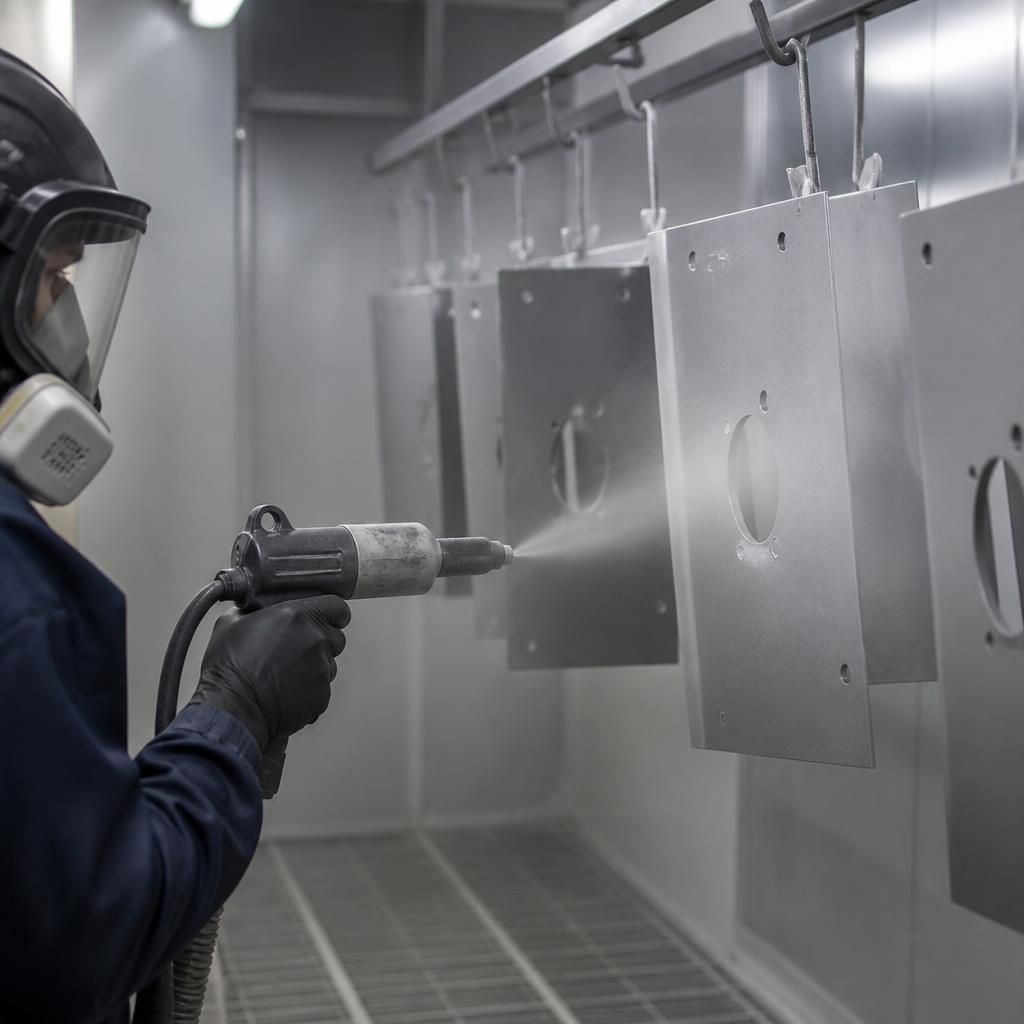
One important advantage of stainless steel high-temperature powder coating is the reduced use of solvents during application. Powder is applied as a dry material, so it does not require the solvent evaporation associated with many traditional liquid high-temperature coatings. This can reduce solvent emissions and avoid leaving a wet film that needs to dry before the component can be handled.
The process can also produce minimal coating waste when application parameters are properly controlled. For manufacturers and fabricators, this provides a cleaner coating operation while retaining the durable protection required for stainless steel components exposed to heat, corrosion or abrasion. The environmental benefit should still be assessed alongside the coating’s formulation, curing requirements and suitability for the component’s service conditions.
Discuss Your Stainless Steel High Temp Powder Coating Requirements
Discuss your stainless steel high temp powder coating requirements with the team, including the component’s operating temperature, exposure conditions, dimensions and expected finish. This information can help establish whether a powder coating system is suitable for your application.