

How do variations in powder coating formulations impact the required oven temperature settings for effective curing?
Different powder coating formulations require different cure schedules because their resin chemistry, hardener system and additives determine the temperature and time needed to form a complete, durable film. The oven setting must therefore follow the coating manufacturer’s technical data, while accounting for the metal part’s actual temperature rather than relying only on the oven air temperature.
The required oven profile is determined by how the powder’s binder, curing system and supporting ingredients react to heat. Formulations designed for different service conditions may therefore need different combinations of part temperature, dwell time and heating rate. Using one standard setting for every powder can result in incomplete cross-linking, excessive curing, surface defects or damage to the substrate.
Resin and hardener chemistry
The resin provides the main film-forming structure, while the hardener enables the chemical reaction that converts the deposited powder into a continuous coating. Different combinations begin and complete that reaction at different temperatures. A formulation intended for lower-temperature processing may reach the required cure at a lower part temperature or with a shorter dwell period than a conventional system. Conversely, a formulation designed for demanding chemical, mechanical or temperature resistance may require a more controlled or extended cure cycle.
The technical data sheet normally expresses the cure schedule as a relationship between metal temperature and time. This may be presented as a single target or as a range. The oven should be configured to achieve the required metal temperature throughout the component, rather than simply reaching a particular air-temperature reading.
Fast-cure and low-temperature powders
Fast-cure formulations are engineered to cross-link within a shorter time once the coating reaches its specified temperature. They can be useful for production lines with limited oven dwell time, but they leave less tolerance for process variation. If the part heats slowly, sections with greater mass may not receive the intended cure even though lighter sections appear satisfactory.
Low-temperature systems are similarly sensitive to process control. Raising the oven temperature unnecessarily can shorten the usable process window, promote over-baking or affect the appearance of the film. The correct approach is to establish how long the metal takes to reach the specified temperature and then confirm that the required dwell is achieved.
Effect of pigments, fillers and additives
Two powders with a similar base resin can behave differently because of their pigment, filler and additive packages. These ingredients can alter heat absorption, melt flow, gloss, texture, colour stability and the point at which the film becomes fully cured. Dark and light finishes may also heat differently when exposed to radiant sources, while metallic or textured products can have specific application and appearance requirements.
Some additives improve flow or help provide a textured, matt or other specialist finish. Those formulations may need closer control of film thickness and heating conditions because excessive heat or an unsuitable dwell can change the intended appearance. A finish that looks acceptable immediately after coating should not be treated as proof of complete cure; performance testing or the coating supplier’s recommended verification method may still be required.
Film thickness and component design
The formulation is only one part of the cure calculation. Thick powder deposits, folded sections, boxed profiles and heavy fabricated parts take longer to heat through than thin, exposed sections. A schedule suitable for a light component may not be suitable for a heavy one, even when the same powder is used. Multiple coats or a primer-and-topcoat system can also require a coordinated process, since the first layer must remain compatible with the subsequent heating cycle.
For batch work, parts should be grouped according to their mass, geometry and coating system where practical. This makes it easier to establish a repeatable profile instead of selecting an oven setting based on the fastest-heating item in the load.
What happens when the formulation is under-cured or over-cured?
Under-curing means the coating has not completed the intended cross-linking reaction. Possible signs include poor solvent resistance, reduced hardness, weak adhesion, inferior impact performance or a film that remains unusually soft. These symptoms can also have other causes, so they should be investigated alongside preparation, contamination, film thickness and application conditions.
Over-curing can change colour, gloss or texture and may reduce the coating’s performance. It is particularly important not to compensate for a slow-heating component simply by increasing the oven temperature without checking the formulation’s permitted cure range. A longer, controlled dwell may be more appropriate, provided it remains within the supplier’s instructions.
Practical process for setting the oven
- Identify the exact powder formulation and obtain its current technical data sheet, including the recommended cure schedule and any limits.
- Record the component’s material, thickness, geometry, loading arrangement and intended film thickness.
- Measure the heating profile at representative points on the heaviest or most difficult-to-heat parts.
- Check that all relevant areas reach the specified metal temperature for the required dwell period.
- Inspect the finish and carry out suitable cure or performance checks where the application demands them.
- Document the approved profile so that changes in powder, colour, batch arrangement or component design trigger a further review.
When changing formulation, do not assume that a successful setting for a previous powder remains valid. Compare the new cure schedule, heating behaviour and finish requirements before production proceeds. For Midlands manufacturers and fabricators processing varied metal components, this formulation-by-formulation approach helps align oven settings with the coating specification rather than relying on a generic temperature.
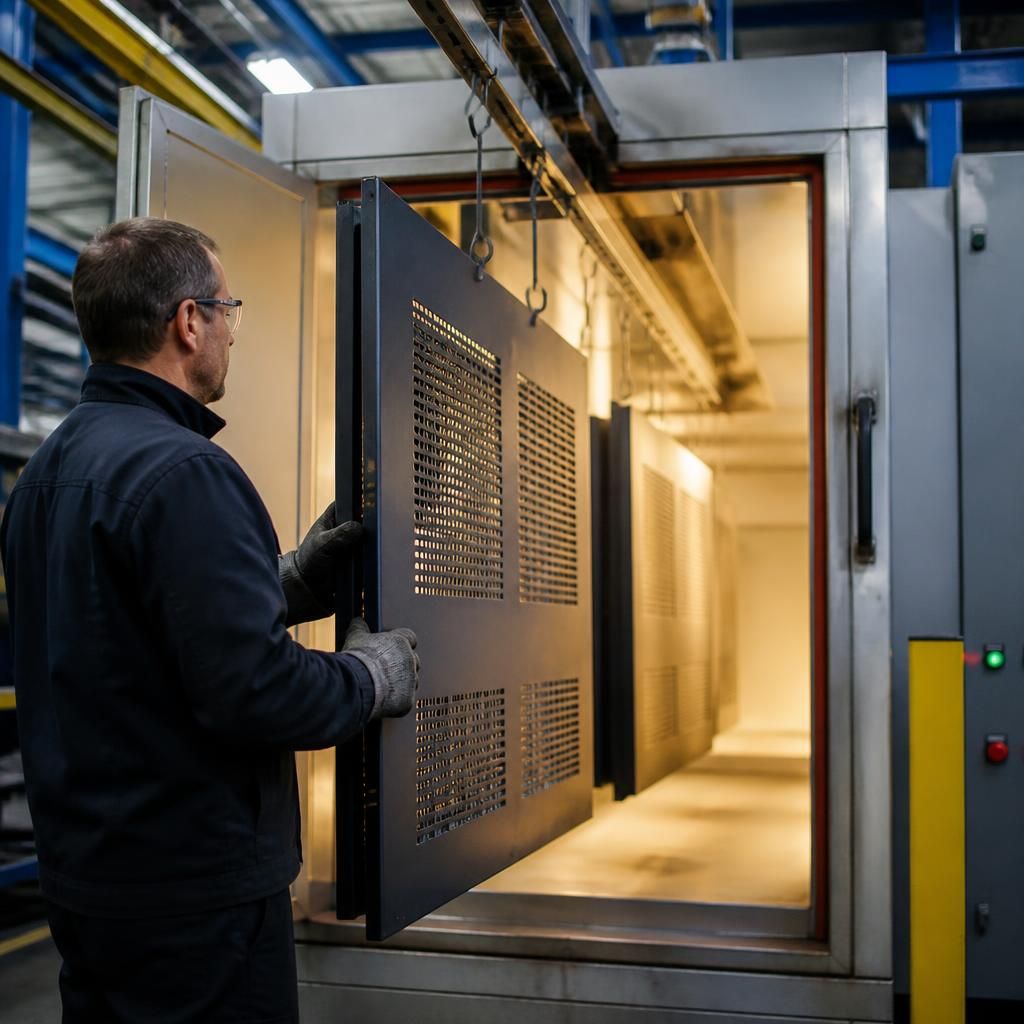
Powder coating curing involves melting, flow and cross-linking, not just reaching a temperature. A formulation must first melt and level across the metal before its hardener develops the final polymer network. The balance between these stages varies between products, so an oven profile that appears suitable for one powder may produce poor flow, texture variation or premature gelation with another.
This is why a smooth-looking finish does not necessarily confirm that the formulation has cured correctly. The coating may have flowed across the surface while the chemical reaction remains incomplete, or it may have gelled before it had sufficient time to level. When assessing a new formulation, compare its technical cure schedule with the required heating profile and check both appearance and the relevant performance properties.
Discuss the right oven settings for your powder coating formulation
If you are changing powder formulation or processing a new component, discuss the coating specification and curing requirements with Powder-coatings.co.uk before production begins. The team can help assess the appropriate powder coating process for your metal parts and finish requirements.